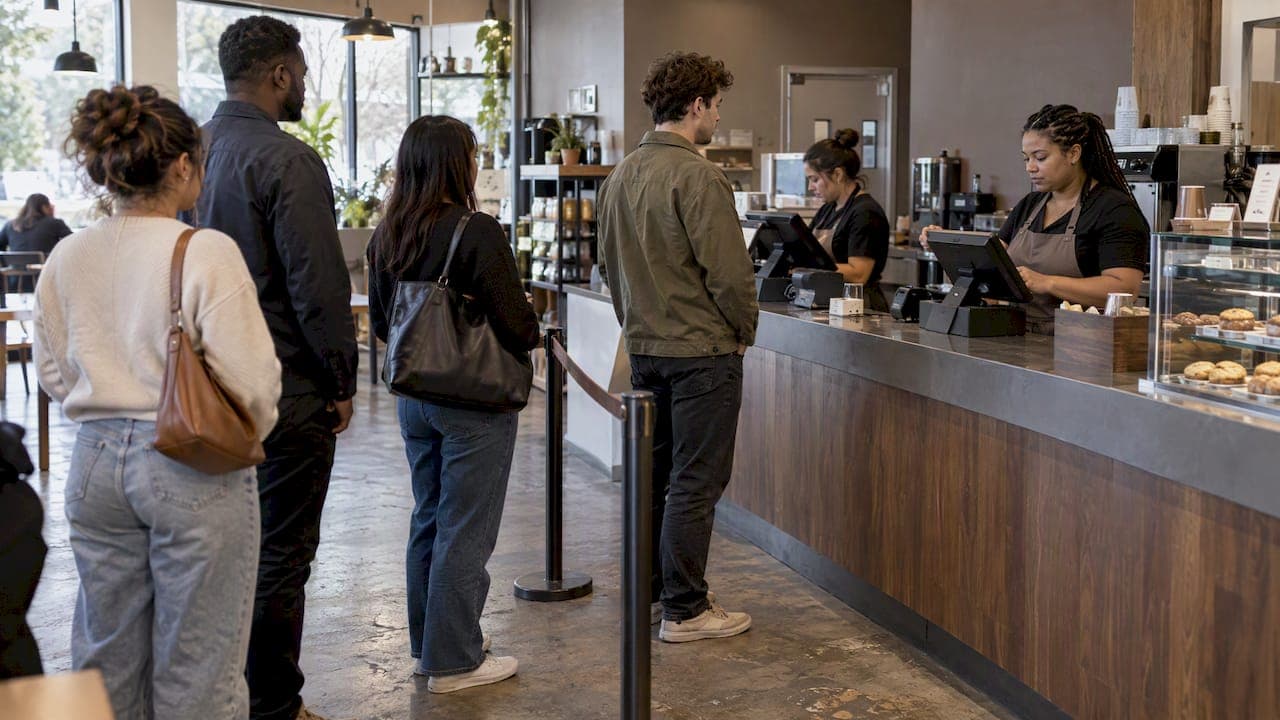
If every server can handle every customer, one shared line feeding all of them is usually faster and fairer than a separate line for each server. Multiple lines still win in a few situations: when servers do different work, when customers expect a long wait, or when you want each worker to feel personally responsible for a line. This guide explains the difference, what the research says, and how to choose for a restaurant, clinic, food truck, barbershop or event.
TL;DR
- A single queue (also called a pooled queue) sends one line to several servers. Multiple lines give each server their own line.
- When servers are interchangeable, a single queue cuts idle time and removes the "I picked the slow line" problem.
- A single line can look long and discourage people from joining. Separate lines can feel better for long waits and can make staff work faster.
- Choose by service type, not by habit: shared work favors one line, specialized work favors separate lines, and walk-in businesses can hide the line entirely with a virtual queue.
- You can run either model, or both, from a phone with Ezseat, and customers join from a browser with no app.
Table of Contents
- What the two setups actually are
- Why a single line is usually faster
- Where multiple lines can win
- Perception matters as much as the clock
- Which setup fits which business
- Our perspective: the choice is smaller than it looks
- Designing the physical line when you still need one
- How to decide in five questions
- Going virtual: one queue, no snake
- Try both setups with Ezseat
- FAQ
- Sources
What the two setups actually are
In a single queue, everyone waits in one line. When any server becomes free, the person at the front goes to that server. Banks, airport security and many post offices work this way.
In multiple lines, each server or station has its own line and customers choose one. Supermarket checkouts are the classic example. Hospitality textbooks describe the same pattern at some quick-serve restaurants, where customers choose one of several single-channel queues, each served by its own server.
A third arrangement matters more every year: the virtual queue, where the line lives on a screen instead of on the floor. We come back to it below, because it changes the trade-offs.
Why a single line is usually faster
The core argument is about idle capacity. With separate lines, one server can run out of customers and stand idle while another line keeps growing. A pooled line cannot do that: a free server always takes the next person waiting. A queueing-theory walk-through of pooled versus separate queues shows this with a two-server model, where the shared line shortens average waits because spare capacity is never wasted.

The effect depends on how busy you are. A modeling text on one queue versus two finds that two lines behave almost like one while both servers stay busy. The gap opens when one line is empty and the other has several people. Practical lane switching can recover much of that loss, but only if customers actually switch.
The size of the benefit can be large. A Kellogg School summary of the research says a single queue can cut waiting time to about one-third of what separate lines produce, and that it feels fair, even though it can look long.
A 2018 article in The Conversation makes the human side plain: when all servers can do the same work, a delay at one server gets spread across the whole pool, and customers stop guessing which line will move fastest.
The fairness and jockeying bonus
Separate lines invite jockeying, where people hop between lines hoping to move faster. Hospitality research notes that single queues reduce jockeying, which stresses customers and creates inefficiency. The same source adds a practical rule: queue discipline should be obvious and familiar, or managers should explain why the rules are fair. A sign that says "One line, next available" does real work.
Where multiple lines can win
The single queue is not a universal answer. Four situations push the other way.
1. Customers expect a long wait
A 2021 study in the International Journal of Research in Marketing found that customers generally prefer a single line for shorter expected waits but may view multiple lines more favorably when they expect a longer wait. A long single snake can look hopeless. Several short lines look manageable, and customers feel they are doing something about it by choosing.
2. You want workers to move faster
Syracuse University's Whitman School reported that separate lines can make workers move faster because responsibility for clearing a line is more visible. A single line is still usually favored for first-come-first-served fairness. The researchers frame it as a trade-off: speed is not the same as satisfaction, and managers should decide whether fast turnover or a more personal, less rushed service matters most. A barbershop that sells attention is a very different case from a lunch counter that sells speed.
3. Servers are not interchangeable
Pooling assumes any server can serve any customer. When they cannot, such as a pharmacist versus a cashier or a specialist versus a general nurse, one shared line breaks down. University of California research on routing flexible customers finds that a separate queue for flexible customers can improve overall system performance but is less fair to them. Flexible customers should go to the shortest queue when only queue lengths are known, or to the shortest workload when workload is known.
4. Physical space or wayfinding
One long line needs room. If your entrance is narrow, a single line can block doors or sidewalks, and separate lines may be easier to stage. Public transit guidance is a good illustration of space logic: NACTO says stops serving multiple routes should provide a separate boarding and queuing area for each route, with markings that keep pedestrians moving. Different destinations get different lines.
Perception matters as much as the clock
People rarely judge a line by a stopwatch. A study of 455 customers in single-queue, single-server settings found that perceived waiting time exceeded actual waiting time. So even the efficient design needs help from the way you present it: show progress, give an honest estimate, and give people something to do. We cover the psychology in what queue psychology reveals about long-feeling lines and the practical fixes in fixing queue customer experience.
One point that is easy to miss: a single line feels like constant progress, because everyone moves forward together, but a particularly difficult customer at the front can feel painful to those behind. In a pooled system that customer ties up one server, not the entire line.
Which setup fits which business
The research above is general. What follows is our own practical reading of it for each type of operation, not a measured result.
| Business | Usually better | Why |
|---|---|---|
| Restaurant with a host stand | Single queue (one waitlist for all tables) | Any party can take the next suitable table; guests do not choose a "line" |
| Clinic or walk-in care | Single queue per type of care, with more than one queue where staff differ | Pooling helps within one skill group; specialties need their own lines |
| Food truck | Single queue, even with two windows | Orders are interchangeable, and one line stops people from jockeying |
| Barbershop | Single queue, optionally with a barber preference field | Fair order matters, but some clients want a specific barber |
| Event with several stations | Separate lines per station type, one line within each | Stations do different things, so pooling only applies within a type |
| Food hall or multi-vendor space | One line per vendor, visible from a phone | Vendors sell different products, so a shared line makes no sense |
Restaurants
A restaurant waitlist is a single queue by nature: one list, next party in line gets the next fitting table. The trouble is the physical crowd at the door. Letting guests join from their phone and wait elsewhere removes that crowd. If you are building this, phone queue management for restaurants and clinics walks through the setup.
Clinics and pharmacies
Healthcare has the strongest case for pooling and the biggest caveat. A 2023 review of healthcare capacity management describes how pooling patient resources can improve utilization and reduce waits, though it can bring complex workflow challenges. In practice that means one shared line within a group of equivalent providers, and separate lines when a pharmacist, a nurse and a doctor are doing different work. Our pharmacy queue management guide covers a typical split.
Food trucks and barbershops
For a food truck with two order windows, put everyone in one line and call the next person to whichever window is free. For a barbershop, the single line is fair, but add an optional "preferred barber" field. That captures the one real reason clients ask for separate lines, loyalty to a particular person, without breaking first-come-first-served for everyone else.
Events and food halls
Events often mix stations: check-in, merchandise, food, entry gates. Pool within each station type, then separate between types. For vendor-heavy spaces, a browser-based approach can show each vendor's wait without forcing anyone to stand in a crowd, which we describe in our food hall multi-vendor queue guide.
Our perspective: the choice is smaller than it looks
Most owners ask us whether they should run one line or several. We think the better question is where the line should live. The classic trade-off assumes a physical line, which forces a compromise: one long, discouraging snake or several lines that waste capacity. Once the queue is a list on a screen, that trade-off loosens.
A virtual single queue gives you the efficiency and fairness of pooling without the long visible snake that puts people off. Customers scan a code or open a link in their browser, take a place, and go sit down, walk to a shop or wait in the car. You, as the operator, manage the flow from your phone instead of shouting names or numbers.
When you do need separate lines, because staff do different jobs or because a barber is requested, you run several queues side by side, with custom fields to route people. The point is to match the design to the work and not to the limits of a rope and a floor.
We built Ezseat around this. It runs in the browser, so customers install nothing, and it works from the phone or tablet you already have. There is no hardware requirement and no per-message cost for notifications. That is the setup we would pick for a small team that cannot afford friction at the door.
— Ezseat
Designing the physical line when you still need one
Some businesses will always have people standing somewhere. If so, size the space to the situation. An MH-USA queue guide recommends matching spacing to expected volume and context: compact spacing where crowding is expected, such as stadiums and events, standard spacing for retail-like settings, and relaxed spacing for airports or hotel check-ins where people carry belongings and want personal space.
A few rules hold for either model:
- Mark the front. People should know where the line starts and which server is next.
- Say the rule out loud. A sign reading "Next available" or "Line for pickup orders only" removes arguments before they start.
- Keep walkways clear. Never let a line block a door, an exit or a path for someone with a mobility aid.
- Give the wait a purpose. A menu to read, a screen with the current number or a place to sit makes the same wait feel shorter. See our guide to waiting area design that cuts perceived wait time.
How to decide in five questions
- Can every server handle every customer? If yes, lean single queue. If no, separate by skill and pool within each group.
- How long is a typical wait? Short waits favor one visible line. Long waits favor hiding the line, or splitting it so it looks smaller.
- Do you sell speed or attention? A fast counter wants maximum throughput. A personal service may want slower, more individual lines.
- Does your space allow one line? If the door or sidewalk would be blocked, move the line onto phones.
- Do customers have a reason to prefer a specific server? Add a preference field instead of building a separate line.
If you answered "yes, short, speed, yes, no" you have a classic single queue. Anything else probably calls for a hybrid, and that is normal.
Going virtual: one queue, no snake
A virtual queue lets people take a place from a browser and be notified when it is nearly their turn. It keeps pooled fairness and removes the long line that makes people balk. If you are new to the idea, start with what a virtual queue is and how small businesses use one, then read the virtual queue best practices. If your customers dislike tickets, ticketless queues and a queue numbering system for walk-in businesses cover the alternatives.
Try both setups with Ezseat
Ezseat lets you run a single queue, several queues or a mix, from a phone or tablet. Customers join in a browser, a public screen can show ticket numbers, a reception kiosk can add walk-ins, and people can be notified by SMS or call. Plans are simple: Light is $3.90 per month or $39.00 per year, and Pro is $14.90 per month or $149.00 per year. Every account starts with a free two-month trial before any charge.
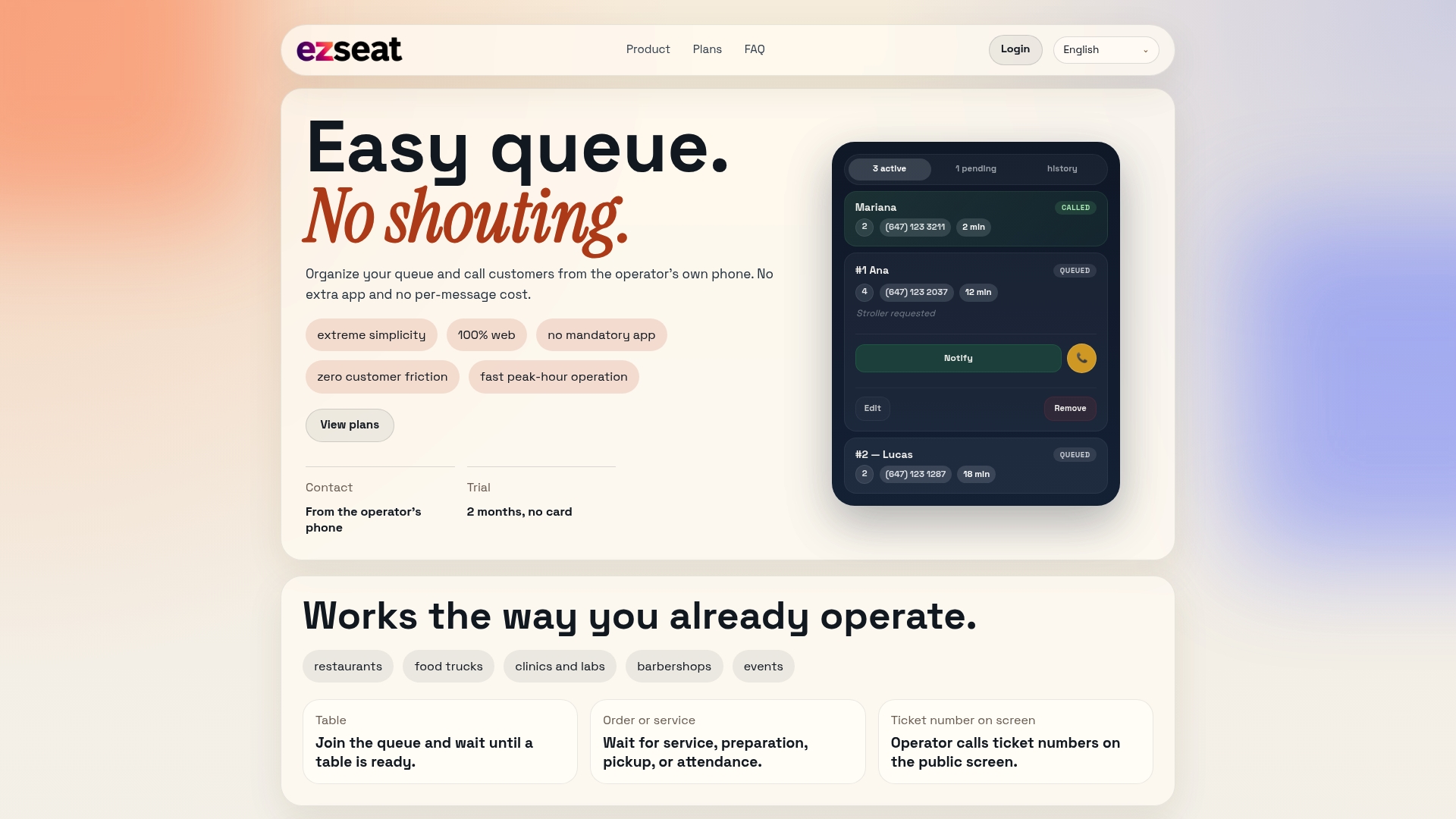
See Ezseat plans and start your free trial and test whether one shared line or separate lines suits your busiest hour.
FAQ
Is a single queue always faster than multiple lines?
No, but it usually is when every server can do the same work, because no server sits idle while another line is long. Research summaries describe waits cutting to about one-third in some settings. It is not a guarantee: if servers differ in skill, or workers speed up when they own a visible line, separate lines can win on throughput.
Why do single lines feel longer?
Because everyone in the line is visible, the total looks large, and perceived waits often exceed actual ones. Customers also tend to favor a single line only when they expect a short wait. Hiding the line on a screen, showing progress and giving honest estimates all reduce that feeling.
Can I use more than one queue for a single business?
Yes, and it is often the right call. Use one queue per type of service or skill group, and keep one shared line inside each group. A clinic might have separate queues for check-in and for pharmacy, while a barbershop might keep one queue with a preferred-barber field.
What works best for a restaurant waitlist?
One shared waitlist, with parties seated as suitable tables open. Letting guests join from their phones and wait outside the entrance keeps the door clear and removes the need to shout names. It also avoids the jockeying that physical lines invite.
Do my customers need to download an app?
Not with Ezseat. Customers join the queue from a web browser, which removes a common barrier, especially for one-time visitors at events or food trucks.
Sources
- Waiting for Service (Managing Quality Service in Hospitality, 2011)
- One-line checkouts are better than multiple-line checkouts, Kellogg School of Management
- Pooled vs. Separate Queues, The Third Bit
- One Queue or Two, Modeling and Simulation in Python
- Why is this line so long? The Conversation
- Investigating the impact of service line formats, International Journal of Research in Marketing
- More Lines Are Usually Better When It Comes to Worker Speed, Newswise
- Partial Flexibility in Routing and Scheduling, University of California
- Passenger Queue Management, NACTO
- Perceived waiting time study, University of Surrey
- Healthcare capacity management: Queuing theory and pooling, Chalmers
- Get the Most Out of Your Queue Lines, MH-USA