
Queue psychology is the study of how people perceive, judge, and react to waiting, and the finding that matters most for operators is simple: visible progress and fair treatment cut perceived wait more than shaving actual minutes off the clock. Customers who can see their place moving and trust the line is orderly tolerate far more real time than those staring at a static number. The practical steps that follow all flow from that one idea.
TL;DR:
- Displaying real-time progress indicators like served counts or estimated wait times significantly reduces perceived wait and abandonment rates.
- Making queue fairness transparent through visible order and clear communication helps preserve customer trust and minimizes dissatisfaction.
- Moving check-in processes online and offering notifications lessens last-place aversion and allows customers to manage their waiting more flexibly.
- Environmental cues such as lighting, music, and distractions influence how long a wait feels, especially in voluntary queues like restaurants.
- Testing small, low-cost interventions such as visible position counters and digital check-ins offers quick improvements without complete system rebuilds.
Table of Contents
- Core Queue Behaviors Every Operator Should Recognize
- Why Perceived Progress Matters More Than the Clock
- Fairness Is the Real Currency of a Waiting Line
- The Sensory and Informational Levers That Shift Mood
- Practical Interventions You Can Deploy This Week
- Simple Queuing Metrics Worth Tracking
- A Checklist for Reducing Perceived Wait This Week
- The Stress Response Hiding Inside a Slow Line
- How Queue Expectations Shift Across Cultures
- The Psychology Behind the Psychology: Prospect Theory and Perceived Control
- How Virtual Queues Are Changing the Way People Wait
- What Customers Do to Cope While They Wait
- Test the Small Stuff Before You Rebuild Anything
- How Ezseat Puts This Research Into Practice
- Sources
Core Queue Behaviors Every Operator Should Recognize
Researchers who study queuing systems generally sort waiting-customer reactions into four behaviors, and each one shows up as a specific business cost. Queuing system research frames these as the standard vocabulary for describing how people act once they hit a line.
- Balking: A customer sees the line and leaves before joining it, usually triggered by a visibly long queue or no posted wait estimate. This shows up directly as lost throughput; the customer never entered your funnel at all.
- Reneging: Someone joins the queue, then leaves before being served, often after watching the line barely move or sensing they are stuck at the back. Reneging inflates your abandonment rate and wastes the staff time already spent processing that customer's arrival.
- Jockeying: A customer switches from one line to another that appears to be moving faster, common at grocery checkouts and clinic front desks with multiple stations. It creates uneven load across staff and frustrates the people who stayed put.
- Prioritizing: Some customers expect (or demand) to jump ahead based on urgency, status, or a booked appointment. Handled visibly, it is fine. Handled quietly, it reads as favoritism and damages trust in the entire line.
All four behaviors spike under the same conditions: uncertainty about how long the wait will be, and visible evidence of being last.
Why Perceived Progress Matters More Than the Clock
A customer who watches three people get served quickly in the first five minutes will wait longer, without complaint, than a customer stuck behind a line that crawls at a flat, steady pace, even when both wait exactly the same total time. That is the relative progress effect, and Aksin and colleagues' 2025 research on reneging behavior found that observed early service speed increases patience independent of the eventual outcome. Fast movement up front buys tolerance for slower stretches later.
The flip side is last-place aversion. Being visibly at the back of the line, or watching newer arrivals get served ahead of you through some invisible priority system, raises the odds a customer switches lines or walks out. Research from Harvard Business School found that last-place aversion in queues produces abandonment effects comparable to adding real, meaningful wait time, even when nothing about the actual line changed.
The takeaway for operators: the position number matters almost as much as the position itself. A few signals reliably create the sense of progress that keeps people in line:
- A running count like "4 served, 6 ahead of you" instead of a silent queue
- A visible depletion indicator (a bar, a counter, a screen ticking down)
- An estimated time that updates as the line moves, rather than a single static guess
- Early acknowledgment that a customer has joined, so they are not wondering if the system even registered them
Fairness Is the Real Currency of a Waiting Line
Customers will forgive a long wait faster than they forgive a wait that feels rigged. Richard Larson's classic operations research analysis of queue social justice argues that perceived fairness, meaning a clear first-in-first-out order that everyone can verify, often shapes satisfaction more than the absolute number of minutes spent standing around. A queue is a social contract, and breaking it quietly costs you more goodwill than a slow line ever will.
Making that contract visible is mostly a matter of small, deliberate choices:
- Issue ticket numbers or timestamps so order is objectively verifiable, not just staff-remembered.
- Post a public display showing whose number is being called, so nobody has to ask.
- Announce exceptions out loud. If a walk-in emergency or a scheduled appointment jumps the line, say why, briefly, instead of letting the rest of the queue guess.
- Train staff to acknowledge visible frustration before it escalates, since a short verbal explanation often defuses what silence would turn into a complaint.
Larson's work also points out that transparency about exceptions preserves trust in ways silence never does. A customer who understands why someone was served out of turn rarely objects. A customer left to assume favoritism remembers it the next time they choose where to spend their money.
The Sensory and Informational Levers That Shift Mood
The physical environment around a queue changes how long it feels, and a synthesis of the experimental literature on queuing psychology confirms several levers operators can pull without touching staffing levels at all.
- Estimated-wait displays and signage reduce retrospective overestimates of how long a wait actually took. People who saw a running estimate consistently guessed their wait more accurately, and more favorably, than people who had no clock at all.
- Music tempo shapes the felt pace of time; slower tempos tend to calm compulsory waits, while upbeat tempos work better where customers chose to wait voluntarily.
- Lighting and seating matter more in compulsory queues (clinics, government offices) than in voluntary ones (concerts, popular restaurants), where people already expect to wait and factor it into showing up.
- Distractions like a menu board, a display of upcoming items, or a simple activity reduce the felt weight of unfilled time, echoing the old airport-baggage-carousel logic of giving people something to do with idle minutes.
Sensory fixes help most when the wait is optional. A frustrated compulsory-queue customer, like a patient at a clinic, needs information and fairness more than ambiance.
Practical Interventions You Can Deploy This Week
Turning the research into action does not require a construction project. Most of these interventions are software and signage changes an operator can roll out in days.
- Replace physical lines with browser-based check-in. When customers join a queue through a web link instead of standing in a physical spot, last-place aversion loses most of its bite because nobody is visibly at the back. A QR code waitlist setup lets a customer scan, join, and walk away rather than stand and stew.
- Send SMS or browser notifications as the queue moves. Real-time updates ("You're now 3rd in line") replace anxious guessing with confirmed progress, and a short code versus 10DLC comparison is worth reading before choosing a messaging channel, since delivery speed affects how trustworthy those alerts feel.
- Put position and depletion counts on a public screen. A queue display screen that shows who is being served next does double duty: it proves fairness and it shows progress at the same time.
- Offer kiosk check-in for walk-ins without smartphones. A kiosk check in option keeps the same visible-position benefits available to customers who would otherwise need a staff member to add them manually.
- Recalibrate your estimated-wait formula weekly. An estimate that is consistently wrong erodes trust faster than having no estimate at all.
Pro Tip: Measure abandonment rate for two weeks before you change anything, then run the same measurement for two weeks after adding visible position updates. That before-and-after comparison, not industry benchmarks, tells you whether the change actually worked for your specific customer base.
Simple Queuing Metrics Worth Tracking
You do not need a statistics degree to use queuing theory. Queueing theory reduces to three numbers that predict most of what customers feel.
- Arrival rate, how many customers show up per hour, tells you your demand pattern.
- Service rate, how many customers your team can process per hour, tells you your capacity.
- Utilization (ρ), arrival rate divided by service rate, tells you how close you are to overload. The Encyclopedia of Mathematics entry on queueing theory notes that keeping utilization comfortably under 1 prevents the long-tail waits that trigger reneging.
- Run a small experiment: track timestamps for 50 to 100 customers across a busy shift and you will have enough data to estimate average wait and abandonment without any specialized software.
If utilization creeps close to 1 during peak hours, reneging spikes disproportionately, since even small demand surges create disproportionately long tail waits once a system is near capacity.
A Checklist for Reducing Perceived Wait This Week
Prioritize by effort versus payoff rather than trying everything at once.
- Add a visible position counter or estimated-wait display; this is the single highest-payoff change available.
- Move to mobile or browser-based check-in so customers are not standing where "last place" is visible to everyone.
- Script a short staff line for handling priority exceptions out loud.
- Calibrate music tempo and lighting for whether your queue is voluntary or compulsory.
- Add kiosk check-in for walk-ins without a smartphone in hand.
- Track abandon rate, throughput, and customer satisfaction weekly, and compare against your pre-change baseline.
Start at the top of that list. Position visibility and mobile check-in address the two behaviors, last-place aversion and balking, that cost the most in lost customers.
The Stress Response Hiding Inside a Slow Line
Waiting triggers a low-grade stress response that most customers cannot articulate but everyone recognizes: the tight shoulders, the phone-checking, the irritation that flares over something minor once they finally reach the counter. Uncertainty is the main driver. A customer who does not know if they will wait five minutes or fifty experiences a kind of chronic low-level vigilance, constantly scanning for signs of movement, that is more exhausting than the wait itself would be if the duration were simply known upfront.
That vigilance compounds with each ambiguous signal. A line that appears to stall, a staff member who disappears from view, a phone that goes quiet after a "you're in the queue" text with no follow-up, each one reads as a potential sign the system has forgotten the customer. Anxiety in queues tends to spike not at the start of the wait but partway through, right when a person's initial patience runs out and they start actively questioning whether staying is worth it.
Time-sensitive contexts amplify this considerably. A patient waiting for a clinic appointment carries different stakes than someone waiting for a table at a restaurant, and operators handling health-related queues face a sharper version of the same psychology. A clinic queue management approach that gives patients clear status updates addresses stress that a restaurant customer would barely notice but a nervous patient feels acutely.
The fix is almost always informational, not environmental. A clear number, a believable estimate, and confirmation that the system has not lost track of someone address the underlying uncertainty directly, which does more for stress than a comfortable chair ever will.
How Queue Expectations Shift Across Cultures
Line behavior is not universal, and operators serving diverse customer bases run into this constantly. Expectations around personal space, acceptable line-jumping, and even what counts as "a line" at all vary by region and by the specific institution involved. In some cultures, a loosely clustered crowd around a counter functions as an understood queue with its own internal order; in others, anything short of a strict single-file line reads as chaos and provokes complaints.
Tolerance for ambiguity also differs. Customers accustomed to formal, ticket-based systems tend to get more frustrated by an unstructured queue than customers who grew up navigating informal ones, because the absence of a visible system feels like a bigger violation of expectation. Conversely, imposing a rigid ticket system on customers used to informal queuing can initially feel bureaucratic and impersonal rather than fair.
Prioritization norms shift too. What counts as a legitimate reason to move ahead (age, disability, appointment time, urgency) carries different weight depending on local custom and the type of venue. A queue system that works for a busy urban food truck may need adjustment for a clinic serving an older population with different expectations about deference and priority.
The practical implication for operators serving mixed or international customer bases is to make the rules explicit rather than assuming shared intuition. Visible signage that states the queue policy plainly removes the guesswork that culture-specific assumptions otherwise fill in, and it protects against the perception that staff are applying rules inconsistently. A written, visible policy also gives staff something neutral to point to when a dispute comes up, rather than relying on their own judgment in the moment.
The Psychology Behind the Psychology: Prospect Theory and Perceived Control
Two theoretical frameworks explain queue behavior more precisely than intuition alone. Prospect theory, originally developed to describe financial decision-making, applies surprisingly well to waiting: people weigh potential losses (time already invested, the risk of losing their place) more heavily than equivalent gains (the chance a new line might move faster). That asymmetry is part of why customers stay in a slow-moving line long after logic says they should switch. The sunk time already spent feels like a loss they are reluctant to write off, even when switching would likely be faster.

Perceived control is the second major lever, and it may matter more than actual control. A customer who can see their position, receives updates, and understands what happens next feels a sense of control over their own wait, even though they cannot actually speed up the line. That perceived agency lowers frustration measurably, which is why a silent, opaque queue frustrates people far more than a transparent one with the exact same average wait time. Giving customers something to monitor, even a number that only confirms what they already suspect, restores a sliver of control that a blank waiting room denies them entirely.
These two frameworks reinforce each other. Prospect theory explains why people stay in a line rather than gamble on another one; perceived control explains why giving them visibility into that choice, rather than removing the choice altogether, reduces their stress regardless of which line they pick. Operators who understand both principles can design systems that work with these instincts rather than fighting them, offering visible position updates specifically because they satisfy the control need prospect theory shows customers are already wired to want.
How Virtual Queues Are Changing the Way People Wait
Moving a line from physical space to a phone screen does more than remove the last-place stigma. It changes the customer's entire relationship with waiting. A customer holding a physical spot in line has no choice but to stand there, watching, present-tense and captive. A customer holding a virtual spot can leave, run an errand, sit in their car, or browse a shop nearby, and that freedom changes what "waiting well" even means.

This creates a behavioral shift worth naming: customers managing a virtual queue increasingly treat their position number the way they treat a delivery tracking link, checking it periodically rather than watching it constantly. That intermittent-checking pattern reduces the chronic vigilance that in-person waiting produces, since the customer is not physically anchored to the spot and can distract themselves fully between checks.
Virtual queues also introduce a new risk operators need to manage: distance-based reneging. A customer who has wandered too far away when their turn comes up may miss the call entirely, and a queue system that cannot reach them fast enough loses a customer who never intended to leave. That is why SMS and browser notifications matter as much as the position display itself; a virtual queue without a reliable notification channel just relocates the anxiety instead of solving it.
The generational split here is real but narrowing. Older customers sometimes distrust a virtual queue's accuracy at first, preferring the concrete reassurance of a physical ticket in hand. Repeated exposure tends to resolve that skepticism quickly, since a virtual system that reliably notifies people on time earns trust the same way any consistent service does, one accurate prediction at a time.
What Customers Do to Cope While They Wait
Customers are not passive during a wait. They actively manage their own discomfort, and understanding those coping strategies helps operators design environments that support rather than fight them.
Distraction is the most common tactic. Phones dominate this now, but the underlying behavior predates smartphones by decades; people have always reached for a magazine, a conversation, or a window display to fill unstructured time. Operators who provide something worth looking at, a menu board, a display case, an interesting piece of signage, are not decorating so much as supplying the coping tool customers already reach for instinctively.
Social interaction is the second major strategy, and it cuts both ways. Waiting alongside strangers in a shared line creates a mild sense of solidarity, sometimes called the "misery shared" effect, where seeing others equally inconvenienced makes an individual's own wait feel more acceptable. Groups waiting together cope even better, since conversation itself functions as a distraction technique.

Mental reframing shows up too, often without the customer even noticing they are doing it. People recalculate their expectations mid-wait, deciding a 15-minute wait they braced for is "not that bad" once it lands at 12, even though 12 minutes would have felt disappointing if they had expected 5. Operators can use this directly: setting an estimate slightly higher than the likely actual wait means most customers experience a small, pleasant surprise instead of a small, frustrating one.
Finally, some customers cope by seeking control proactively, asking staff for updates, checking a display repeatedly, or requesting a specific estimate. Rather than treating these requests as a nuisance, a well-designed queue system answers that need before it is asked, which is exactly what a visible position counter is built to do.
Test the Small Stuff Before You Rebuild Anything
The biggest mistake operators make is assuming they need a full system overhaul before seeing results. A single restaurant that added nothing more than a visible position counter to its existing waitlist saw fewer walk-offs within days, not because the wait got shorter, but because customers stopped guessing.
That is the pattern worth trusting: test one visible-progress change, measure abandonment for two weeks, then decide what is next. Iteration beats a big-bang redesign every time, because you learn what your specific customers actually respond to instead of assuming the research applies uniformly. If a small internal resource or trial period is available to test one of these interventions, that is the lowest-risk place to start.
— Ezseat
How Ezseat Puts This Research Into Practice
Ezseat is built directly around the interventions this article covers, not as an afterthought but as the core product. Customers join a queue through a browser, no app download required, which removes the visible last-place stigma that drives so much reneging. Position updates and estimated-wait recalculation happen automatically, and SMS or browser notifications keep customers informed without requiring them to stand and watch a screen. Public displays and kiosk support cover the walk-in customers who need a physical touchpoint, while the same fairness and transparency principles apply whether you run a restaurant, a clinic, a food truck, or an event.
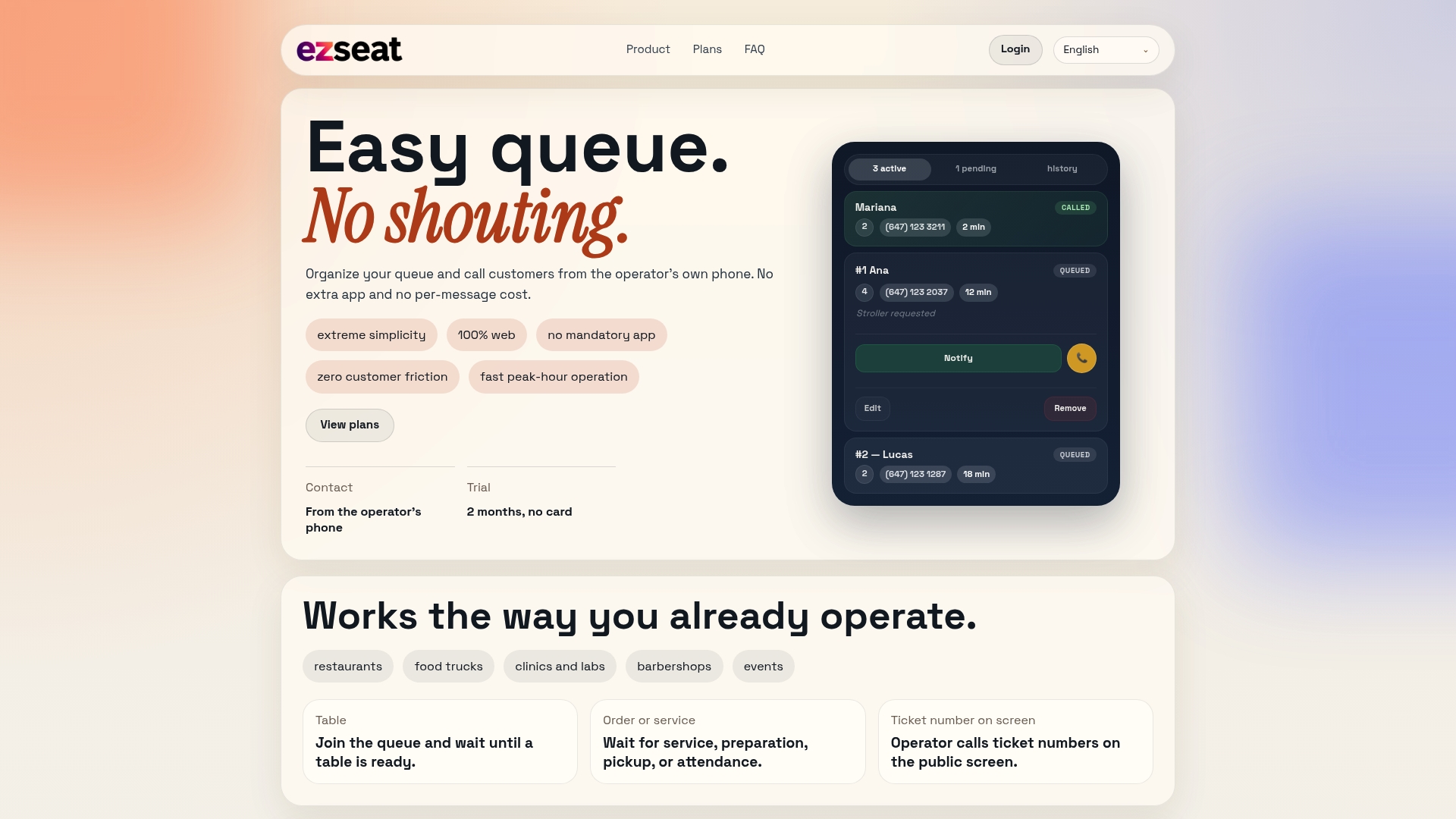
Restaurants juggling walk-ins during a dinner rush, clinics managing patient flow without shouting names across a waiting room, and food trucks handling a lunchtime crowd all face the same underlying psychology, and Ezseat's multi-queue setup adapts to each without extra hardware. Ezseat currently offers a free two-month trial before moving to a paid Light or Pro plan, so you can measure your own abandonment rate before and after switching, exactly the kind of test this article recommends. Visit Ezseat to start that trial and see whether visible progress and fair queuing actually move your numbers.
Sources
- How observed queue length and service times drive reneging behavior — Aksin et al. (2025)
- Last place aversion in queues — HBS working paper
- OR Forum—Perspectives on Queues: Social Justice and the Psychology of Queueing — Richard C. Larson (1987)
- The Psychology of Queuing (synthesis paper)