
For most web-based queue and waitlist systems, a registered A2P 10DLC number is the right choice. It supports two-way SMS, voice callbacks on the same number, provisions in days rather than months, and costs a fraction of what a short code runs. Short codes are purpose-built for mass broadcast at scale — they are not designed for the conversational, back-and-forth flow that queue notifications require.
Three reasons 10DLC wins for queue operations:
- Two-way messaging and voice on one number. Customers can reply to confirm their spot, and voice support means you can call them back on the same number when they miss an SMS.
- Fast provisioning and lower cost. A registered 10DLC number typically goes live in a few days to a few weeks, not the 6–10 weeks a short code requires.
- Reliable delivery when registered. TCR registration is mandatory for A2P long-code traffic; once registered, carrier filtering drops sharply.
Pro Tip: If your queue system sends millions of messages in a tight window — think a national flash sale or high-volume OTP distribution — short codes may still be necessary. For most local or regional operators, 10DLC handles the load comfortably.
Table of Contents
- What is a short code and when does it make sense?
- How 10DLC works and why carriers prefer it for business messaging
- Short code vs 10DLC: side-by-side comparison
- How each number type maps to queue and waitlist scenarios
- How to decide between short code and 10DLC for your business
- Step-by-step: registering and deploying compliant queue notifications
- When a short code is actually the right answer
- Key Takeaways
- Why the "prestige" of a short code is mostly a distraction
- Ezseat handles the messaging infrastructure so you don't have to
- Useful sources and official references
What is a short code and when does it make sense?
Short codes are 5–6 digit numbers leased specifically for high-throughput A2P messaging. Every major U.S. carrier vets and approves them individually, which is why they take so long to provision.
The throughput is genuinely impressive. Short codes can handle very high message volumes suitable for mass broadcasts, making them the right tool for OTPs, emergency alerts, and national marketing blasts where volume is the only variable that matters. Carriers do not filter them the way they filter unregistered long codes.
The trade-offs are real, though. Short codes do not support voice, so callback flows require a separate number. Two-way conversational patterns are limited. And provisioning takes 6–10 weeks with setup and leasing fees that add up fast.
| Dimension | Short Code |
|---|---|
| Setup time | 6–10 weeks |
| Typical monthly cost | Higher leasing fees (exact amounts vary) |
| Throughput | High message throughput suitable for mass broadcasts |
| Voice support | No |
| Two-way messaging | Limited |
| Best for | Mass blasts, OTPs, emergency alerts |
How 10DLC works and why carriers prefer it for business messaging
10DLC stands for 10-digit long code — a standard local phone number registered for A2P commercial messaging. The key infrastructure piece is The Campaign Registry (TCR), the centralized hub where businesses register their brand and specific messaging campaigns before sending.

Once registered, a 10DLC number supports two-way messaging and voice calls on the same number. For a queue system, that means one number handles the outbound "your table is ready" SMS and the inbound "I'll be there in 2 minutes" reply — plus a voice call if the customer doesn't respond. That simplicity reduces integration complexity considerably.
Throughput on 10DLC is variable. It depends on your brand's trust score, which TCR and carriers calculate based on registration completeness, campaign type, and messaging behavior. Trust score drives throughput allocation; a well-registered campaign with clean opt-in records consistently outperforms a poorly documented one.
| Dimension | 10DLC |
|---|---|
| Setup time | A few days to a few weeks |
| Registration | TCR brand + campaign required |
| Throughput | Variable, depends on trust score and campaign type |
| Voice support | Yes |
| Two-way messaging | Full support |
| Best for | Conversational A2P, queue notifications |
Pro Tip: When registering your 10DLC campaign with TCR, select the campaign type that most accurately describes your use case (e.g., "notifications" or "customer care"). Mismatched campaign types are one of the most common reasons trust scores come in lower than expected.
Short code vs 10DLC: side-by-side comparison
| Dimension | Short Code | 10DLC |
|---|---|---|
| Best for | Enterprise-scale blasts, OTPs | SMB conversational, queue/waitlist |
| Two-way messaging | Limited | Full |
| Voice support | No | Yes |
| Throughput | High message throughput appropriate for mass blasts | Variable (trust score dependent) |
| TCR registration | Not required | Required |
| Setup time | 6–10 weeks | Days to a few weeks |
| Typical cost | Higher leasing + setup fees | Lower; per-message rates apply |
| Deliverability | High (carrier-approved) | High when TCR-registered |
| Carrier restrictions | Carrier-vetted per campaign | A2P registered; carrier-approved routing |
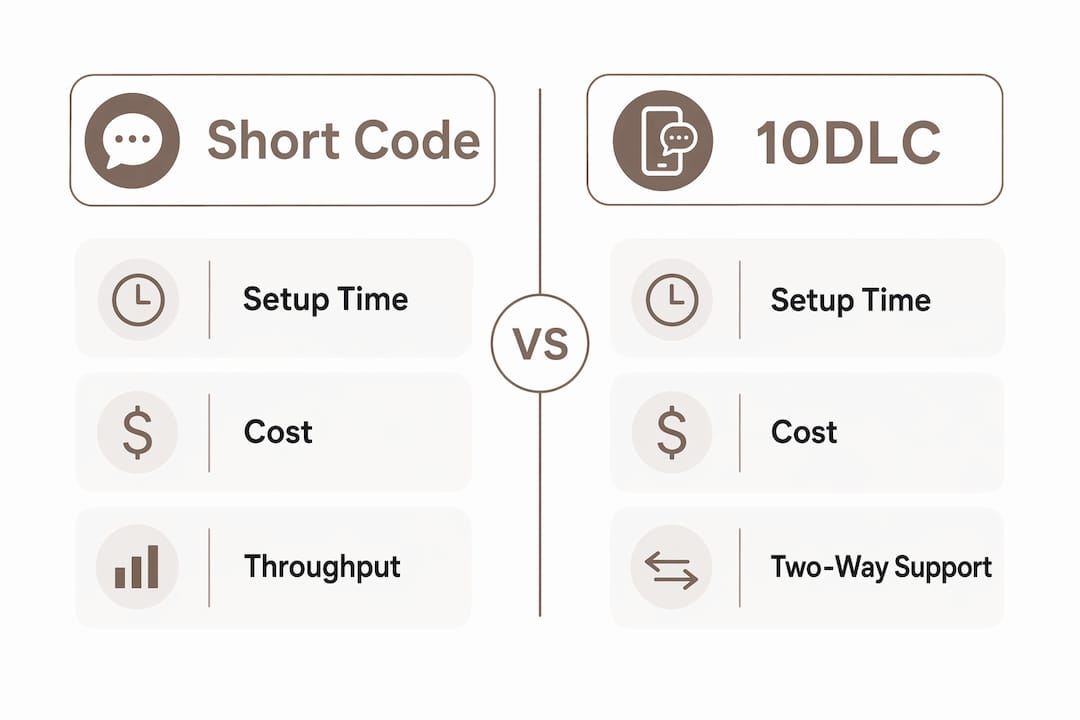
For queue systems, the 10DLC column wins on nearly every row that matters operationally.
How each number type maps to queue and waitlist scenarios
Different queue actions call for different capabilities. Here is how the two sender types perform across the most common scenarios:
- Join-queue confirmation. A customer scans a QR code and receives a confirmation SMS. 10DLC handles this cleanly; the local number feels familiar rather than robotic.
- ETA updates. Outbound-only notifications work on either type, but 10DLC lets the customer reply if plans change.
- Two-way confirmations. "Reply YES to hold your spot." This requires conversational support — 10DLC only. Short codes can technically receive replies, but the flow is limited.
- Voice fallback. Customer doesn't respond to SMS after two attempts. The system places a voice call. 10DLC supports voice on the same number; short codes do not.
- Multi-location queues. Each location can have its own 10DLC number with a local area code, which builds customer trust and makes the source of the message obvious.
- Flash re-openings or last-minute availability. If you need to blast a large waitlist simultaneously, 10DLC throughput is sufficient for most SMB volumes. National-scale operators may need a short code here.
Pro Tip: To run a compliant SMS-to-voice fallback without violating opt-in rules, capture consent for both SMS and voice calls in your initial opt-in language. A single checkbox that says "I agree to receive text and phone notifications" covers both channels under TCPA.
How to decide between short code and 10DLC for your business
Work through this checklist before you provision anything:
- Monthly and burst volume. Sending fewer than a few thousand messages per day? 10DLC handles it. Sending millions in a tight window? Short code territory.
- Voice on the same number. If callbacks matter to your operation, 10DLC is the only option. Short codes cannot make or receive calls.
- Speed to launch. Need to go live within a week or two? 10DLC provisions in a few days to a few weeks. Short codes take 6–10 weeks minimum.
- Budget. Short codes carry higher leasing and setup fees. 10DLC costs less upfront and per message for most SMB volumes.
- Compliance readiness. Both types require documented opt-in flows. 10DLC additionally requires TCR brand and campaign registration before sending.
- Geographic scope. Local or regional operation? A local area code on a 10DLC number builds recognition. National brand with recall-driven campaigns? A vanity short code may be worth the cost.
Scoring it quickly: If you answered "yes" to voice, speed, and budget constraints, 10DLC is your number. If you answered "yes" to millions of messages in minutes and national brand recall, evaluate a short code.
Request these trust signals from any provider during procurement: TCR registration confirmation, carrier delivery reporting (DLRs), and published throughput caps per number type.
Step-by-step: registering and deploying compliant queue notifications
- Choose your sender type based on the checklist above.
- Register your brand with TCR (for 10DLC). Providers like Twilio and Bandwidth submit this on your behalf or offer self-service portals. Expect a one-time brand registration fee.
- Register your campaign with TCR. Describe the use case accurately — queue notifications, customer care, or similar. This determines your trust score and throughput ceiling.
- Provision your number. For 10DLC, this typically completes in days once TCR approves the campaign.
- Implement opt-in flows. Capture consent at the point of queue entry — a web form checkbox works. Store timestamps and consent language.
- Integrate with your messaging provider API. Twilio and Bandwidth both publish detailed docs for number types and throughput limits.
- Test before launch. Send to a small internal group first. Verify opt-out handling (STOP keyword), check delivery receipts, and simulate a voice fallback.
- Monitor after launch. Track delivery rate, latency, and carrier error codes. A drop in delivery rate often signals a trust score issue.
| Cost Item | Short Code | 10DLC |
|---|---|---|
| One-time setup | Higher (carrier vetting fees) | Lower (TCR brand + campaign fee) |
| Monthly leasing | Higher recurring lease | Lower or none beyond provider fees |
| Per-message rate | Varies by provider | Varies by provider |
| Provisioning time | 6–10 weeks | Days to a few weeks |
Monitoring metrics to track post-launch: delivery rate, message latency, opt-out rate, carrier error codes, and trust score changes in TCR.
When a short code is actually the right answer
Short codes are not obsolete — they are just narrowly applicable. Here are the scenarios where they genuinely make sense:
- Very high burst volume. Sending millions of messages in minutes — national OTP distribution, emergency alerts, or a flash sale to a massive subscriber list — requires the 100+ MPS throughput that short codes deliver.
- Vanity number recall. If your brand campaign depends on customers texting a memorable number (like a 5-digit code tied to a keyword), a vanity short code has no equivalent.
- Regulatory mandates. Some OTP providers and emergency alert systems specify short-code provisioning at the carrier level. Check your specific use case requirements.
- Operational warning. If you choose a short code for a planned campaign, budget 6–10 weeks for provisioning and account for leasing fees in your launch timeline. Starting that process after you need the number is a common and costly mistake.
Key Takeaways
For queue and waitlist systems, 10DLC is the right default: it provisions faster, costs less, and supports the two-way SMS and voice fallbacks that short codes simply cannot deliver.
| Point | Details |
|---|---|
| 10DLC for most queue systems | Two-way messaging, voice support, and faster provisioning make 10DLC the default for SMB operators. |
| Short codes for mass blasts | Use short codes only when burst volume exceeds what 10DLC throughput can handle (100+ MPS). |
| TCR registration is mandatory | Unregistered A2P long-code traffic is filtered by carriers; register brand and campaign before sending. |
| Voice fallback requires 10DLC | Short codes do not support voice; 10DLC handles SMS and callbacks on one number. |
| Ezseat integrates both channels | Ezseat's queue system supports compliant SMS and voice call notifications with built-in opt-in flows. |
Why the "prestige" of a short code is mostly a distraction
Most operators assume a short code signals professionalism. The research says otherwise. A local 10-digit number often improves customer trust and response rates because it looks like a real person or local business, not a marketing blast. For a restaurant or clinic managing a queue, that local feel matters more than a memorable 5-digit number.
The deeper issue is that short codes were designed for a one-to-many broadcast world. Queue management is fundamentally conversational — a customer needs to confirm, reply, or get called back. Forcing that interaction through a broadcast-only channel creates friction at exactly the moment you need it least.
One configuration detail that reduces opt-outs significantly: keep your initial opt-in message short, name your business explicitly, and include the opt-out instruction in the first message. Carriers and customers both respond better to transparency up front than to a buried STOP instruction three messages in.
Ezseat handles the messaging infrastructure so you don't have to
Queue management should not require a crash course in carrier compliance. Ezseat comes with compliant SMS and voice call notifications built in, including opt-in flows that satisfy TCPA requirements and voice fallback support on the same number — the exact setup this article recommends for queue operations.
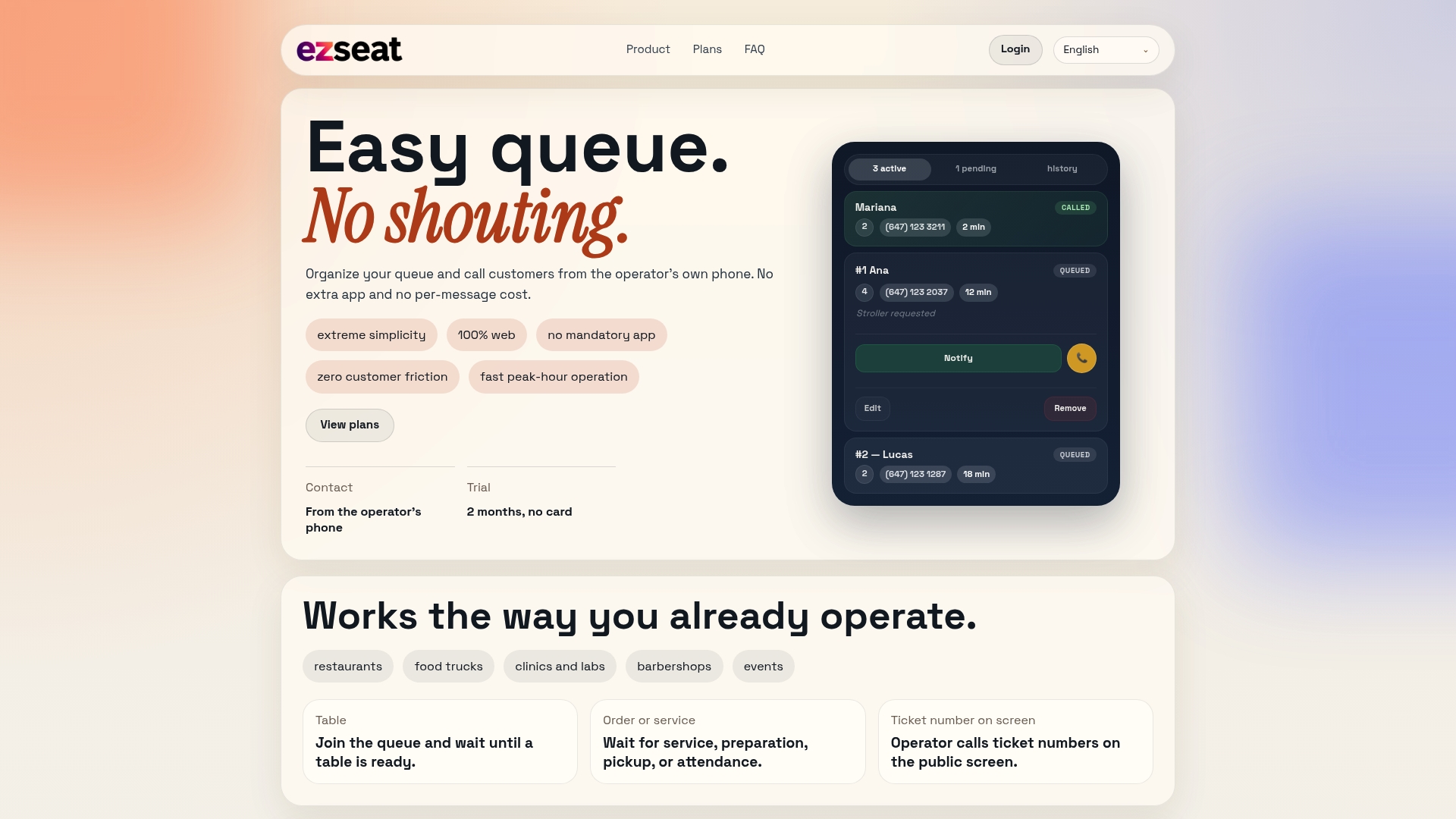
You get fast deployment without managing TCR registration yourself, a browser-based queue that customers join without downloading anything, and notification delivery that works across restaurants, clinics, food trucks, and events. Start with a free two-month trial and see how the messaging layer performs under real peak-hour conditions. Try Ezseat free and have your queue running with compliant notifications before the end of the week.
Useful sources and official references
- The Campaign Registry (TCR) — official hub for 10DLC brand and campaign registration; start here for registration steps and trust score guidance.
- Twilio: Number type comparison — detailed throughput caps, provisioning timelines, and compliance notes for short codes, 10DLC, and toll-free numbers.
- Twilio: Long code vs. short code — practical breakdown of when each sender type fits, with carrier behavior context.
- Plivo: SMS long codes vs. short codes — throughput benchmarks and deliverability comparison, including 10DLC transactions per minute figures.
- Infobip: 10DLC vs. short codes vs. toll-free — covers carrier filtering behavior and why TCR registration is a delivery requirement, not just a compliance formality.
- Sinch: US short codes vs. long codes — good reference for provisioning timelines and the cost range for short codes starting around $500.