
The fastest way to improve queue customer experience is to fix what customers can't see: their position, their wait, and what happens next. Give people that information, let them join a queue from their phone instead of standing in one, route them to the right resource on the first try, and ask how it went the moment they're served. That combination consistently beats faster service alone.
Here's what changes when you do this right:
- Abandonment drops. Kellogg research found that removing the visual cue of being last in line cut abandonment by a significant margin in study scenarios.
- Satisfaction scores rise even when actual wait times stay flat, because perceived wait, not clock time, drives how people rate the experience.
- Staff stop firefighting. Fewer walk-outs and fewer "how much longer?" questions mean fewer interruptions during service.
Quick take: Prioritize transparency (position and ETA), enable web or QR-based virtual queuing, apply smart routing, and collect feedback right after service. Tools like Ezseat build these four levers into one browser-based system, but the levers themselves matter more than any specific vendor.
Key Takeaways
Queue customer experience improves most reliably when businesses combine visible wait information, virtual queuing, smart routing, and immediate feedback into one system.
| Point | Details |
|---|---|
| Visibility beats speed | Removing the "last in line" cue cut abandonment by 43.5% in Kellogg's research, without serving anyone faster. |
| Perceived wait rules | Satisfaction tracks how fair and predictable a wait feels more than the actual clock time. |
| Start with a minimal pilot | Track timestamps, service duration, and outcome on one queue for four weeks before scaling anything. |
| Watch the 90th percentile | Averages hide the worst waits; the 90th percentile and abandonment rate reveal where customers actually suffer. |
| Ezseat covers the core levers | Its browser-based join, operator dashboard, and public displays let managers apply these levers without requiring an app download. |
Table of Contents
- Why Waiting Matters: The Psychology and Cost of Unmanaged Queues
- How Modern Queue Systems Improve Experience: Feature by Feature
- Benefits by Industry: What Changes in Healthcare, Retail, and Service Centers
- Technology and Implementation: What You Actually Need to Get Started
- Measuring Success: The KPIs That Actually Tell You Something
- Addressing Common Concerns: Cost, Adoption, Fairness, and Privacy
- Ezseat in Practice: A Web-Based Approach to These Levers
- Role of Staff Training in Managing Queues and Improving Experience
- Case Studies Showing Real Queue Experience Improvements
- Strategies for Managing Peak Times and Unexpected Surges
- Author Perspective: What I'd Tell a Manager Starting Today
- Try a Web-Based Queue System Built Around These Levers
- Frequently Asked Questions
- Sources
Why Waiting Matters: The Psychology and Cost of Unmanaged Queues
David Maister's classic observation, that unoccupied time feels longer than occupied time, still holds up decades later, and it explains almost everything that goes wrong in a badly run line. A customer standing still, watching the door, checking a phone with no updates, will report a worse experience than one who waited the same number of minutes but had something to do or something to watch.
Kellogg researchers describe what happens when queues go unmanaged as a vicious cycle: longer waits put customers in a worse mood before they even reach the counter, and frustrated customers take longer to serve once they get there. That extra service time then pushes wait times up further for everyone behind them. One slow morning can compound into an afternoon that never recovers.
The visibility problem is where this gets fixable.
People don't mind waiting nearly as much as they mind not knowing how long the wait will be, or feeling like they've been forgotten at the back of the line.
That's the core insight behind perceived wait research: perceived wait predicts satisfaction better than actual wait, which means a business can improve customer experience without necessarily serving anyone faster. The financial cost of ignoring this shows up as walk-outs during peak hours, missed appointments in healthcare settings, and staff who spend more energy managing frustration than managing the actual work.
How Modern Queue Systems Improve Experience: Feature by Feature
Not every queue feature carries equal weight. Some change customer behavior immediately; others are nice polish. Here's the order that tends to produce results, based on what the research and operational evidence actually show:
- Real-time position and ETA. This is the single highest-leverage fix. Removing uncertainty about where someone stands in line directly reduces abandonment, and it's the mechanism behind that 43.5% figure from the Kellogg study.
- Virtual queuing through web or QR join. Once customers can join remotely, they stop occupying physical space and start using that time productively, running an errand, sitting down, working, instead of standing against a wall.
- Web-based check-in over app downloads. Every extra step between "I want to join this line" and "I'm in the queue" costs you customers. A browser link works on any phone; an app store detour loses a percentage of people before they ever get in line.
- Smart routing and prioritization. Matching a customer to the right resource on the first attempt, the technician who handles their issue, the provider who has their file, cuts transfers and repeat visits, which shortens actual service time downstream.
- Occupied-time tactics. Menus to browse, forms to fill out, or simple in-queue updates keep attention off the clock and make the same wait feel shorter.
- Post-service feedback captured immediately. Feedback tied to the actual visit produces more honest, more useful signals than a survey that arrives by email three days later.
Microsoft's own guidance on displaying average wait time is worth flagging here: showing an estimate only builds trust if the estimate is reasonably accurate, and their system requires a baseline of at least 20 prior conversations before it trusts its own average. Show a number too early, before you have that baseline, and you risk publishing a guess that undermines the very transparency you're trying to create.
Pro Tip: Don't roll out every feature at once. Start with position visibility and virtual join. Those two alone address the majority of the abandonment problem, and you can layer routing and feedback in once staff are comfortable with the basics.
Benefits by Industry: What Changes in Healthcare, Retail, and Service Centers
The same four levers, visibility, virtual queuing, routing, and feedback, produce different payoffs depending on what you run.
- Healthcare clinics: Reduced no-shows are the biggest win, since patients who can see an accurate ETA are less likely to leave before being seen. Documented wait-time data also helps clinics track compliance and patient flow, a use case backed by peer-reviewed research on queue management in healthcare settings. Watch abandonment rate first.
- Retail and food service: Virtual queuing during peak hours (lunch rush, weekend crowds) keeps customers from walking away at the door, and a smoother checkout experience tends to bring people back sooner. Watch conversion rate during your three busiest hours of the week.
- Service centers and government offices: Visible, fair queue order reduces complaints even when total wait time doesn't change, because fairness is what people are actually reacting to. Watch how quickly average wait recovers after a surge, not just the daily average.
A single small clinic that starts showing patients their position on a waiting-room screen, instead of just a name called at random intervals, often sees fewer "how much longer" interruptions at the front desk within the first week.
Technology and Implementation: What You Actually Need to Get Started
You don't need a data warehouse to start managing queue customer experience well. You need three things tracked accurately: timestamps (join time, called time, served time), service duration per customer or ticket type, and outcome (served, abandoned, no-show). That's the minimum viable dataset, and it's what peer-reviewed queue research points to as the core inputs for predicting wait times reliably.
Deployment typically looks like one of these combinations:
- Web or QR join plus a public display screen, good for walk-in retail and food service.
- Kiosk check-in plus SMS notifications, useful where customers arrive on-site but don't want to wait in a physical line.
- Operator dashboard on a phone or tablet, letting one staff member manage the whole flow without shouting names.
Predictive or AI-driven wait estimates only add real value once you have enough historical volume, Microsoft's own system waits for a baseline of 20 conversations before trusting an average. Below that, a simple position number beats a shaky prediction.
Pilot checklist:
- Pick one queue that causes the most complaints today.
- Set two KPIs before you start: abandonment rate and 90th percentile wait.
- Run the pilot for four weeks, no longer.
- Review both numbers, not just the daily average, before deciding what to scale.
Measuring Success: The KPIs That Actually Tell You Something
Averages hide the problem you're trying to solve. Track these instead:
- Abandonment rate: the percentage of people who join and leave before being served, your single clearest signal of a broken experience.
- 90th percentile wait: how bad the wait gets for your unluckiest one in ten customers, not just the typical one.
- Average service time: rising service time is often the downstream symptom of the vicious cycle described earlier, frustrated customers take longer to help.
- CSAT captured at exit: feedback tied to the actual visit, which queue-linked feedback programs show produces more candid, actionable responses than a delayed survey.
Review abandonment and the 90th percentile weekly for the first month of any change, then move to monthly once the numbers stabilize. When CSAT dips alongside a spike in the 90th percentile, that's your cue to check staffing or routing before the trend becomes a pattern.
Addressing Common Concerns: Cost, Adoption, Fairness, and Privacy
- Cost: Start with a small pilot on one queue instead of a full rollout. The staffing efficiency gained from fewer manual name-calls and fewer walk-outs often offsets the subscription cost within the first month.
- Adoption: Favor web or QR join over app downloads. Every download step you remove is a customer you keep. Pair it with simple signage and a one-line staff script.
- Fairness: Post your queue rules where customers can see them, and define exceptions (urgent cases, appointments) in advance so staff aren't improvising under pressure.
- Privacy and safety: In healthcare settings, CDC guidance on waiting areas covers spacing and environmental controls worth reviewing alongside your queue setup, though it isn't a substitute for your own compliance review.
Ezseat in Practice: A Web-Based Approach to These Levers
Ezseat applies each lever above without asking a single customer to download anything: people join through a QR code or web link, operators run the whole flow from a phone or tablet, and a public display screen shows position and status so nobody has to ask "am I next?"
- Browser-based join removes the app-download friction that causes early abandonment.
- Public displays and SMS notifications let customers step away and come back, turning dead time into free time.
- Kiosk check-in covers walk-in traffic without adding a line at the front desk.
Pro Tip: During predictable peak windows, add a second operator device instead of a second physical line. Ezseat's multi-device setup lets two staff members manage the same queue without duplicating the customer list.
Role of Staff Training in Managing Queues and Improving Experience
Technology sets the stage, but staff behavior decides whether a queue feels managed or chaotic. A well-designed display screen doesn't help if the person at the counter still calls names out of order, contradicts the posted wait estimate, or looks annoyed when someone asks a question.

Training should cover three things specifically. First, consistency: staff need to follow the queue order the system shows, because nothing erodes trust in a "fair" system faster than watching someone get served out of turn without explanation. Second, communication scripts: a short, standard line like "you're third in line, about 12 minutes" said with confidence does more for perceived wait than a vague shrug, even when the actual number is identical.
Third, exception handling. Every queue eventually has a walk-in emergency, a VIP, or a mistake that needs correcting live, and staff need a rehearsed way to explain the deviation to everyone else waiting, so it doesn't look like favoritism. A receptionist who says "we're bringing this patient in for an urgent issue, we'll get you next" defuses tension that silence would only inflame.
Managers who invest an hour in training staff on the queue tool itself, not just the policy but which buttons do what, tend to see fewer errors in the first two weeks after launch. The system can only be as fair and as calm as the person operating it.
Case Studies Showing Real Queue Experience Improvements
The clearest evidence for what works comes from research that isolated one variable at a time rather than case studies that changed everything at once. Kellogg's study on queue position visibility is the standout example: by changing only whether customers could see they were last in line, researchers isolated the effect of that single piece of information and measured a 43.5% swing in abandonment. That's a controlled result, not a marketing claim, and it's why position visibility sits at the top of the feature list in this article.
On the feedback side, queue-linked feedback programs that capture responses tied to the actual service event, rather than a follow-up email days later, report meaningfully higher response rates and faster same-visit recovery when something goes wrong. The mechanism is straightforward: a customer who just experienced a problem and gets asked about it immediately will tell you the truth, and a manager who hears about it while the customer is still on-site can often fix it before that person leaves upset.
The pattern across this evidence is consistent. Small, specific changes, visibility, immediate feedback, tend to outperform sweeping overhauls, because they target the exact moment where customer perception forms.
Strategies for Managing Peak Times and Unexpected Surges
Peak-time failure usually isn't a capacity problem, it's a communication problem. When wait times stretch during a lunch rush or a surprise crowd, customers don't actually need the wait to disappear, they need to know it's being managed.

Set a surge threshold in advance, a queue length or wait time that automatically triggers a response, rather than waiting for a manager to notice the line has spiraled. Once that threshold hits, three moves help most: post an updated, honest ETA immediately rather than letting the old estimate sit and erode trust; add a second staff member to run the queue rather than the service itself, so the person managing the crowd isn't also trying to work the counter; and communicate proactively to customers already in the virtual queue that the wait has grown, since a surprise is worse than a known delay.
Recovery matters as much as the response itself. The vicious cycle research explains why surges compound: frustrated customers take longer to serve, which keeps the queue backed up even after the initial rush passes. Breaking that cycle usually means temporarily over-staffing the recovery period, not just the peak itself, so the 90th percentile wait comes back down instead of lingering.
Author Perspective: What I'd Tell a Manager Starting Today
Pick the one queue that generates the most complaints. Set exactly two KPIs, abandonment rate and 90th percentile wait, and run a four-week pilot before touching anything else. Pair that measurement with the cheapest fix available: honest, visible ETA signage. For more detailed how-tos, the Ezseat blog covers specific setups by venue type.
Try a Web-Based Queue System Built Around These Levers
Ezseat gives you the four levers this article covers in one browser-based setup: customers join through a web link or QR code with no app to download, you run the queue from your own phone or tablet, and a public display keeps everyone informed without a single shouted name.
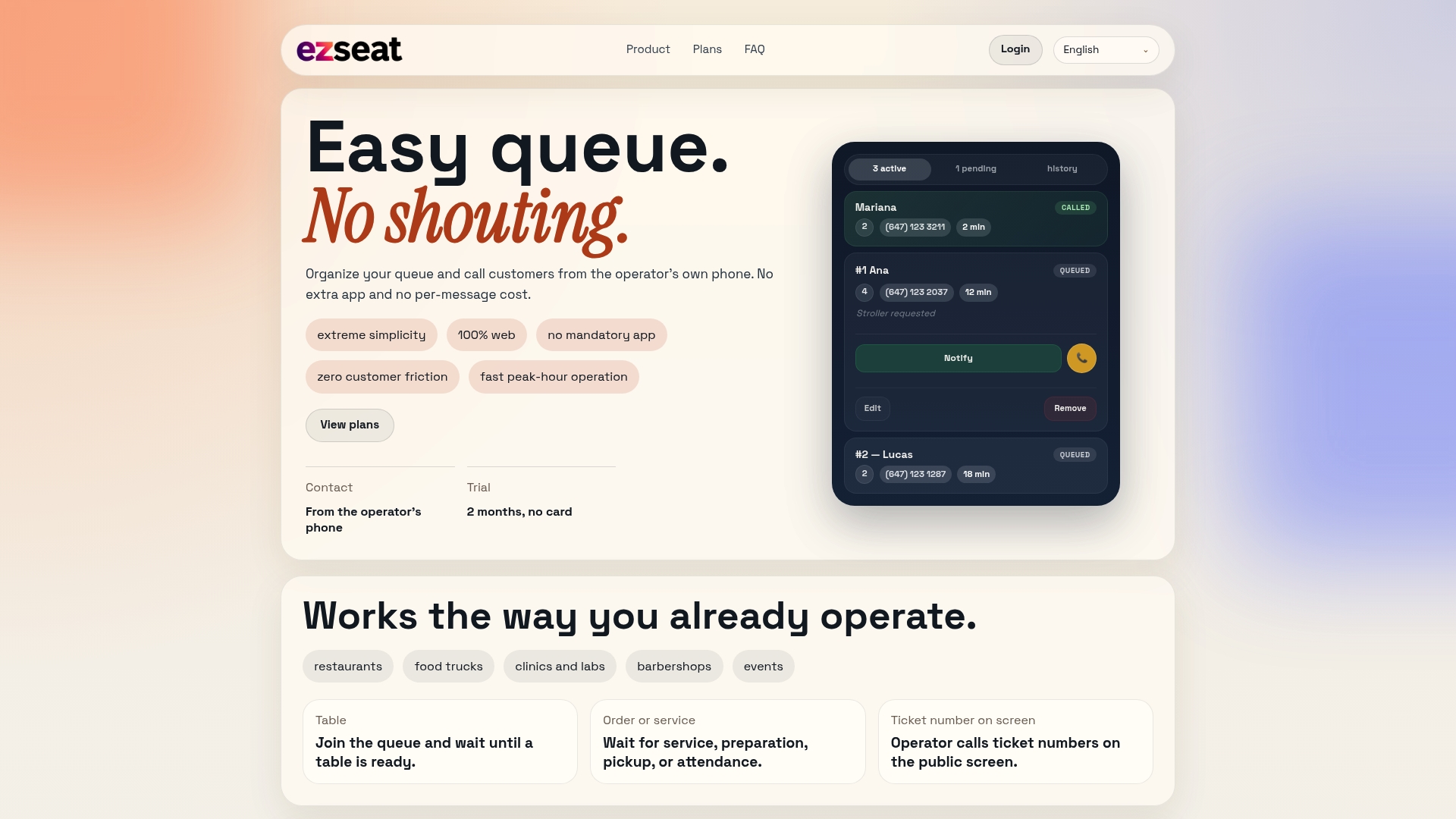
If you're running a restaurant, clinic, food truck, or service counter and want to see how this looks in practice, you can try Ezseat free for two months before choosing a plan. Visit the Ezseat landing page to start a trial or see how the setup works for your specific queue.
Frequently Asked Questions
What is the single biggest factor in queue customer experience? Perceived wait time, not actual wait time, is the strongest driver of satisfaction. Customers who can see their position and an honest ETA tolerate longer waits better than customers left in the dark for a shorter one.
How much does virtual queuing reduce abandonment? Adding virtual queuing, letting customers wait elsewhere, compounds that effect further by removing the discomfort of standing in a physical line altogether.
What KPIs should I track first for queue management? Start with abandonment rate and 90th percentile wait time. Both expose problems that a simple average wait time hides, since averages smooth over the worst experiences your customers actually have.
Do I need an app to run a modern queue system? No. Web-based and QR-code check-in let customers join a queue directly through a browser, which avoids the download friction that causes people to abandon the process before they even get in line.
How long should a queue management pilot run before deciding to scale it? Four weeks is usually enough to gather a reliable baseline for abandonment rate and 90th percentile wait, especially if the queue handles regular daily traffic rather than rare events.
Sources
- How a different AI approach can cut the queue
- The curious psychology of queues and the AI quietly trying to calm us down
- Show customers their average wait time in a queue | Microsoft Learn
- PMC article on queue/flow (healthcare)