
The fastest way to cut walkouts and make wait times predictable at live events is to pair a virtual queue system with three operational fixes: smarter layout, staffing that flexes with demand, and signage that keeps guests informed. Together they replace the guessing game of a physical line with a managed, visible process. The payoff shows up fast: fewer people bailing before they're served, throughput you can actually forecast, and an attendee experience that doesn't sour before the main event even starts.
TL;DR:
- Real-time notifications and transparent ETA updates significantly reduce wait-time anxiety and abandonment rates during high-pressure crowd points.
- Organizers should test wait-time estimates under overload conditions to ensure accuracy during peak demand and avoid system failures.
- Integrating queue management with ticketing, access control, and CRM simplifies capacity tracking, automates routing, and enhances post-event analysis.
- Physical layout, staffing triggers, and signage influence wait perception and must be planned to match actual foot traffic and guest behavior.
- Automated systems handle volume surges well but require manual staff judgment for unexpected delays and staffing adjustments.
Table of Contents
- What Event Queue Management Actually Means
- How Virtual Queue Systems Actually Work
- Software Features Your Event Actually Needs
- Layout, Staffing, and Signage on Event Day
- Your Pre-Event, Day-Of, and Post-Event Checklist
- The KPIs That Actually Predict a Good or Bad Event
- Ezseat In Practice: Cutting Friction At The Point Of Entry
- Connecting Queues To Ticketing, Access Control, and CRM
- What Goes Wrong: System Failures, Peak Loads, and No-Shows
- Keeping Attendees Informed and Engaged While They Wait
- A Field Note On Planning For Surges You Didn't See Coming
- Try Ezseat For Your Next Event
- Sources
What Event Queue Management Actually Means
Event queue management is the practice of organizing, tracking, and communicating with guests who are waiting for something, whether that's a gate, a food stall, a merchandise booth, or a meet-and-greet. It's less about the line itself and more about controlling the information around it: how long the wait actually is, how long it feels, and what happens if it gets too long.
The stakes are higher than most planners assume. Verint's research on digital queueing found that keeping people informed during a wait directly reduces walkouts, because uncertainty, not just duration, is what drives people to leave. A guest who knows they have 12 minutes left tolerates the wait. A guest with no information starts calculating whether it's worth it at all.
This matters most in a handful of high-friction spots:
- Entry gates and security checkpoints, where bottlenecks ripple through the entire schedule.
- Activation booths and sponsor experiences, where a bad wait taints a brand impression that was supposed to be positive.
- Food and beverage areas, where long lines eat into the time guests spend actually enjoying the event.
- Merchandise and box office lines, where abandoned queues mean lost revenue, not just lost goodwill.
How Virtual Queue Systems Actually Work
A virtual queue replaces the physical line with a digital placeholder. Guests join remotely, get a real-time position, and show up when it's their turn instead of standing around. The mechanics break down into three layers:
- Join methods. Guests get into the queue through a QR code posted at the entrance, a text or web link shared at check-in, a self-service kiosk, or a pre-booked time slot set up before the event even opens. Browser-based entry, with no app download required, tends to produce higher join rates simply because there's no friction between "I want in line" and "I'm in line."
- Position tracking and ETA logic. The system estimates wait time based on current throughput and queue depth, then updates that estimate as conditions change. This is where a lot of software gets it wrong, treating ETA as a static number instead of something that should shift as lanes open or staff pull back.
- Notifications and callbacks. When a guest's turn is close, the system pings them by text or in-browser alert, often with a callback window (say, five minutes) to walk over. This is the mechanism that lets people wander, buy a drink, or sit down instead of hovering near a rope line.
Public displays and staff dashboards run in parallel with all of this. A screen showing "Now serving" with real-time group updates does for a crowd what a notification does for an individual. It answers the only question anyone in a line actually has: how much longer? Staff-facing dashboards give the same information from the other direction, letting a floor manager see queue depth across five different lines at once instead of walking a lap to check.
Software Features Your Event Actually Needs
Not every feature marketed as "queue management" solves a real event-day problem. Before signing anything, map each feature to the operational pain it's supposed to fix.
- Check-in and ticket scanning that ties a guest's queue position to their actual ticket, so you're not running two disconnected systems side by side.
- Multi-queue support, since a mid-size event typically runs several lines at once (food, merch, gates) and needs one dashboard to see all of them.
- Real-time notifications by SMS or web push, so guests aren't required to install anything to get an update.
- Public queue displays for the areas where a crowd, not an individual, needs the status update.
- Wait-time estimation that recalculates dynamically rather than showing a number set at the start of the shift.
- Capacity controls that cap how many people a lane or activation can hold at once, which matters as much for safety as for pacing.
- Scheduling and appointment slots for anything that benefits from pre-booking, like VIP experiences or timed entries.
- Integrations with ticketing and access control, covered in more detail further down.
Pro Tip: Test wait-time estimation under a deliberately overloaded scenario before the event, not during it. Feed the system a burst of fake joins and watch whether the ETA recalculates sensibly or lags behind reality. A system that only performs well under light load will fail you exactly when you need it most.
Layout, Staffing, and Signage on Event Day
Software solves the information problem. Layout and staffing solve the physical one, and they matter just as much, since even a perfectly accurate ETA won't help if the queue footprint funnels 400 people into a space built for 100.
Design the footprint before the crowd shows up. Walk the space and mark where a queue will naturally form based on sightlines and foot traffic, not where a diagram says it should go. Guests default to the shortest visible path, so lanes need physical cues (stanchions, ground markings, staging zones) that match how people actually move, not how the floor plan looks on paper. A waiting area laid out around perceived comfort rather than raw square footage will outperform a technically larger space that feels chaotic.

Build staffing triggers, not just a staffing schedule. Assign a threshold, say, queue depth over 40 or estimated wait over 15 minutes, that automatically opens a new lane or pulls in a floater staffer. Static staffing plans built around expected attendance always break the moment reality diverges from the forecast, which it usually does by early afternoon.
Use signage to manage the wait people feel, not just the wait they're actually experiencing. A clock counting down, a sign explaining why a line is moving slowly, or simple distance markers ("15 minutes from this point") all reduce the anxiety that makes a wait feel longer than it is. The psychology here is well documented: uncertainty and idleness inflate perceived wait time far more than the clock actually moving slowly.
Build in safety and accessibility checkpoints from the start. Wheelchair-accessible lanes, clear sightlines for staff to spot medical issues, and density limits that follow public event guidance from bodies like the CDC's considerations for large gatherings aren't add-ons. They're part of the base layout plan, not a retrofit after opening day.
Your Pre-Event, Day-Of, and Post-Event Checklist
Running queue management well is a sequencing problem as much as a technology one. Here's the order that actually works:
- Forecast demand using past attendance data or ticket sales, and size your lanes and staffing plan around the busiest 90-minute window, not the daily average.
- Test the tech under load at least once before doors open, including notification delivery and dashboard accuracy.
- Train staff on lane-opening triggers, callback procedures, and what to do when the system goes down (it will, eventually).
- Print and post signage for wait times, accessibility routes, and queue entry points before gates open, not while the first wave is already forming.
- Run device checks the morning of the event: battery levels, network connectivity, backup hardware on hand.
- Brief the floor team on current forecasts and staffing triggers at the start of each shift.
- Monitor dashboards continuously through peak windows and adjust lanes in real time rather than waiting for a scheduled check-in.
- Export analytics immediately after doors close, while the data is fresh and staff still remember context for anomalies.
- Debrief the same week, comparing forecasted versus actual wait times, and write down one or two concrete changes for the next event.
The KPIs That Actually Predict a Good or Bad Event
Four numbers tell you almost everything you need to know about how your queues performed: average wait time, throughput (guests served per hour per lane), abandonment or walkout rate, and staff utilization.
Abandonment is the one to watch most closely. Verint's data on digital queueing points to high abandonment risk whenever waits stretch on without updates, which is exactly the scenario a virtual queue with live notifications is designed to prevent.
- Average wait time should be tracked per lane, not as an event-wide average, since one clogged lane can hide behind three fast-moving ones in an aggregate number.
- Throughput tells you whether a lane is actually the bottleneck or just looks busy.
- Abandonment rate is your earliest warning sign that something upstream, staffing, signage, or wait accuracy, needs attention right now, not after the event.
- Staff utilization flags when you're overstaffed on a slow lane while a fast-filling one sits short-handed.
Short-interval dashboards, refreshed every few minutes, let a floor manager act on these numbers in real time instead of finding out in a post-event report that lane three abandoned 30% of its queue at 2 p.m. Research on adaptive queue control backs this up directly: a closed-loop system that adjusts thresholds based on live signals, rather than sticking to a fixed schedule, cut queuing latency by roughly 59% compared with static-threshold baselines in controlled testing. The underlying principle translates cleanly to event lanes: watch the live signal, not the plan you made yesterday.
Ezseat In Practice: Cutting Friction At The Point Of Entry
Every queue system loses some percentage of guests at the join step, and app-download friction is usually the biggest culprit. A browser-based queue removes that step entirely: a guest scans a code or taps a link, joins instantly, and gets updates without installing anything. That small change tends to produce a noticeably higher join rate at gates and activation booths where people are moving fast and won't stop to download software.
The same setup holds up during peak hours precisely because it doesn't ask more of the guest as volume spikes. Plans that scale with a growing footprint mean the same browser-based join flow works whether you're running one line or a dozen.
Connecting Queues To Ticketing, Access Control, and CRM
A queue system that operates on its own island creates more work, not less. The real value shows up when it talks to the systems already running your event.
Ticketing integration ties a guest's queue position to their actual ticket type, so a VIP pass or timed-entry ticket automatically routes to the right lane instead of relying on a staffer eyeballing wristbands. This is also where pre-booked slots and walk-up queues reconcile, since both need to draw from the same capacity pool without double-counting attendance.
Access control integration matters most at gates and secured zones, where a queue system needs to know, in real time, whether a scanned credential is valid before letting someone advance. Without this link, you end up with two separate lines of truth: the queue's position data and the access system's admission log, and reconciling them after the fact is a mess nobody wants to do at 11 p.m.
CRM integration captures the data that pays off long after the event ends. Contact details collected at queue join, combined with wait behavior and abandonment patterns, feed directly into how you plan the next event's staffing and layout. Verint's guidance on integration patterns points to exactly this kind of connected setup as standard practice for organizations running recurring or multi-day events, since it removes the need to reconcile attendee identity and capacity across separate systems.
For multi-venue events, this integration layer gets more complex, since queue displays, AV systems, and access points may all sit in different physical locations running on different networks. Planners coordinating those pieces often lean on dedicated AV and logistics planning to make sure a queue display screen at Venue B isn't blind to what's happening at Venue A's gate.
What Goes Wrong: System Failures, Peak Loads, and No-Shows
Three failure modes account for most of the queue management disasters organizers actually deal with, and each has a distinct fix.

System failures happen at the worst possible time, usually right as doors open and load spikes. The fix isn't a perfect system, since no system is immune to a network outage or a server hiccup. It's a manual fallback plan: printed number tickets, a staffer with a clipboard, and a clear protocol for switching over without guests noticing chaos behind the scenes.
Peak load handling trips up systems that were tested under normal conditions but never under a surge. A gate that processes 200 people an hour smoothly can choke completely at 600. Predictive models using arrival-pattern data can help forecast these surges before they hit, and applied research on AI-driven queue orchestration shows optimization approaches can meaningfully improve resource allocation under variable demand. But predictions need a simple manual override sitting right next to them, because no model catches every surge, especially the ones caused by something offsite, like a headliner running late.
No-show management is the quiet problem that eats capacity nobody notices missing. A guest who joins a virtual queue, gets called, and never shows up leaves a slot open that could have gone to someone else. The fix is a short callback window (five to ten minutes) with automatic requeuing if the guest doesn't respond, rather than holding a slot indefinitely on the hope they'll wander back.
Keeping Attendees Informed and Engaged While They Wait
The single biggest lever for improving how a wait feels, independent of how long it actually is, is communication. A guest who gets a real-time update every few minutes tolerates a 20-minute wait better than one who gets silence for five.
Real-time updates work best when they answer a specific question rather than restating a vague status. "You're 6th in line, estimated 8 minutes" beats "Please wait" every time, because it gives the guest something concrete to plan around, whether that's grabbing a drink or just staying put.
Engagement during the wait matters more at events than in almost any other queue context, because guests are already there to be entertained. Activation sponsors, background music, or simple wayfinding content displayed on the same screens showing queue position turn dead time into something closer to part of the show. A queue display screen that mixes wait status with light content performs better on perceived-wait surveys than a bare countdown number.
The callback window itself is an underused engagement tool. Telling a guest "come back in 12 minutes" instead of "stay here" doesn't just reduce line density, it hands the guest control over their own wait, which research on digital queueing consistently ties to lower abandonment and better satisfaction scores.
A Field Note On Planning For Surges You Didn't See Coming
Two lessons keep showing up across event deployments, and neither is complicated. First, the surges that break a queue plan almost never match the surge you forecasted. A headliner running 20 minutes late, a weather delay that bunches three waves of arrivals into one, a viral social post that doubles walk-up traffic at a merch booth. The specific trigger changes every time; the fact that something unplanned will hit peak load does not.
Second, automation handles volume well but handles judgment poorly. A system can recalculate an ETA in real time and flag when a lane is overloaded. It cannot decide whether to pull a staffer from the quiet gate to cover the swamped one, or whether a delayed headliner justifies extending a callback window past its normal cutoff. That call needs a person watching the dashboard, not just a system generating alerts. The best setups treat automation as the early-warning system and staff as the decision-makers who act on it.
— Ezseat
Try Ezseat For Your Next Event
Ezseat runs as a browser-based queue system, which means guests join through a link or QR code with no app to download, while your team manages every lane, notification, and public display from a phone or tablet. Public screens keep crowds informed at a glance, SMS notifications handle individual callbacks, and multi-queue support lets you run gates, food areas, and activations from one dashboard instead of juggling separate tools.
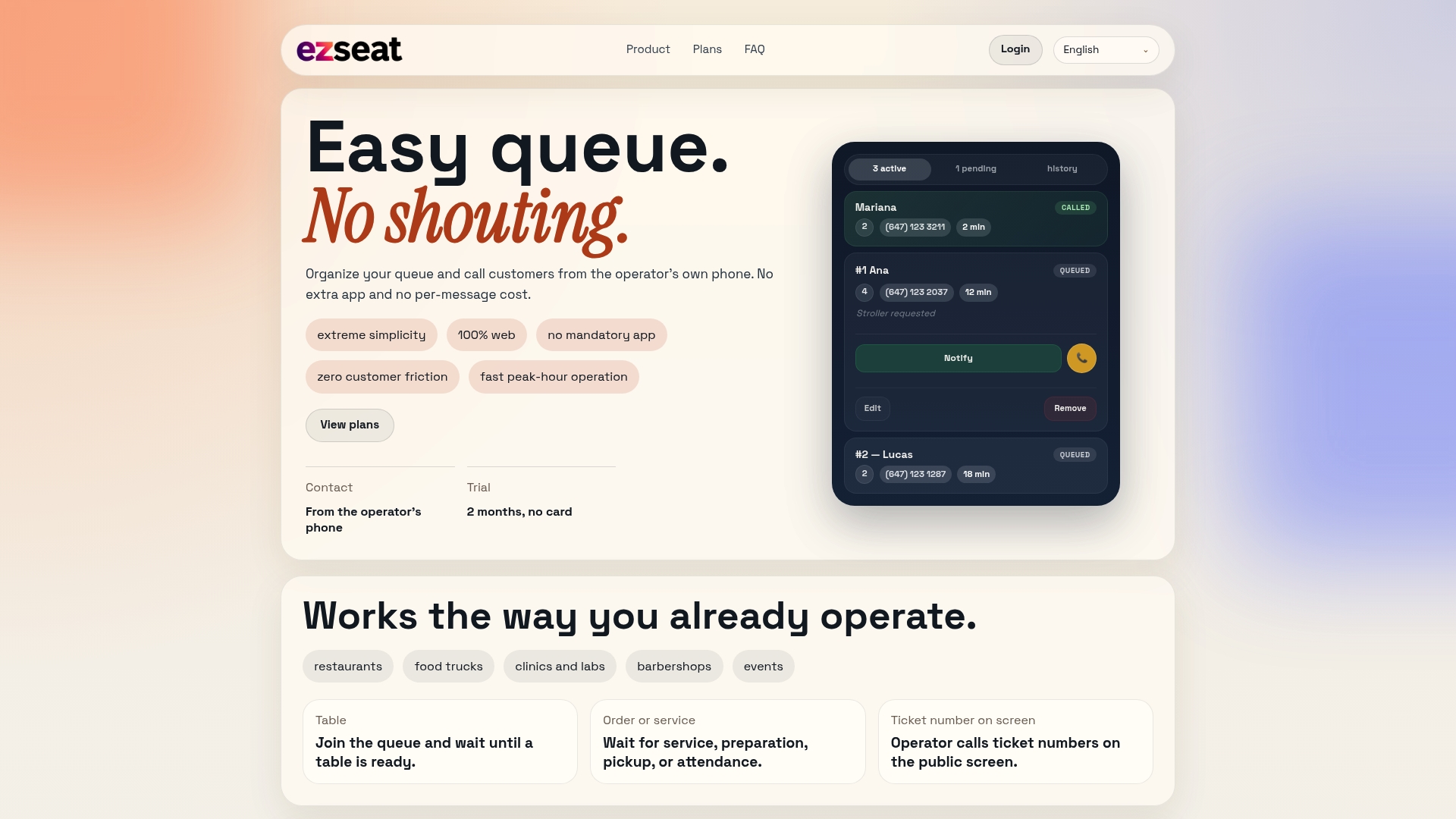
Match whatever you pick against the implementation checklist covered earlier: check-in and ticket scanning, real-time notifications, capacity controls, and integrations that keep your data in one place instead of scattered across three systems. A free trial is available to run an actual event through the system before deciding whether it fits your operation. Start the trial at the Ezseat landing page and get your queue tested before your next event's gates open.
Sources
- Queue management | Verint
- Controlling arbitrary Internet queues with Titrate — Zhou et al. (NSDI26)
- Intelligent Queue Management System using Optimization and Generative AI Models (conference paper, 2025)