
SMS queue notifications let a customer join a line from their phone and get a text when their spot is close, so they can wait wherever they want instead of standing in a lobby. That single shift changes behavior: people spend a significant amount of time daily on their smartphones, so a text lands fast and gets read. With mobile phone ownership is near-universal across age groups, SMS reaches nearly every customer without asking them to download anything, which is exactly how Ezseat's web-based check-in works.
Who should set this up, and what should they expect?
- Best fit: restaurants, clinics, retail counters, barbershops, event check-ins, and any business with an on-site wait.
- Expected outcome: fewer no-shows, calmer waiting areas, and customers who actually come back when paged instead of vanishing.
Key Takeaways
SMS queue notifications work because they replace uncertain, in-person waiting with a predictable text sequence that customers can trust and staff can automate.
| Point | Details |
|---|---|
| Core function | SMS queue notifications text customers at check-in, reminder, and paged moments to cut walkaways. |
| Five essential events | Added, reminder, paged, no-show, and requeued each need their own template and timing. |
| Delivery channel choice | Long number SMS suits most single-location queues; short codes fit high-volume chains. |
| Compliance basics | Include STOP/HELP language and document a re-opt-in process for blocked numbers. |
| Ezseat's approach | Ezseat offers web-based check-in with no app download, SMS alerts, and per-queue templates that scale with business size. |
Table of Contents
- What Is an SMS Queue Notification System?
- Why Walk-In Businesses Rely on Text Message Waitlists
- The Five Notification Events Every Queue System Needs
- How SMS Queue Alerts Run Behind the Scenes
- What to Look for When Choosing an SMS Queue System
- Staying Compliant With Opt-In and Opt-Out Rules
- What I've Learned Running Live Queues
- Set Up SMS Queue Notifications Without the App Download
- Frequently Asked Questions
- Sources
What Is an SMS Queue Notification System?
An SMS queue notification is a text message sent automatically as a customer moves through a queue, from the moment they join to the moment they're called. It's built on three working parts: a check-in method (a web link, kiosk, or phone entry), a queue engine that tracks position and estimated wait, and a notification engine that fires texts at defined trigger points.
The flow typically runs like this: a customer checks in through a browser or kiosk, gets added to the queue, receives a confirmation text with an estimated wait, then gets a reminder as their turn nears, and finally a "you're up" message. If they don't respond in time, the system can automatically remove or requeue them.
- Check-in: web link, kiosk screen, or staff-entered phone number
- Queue engine: tracks position and recalculates estimated wait as the line moves
- Notification engine: sends the actual SMS at each trigger point
- Customer action: reply to confirm, or simply show up when paged
Most platforms let you configure per-queue business hours, a custom greeting, and an after-hours auto-reply, along with dynamic wait-time variables like @{EWT_minutes} that pull a live estimate into the message text.
Pro Tip: Keep your after-hours message specific ("We reopen at 9 AM, text back then to join") rather than a generic "closed" reply. It cuts down on confused follow-up texts.
Why Walk-In Businesses Rely on Text Message Waitlists
The operational payoff is straightforward: customers who know their wait time and get a heads-up before their turn are far less likely to leave. That means fewer walkaways, more predictable staffing since you can see queue depth in real time, and a smoother handoff between front-of-house and back-of-house teams.
The customer side matters just as much. Nobody enjoys standing in a doorway watching a hostess stand. A text message waitlist lets people wait in their car, browse a nearby store, or just sit down somewhere comfortable, then walk back only when they're actually needed. Classic queuing research has long shown that uncertainty is what makes a wait feel unbearable, not the wait itself. Regular status updates remove that uncertainty, which is why a confirm-and-fill model, like the kind used in commercial waitlist rebooking flows, can refill a canceled slot in minutes by texting the next person in line until someone confirms.
Common use cases include:
- Restaurants and bars: waitlists during peak dinner hours, tracked against table turnover.
- Clinics and urgent care: patients wait off-site instead of in a crowded room, reducing perceived wait and exposure concerns.
- Retail and repair shops: customers get paged for fitting rooms or finished repairs, freeing up floor space.
- Government service counters: predictable queue position reduces frustration at DMV-style windows.
- Events and pop-ups: vendors manage line surges without needing extra staff to shout names.
The Five Notification Events Every Queue System Needs
Reliable systems build around five core moments in a customer's queue lifecycle. Each one needs its own message and its own timing logic, not a single generic "your turn" text.
| Event | Timing | Example message |
|---|---|---|
| Added | Immediately after check-in | "You're in line at Joe's Diner. Estimated wait: about 20 minutes. We'll text you when it's close." |
| Reminder | 1–2 positions before their turn | "You're almost up! About 5 minutes left. Please head back to the front." |
| Paged | When it's their turn | "It's your turn! Please come to the counter now." |
| No-show | After a set grace period with no reply/arrival | "We tried to reach you and had to move on. Reply JOIN to get back in line." |
| Requeued | When staff manually re-adds someone | "You've been added back to the queue at position 4." |
You don't need every event active on every queue. A fast-moving retail line might skip the reminder step entirely and just page, while a clinic with longer waits benefits from both.
Pro Tip: Keep messages under 160 characters where possible and always include a dynamic wait estimate rather than a static number. Long messages sometimes get split or flagged by carrier filters, which delays delivery right when timing matters most.
How SMS Queue Alerts Run Behind the Scenes
Once a customer checks in, the queue engine watches for state changes. When their position hits a threshold, or a staff member taps a "Page" button, the notification engine fires the matching text. No-shows and requeues are usually handled automatically after a set grace period, so staff aren't stuck manually tracking timers.

Delivery channel matters more than most operators realize going in. Standard SMS on a registered 10DLC or long number is the default for most small and mid-size operations. Short codes handle much higher message volume and look more polished, but they cost more and take longer to register. App push notifications avoid carrier issues entirely but require the customer to install something first, which defeats the purpose of a walk-in queue. WhatsApp and similar messaging platforms work well in regions where they dominate, but adoption varies heavily by country.
| Delivery type | Deliverability | Setup effort | Best fit |
|---|---|---|---|
| Long number SMS (10DLC) | Good, subject to carrier throughput limits | Low to moderate | Most single-location queues |
| Short code SMS | High volume, fast delivery | Higher, longer registration | High-traffic multi-location chains |
| App push | Depends on install rate | Low for sender, high for customer | Repeat customers with an existing app |
| WhatsApp/messaging apps | Strong where locally dominant | Moderate | Regions with high app-based messaging use |
For a closer look at the tradeoffs between short code and 10DLC sending, it's worth understanding registration overhead before committing to one path. Integration also matters: syncing with existing POS or CRM systems, feeding a public display screen for the paged event, and supporting kiosk check-in all depend on whether the platform exposes a real-time API or webhook, not just a dashboard.
What to Look for When Choosing an SMS Queue System
Not every provider handles the details that separate a smooth rollout from a frustrating one. Before signing up, confirm the system can handle these basics:
- Reliable delivery rates with visibility into failed or delayed messages
- Configurable notification events (added, reminder, paged, no-show, requeued)
- Per-queue business hours and custom message templates
- Built-in opt-in and opt-out handling, including STOP compliance
- Reporting on wait times, no-show rates, and message delivery success
- Integration options for POS, CRM, or public display screens
When you talk to a vendor, ask directly about their delivery rates, whether they use a short code or 10DLC number, how they handle opt-outs, and whether their platform supports dynamic wait-time variables in templates. Vague answers on any of these are a red flag.
A practical rollout usually follows this order:
- Define how customers will join: web link, kiosk, or QR code.
- Configure your queues, business hours, and message templates for each event.
- Test delivery end to end, including a real STOP reply.
- Train front-line staff on manual paging and requeue actions.
- Launch on a single queue or shift before rolling out everywhere.
Most small operations get a single queue live within a day or two of setup work. Pricing shapes vary, some platforms charge per message, others bundle messaging into a flat monthly plan, so it's worth running a short pilot before committing to a full rollout across every location.
Staying Compliant With Opt-In and Opt-Out Rules
Most walk-in queues rely on implicit opt-in: a customer who types their number into a check-in screen is agreeing to receive that one queue's texts. Healthcare settings and some regions require more explicit consent language, so check local rules before assuming implicit opt-in covers you.
Every message needs a clear path out. When someone replies STOP, carriers typically block that number from receiving further texts from your sender, so you need a documented process for re-opt-in if that customer wants back in later.
- Include HELP and STOP instructions in your first message to each customer.
- Avoid promotional language in service texts, stick to queue status only.
Pro Tip: Test a STOP reply yourself during your pilot phase and write down exactly what happens on both the customer and admin side. It's the one scenario operators forget to check before launch.
What I've Learned Running Live Queues
The hardest part isn't the technology, it's the volume of messages. Send too many reminders and customers get annoyed; send too few and they miss their turn. The sweet spot is usually one confirmation, one reminder, and one page, nothing more.
Staff will run into the same handful of issues: a customer's phone silently blocks the number, a carrier filters a message for looking too automated, or someone left an old template running from before a policy change. None of these are catastrophic. Run a short pilot during a slower shift, watch how customers actually respond, and adjust your wording from there rather than trying to perfect it on paper first.
Set Up SMS Queue Notifications Without the App Download
Ezseat runs the whole flow described above: customers check in through a browser, no app required, and get SMS updates as they move through the line. Staff manage everything from a phone or tablet, tapping to page the next customer instead of shouting across a lobby.
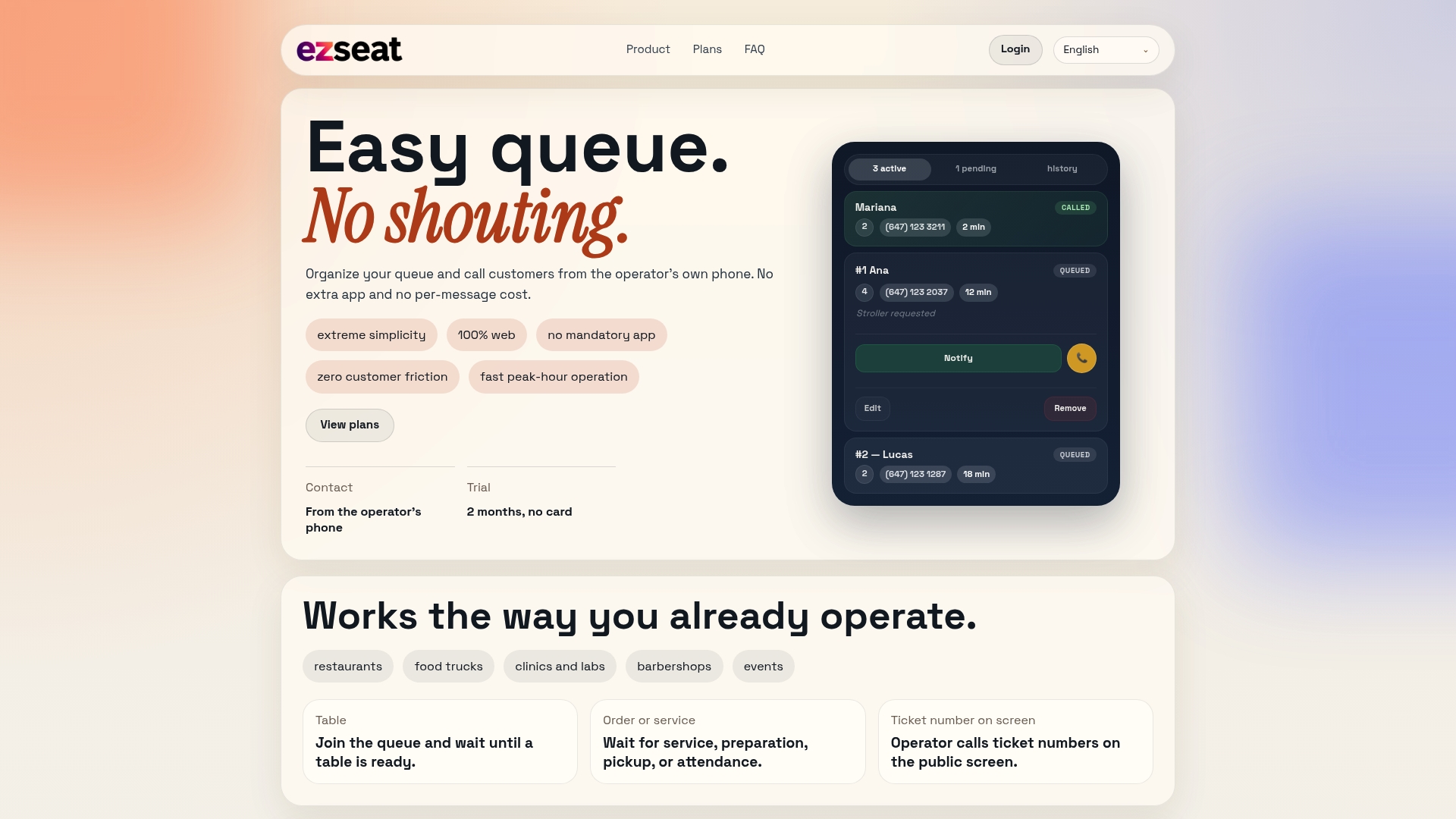
What that looks like in practice: per-queue templates you can edit in minutes, public display integration for busy waiting areas, kiosk check-in for walk-ups, and plans that scale from a single-location food truck to a multi-site clinic group. Setup takes hours, not weeks, since there's no app for customers to install and nothing for them to learn.
If you're running a walk-in business and tired of shouted names or a paper sign-in sheet, start with Ezseat's queue management platform and get your first queue live before your next shift.
Frequently Asked Questions
What is an SMS queue notification? It's an automated text sent to a customer as they move through a line, covering confirmation, reminders, and the final "you're up" alert.
How do I set up SMS queue alerts for my business? Choose a check-in method, configure your notification events and templates, test delivery including a STOP reply, then train staff before launching on one queue.
Do customers need to download an app for text message waitlists? No. Systems like Ezseat let customers join through a web browser or kiosk, and all updates arrive by standard text message.
What's the best SMS waitlist option for a small restaurant? A long number (10DLC) SMS setup with added, reminder, and paged events covers most restaurant needs without the cost of a short code.

How do opt-out requests work with SMS queue systems? When a customer texts STOP, carriers block further messages to that number, so you need a clear, documented process for them to opt back in later.
Sources
- SMS messaging and queue settings | Google Cloud Documentation
- Mobile fact sheet | Pew Research Center
- Average time spent per day on smartphone in the United States
- Report: 2020 annual survey highlights | CTIA