
The fastest, lowest-friction way to run a waitlist without an app is a browser-first system guests join by scanning a QR code or tapping a hosted link, managed from a simple staff dashboard. It works because nobody downloads anything, waits for an app-store install, or creates an account. If you run a restaurant, clinic, or service business, the next move is simple: set up a QR-hosted queue page today, or visit Ezseat and get one running before your next rush.
TL;DR:
- QR codes and hosted landing pages are the fastest ways to deploy a no-app waitlist, suitable for small to mid-sized venues with quick setup needs.
- The ideal system minimizes guest friction by requiring no download, one-tap join, and optional phone number collection, with real-time staff updates across devices.
- SMS notifications serve as a reliable fallback for guests who walk away or lose signal, but providers may charge extra per message, impacting costs.
- Setting up involves customizing a simple form, printing durable QR codes, locking kiosks into kiosk mode, and testing during quiet shifts to avoid guest complaints during busy times.
- Ongoing operations require routine device charging, Wi-Fi testing, clear host scripts, and tracking key metrics like wait time, walkaway rate, and seating efficiency for continuous improvement.
Table of Contents
- What Does a No-App Waitlist Actually Look Like?
- What Should Owners Actually Look for in a Waitlist Tool?
- How Do You Set Up a No-App Waitlist Step by Step?
- What Should Your Team Do Every Day and When Things Go Wrong?
- What Does a No-App Waitlist Cost?
- How Ezseat Approaches No-App Queue Management
- The First 30 Days: What to Expect and Where Owners Trip Up
- Start Your No-App Waitlist Trial Today
- Where These Recommendations Came From
- Sources
What Does a No-App Waitlist Actually Look Like?
Before comparing setups, it helps to name the standard term for what you're building: a "browser-based" or "hosted" queue system, sometimes called a virtual queue. That's the industry phrase for any waitlist a guest joins through a web page instead of a native app. "No app waitlist" describes the same thing from the owner's point of view, and both terms show up throughout this guide.
Four approaches dominate how restaurants and service businesses solve this today, and picking the right one depends on your volume, your staff, and how much branding control you want.
- Browser plus QR code. A guest scans a code on the door, types their name and party size into a web form, and gets a text or on-screen update. This is the fastest option to deploy and fits pop-ups, food trucks, and small to mid-size restaurants that need something running in an afternoon, not a week.
- Kiosk check-in. A tablet mounted at the host stand or reception desk runs in a locked kiosk mode so guests check themselves in without staff typing anything. This suits venues with predictable peak times (Friday dinner rush, Saturday morning walk-ins) where a host can't greet everyone the second they arrive.
- Hosted landing page with a staff dashboard. Instead of a bare form, you get a branded page under your own name or subdomain, paired with a dashboard staff use to manage the queue across multiple devices. Hosted queue pages that require no signup are increasingly common precisely because they let a guest join in seconds, and they suit higher-volume operations that want the queue to look and feel like part of their own brand.
- SMS fallback. For guests who'd rather text than open a browser, an SMS option keeps the same no-download promise. Be upfront about cost here. Text messages route through short codes or 10DLC numbers, and per-message fees add up fast if you're texting hundreds of parties a weekend, so understand the SMS pricing model before you lean on it as a primary channel.
Match the method to your reality, not the flashiest option. A single-location taco counter with three staff on a busy night needs QR plus SMS fallback. A multi-location group with dedicated hosts and a marketing team benefits more from a hosted, branded landing page. Kiosk mode earns its keep specifically when foot traffic outpaces your ability to greet each party individually.
What Should Owners Actually Look for in a Waitlist Tool?
Strip away the marketing copy and every no-app waitlist gets judged on the same handful of outcomes. Get these right and the rest is decoration.
Guest friction is the first test. Joining should take one tap and under 30 seconds, with no download and no account creation, because that speed is exactly what keeps walk-in guests from abandoning the line before they even join it. The form itself should ask for name, party size, and an ETA estimate, with phone number optional rather than mandatory. Every extra required field is a guest who decides it's not worth the trouble.

Staff efficiency matters just as much. Your host or receptionist needs to seat, claim, or bump a party in one tap, and if you're running multiple devices (a host stand tablet plus a manager's phone), those devices need to sync in real time. Nobody should be seating the same table twice because two screens showed different information. An audit trail helps too. When a guest complains about wait time, you want a timestamp showing exactly when they joined and when they were sat.
Notifications need a fallback. In-browser push works fine when a guest keeps the page open, but people walk away, lock their phones, or lose signal. SMS as backup keeps them informed without requiring your app.
On data, collect the minimum you need and nothing more. Exportable guest lists help with marketing follow-up, but every additional required field is friction you're adding to save yourself a report you'll rarely run.
Finally, ask what happens when Wi-Fi drops or your dashboard glitches mid-rush. A no-app system still needs an offline fallback, whether that's a paper backup sheet or a manager's ability to reset the queue fast.
Pro Tip: Before you commit to any setup, walk through the guest side yourself on your own phone, using your restaurant's actual Wi-Fi signal strength at the host stand. If it takes you more than 30 seconds to join your own waitlist, your guests will feel it too.
How Do You Set Up a No-App Waitlist Step by Step?
Each method below can be running within a single shift if you follow the sequence in order.
- Build your hosted queue page. Set the visible fields to name, party size, and an optional phone number. Skip anything you don't need for seating; every extra field costs you completed sign-ups.
- Generate and place your QR code. Print it large enough to scan from three feet away and laminate it for the host stand, front window, and any outdoor waiting area. Add the same link to your Instagram bio and Google Business profile so guests can join before they even walk in.
- Configure kiosk devices, if you're using one. Lock the tablet into kiosk or single-app browser mode so guests can't back out into settings or another app. Post clear signage next to it: "Tap here to check in," with an arrow, works better than a paragraph of instructions.
- Set up staff accounts and dashboard workflows. Each staff member managing the queue needs their own login so actions tie back to a name. Walk the team through the four core actions: accept a new party, mark them ready, seat them, and handle a no-show. If you run multiple stations (host stand and a back kitchen screen), confirm updates sync across both instantly, since Ezseat's multi-queue and multi-device support exists exactly for this kind of setup.
- Configure SMS and notification settings. Write clear opt-in language ("Reply STOP to opt out") and keep verification steps minimal. Know your per-message cost before your first busy weekend, not after the bill arrives.
- Pilot during a slow shift first. Running a new system for the first time on a Saturday night is how small bugs become guest complaints. Testing during a quieter shift lets you catch friction points, like a confusing form field or a QR code placed where nobody looks, before real volume hits.
Pro Tip: Run your pilot shift with a notepad next to the host stand. Every time a guest asks the host "wait, how do I do this?", write down exactly what confused them. That list becomes your signage fix for week two.
What Should Your Team Do Every Day and When Things Go Wrong?
A system is only as good as the routine around it. Build these into your pre-shift checklist and every shift runs the same way, no matter who's hosting.
- Charge tablets and phones fully before doors open, and test Wi-Fi strength at the actual host stand location, not just in the back office.
- Keep a laminated backup QR code on hand in case the primary sign gets damaged or walked off with.
- Confirm every staff member working the floor has an active login before the first guest arrives.
For host scripts, keep the language short and consistent. On join, something like "You're in, we'll text you around 20 minutes" sets expectations immediately. If a party arrives early, "We're not quite there yet, but you're next up" keeps them from feeling forgotten. If they arrive late after being called, a two-to-five minute grace period before reassigning the table avoids both an empty seat and an angry no-show.
Your walkaway policy should be written down, not improvised. Give a clear grace period, reassign promptly once it passes, and follow up with a quick text if a guest disappears without canceling. Track three numbers weekly: average wait time, walkaway rate, and seating rate. These three tell you more about whether your setup works than any anecdote from a busy Friday.
On privacy, collect only what you need to seat someone, and publish plain opt-out language for texts. Guests trust a system more when it's obvious what happens to their phone number.
What Does a No-App Waitlist Cost?
Pricing in this category splits into three shapes, and the right one depends less on your budget and more on how often you'll use it.
- Free tiers typically cap you on party volume, remove your branding in favor of the provider's, or limit data export. Fine for testing the concept, but restrictive the moment you scale past a soft launch.
- One-time payment models suit short-term needs. Some providers offer a free core product with a one-time paid upgrade instead of a recurring bill, which fits a seasonal pop-up, a single event, or a launch weekend where a monthly subscription doesn't make sense.
- Monthly subscriptions earn their keep once you're running a queue every service, need multi-device sync, ongoing support, and features like exportable guest lists or multi-queue management across locations.
Whichever model you pick, watch for the line items that don't show up in the headline price: per-message SMS fees, extra charges for additional devices, or a surcharge to remove the provider's branding from your guest-facing page.
Run a quick back-of-envelope ROI check before you decide. If a no-app waitlist recovers even a handful of walkaways per weekend, and your average check runs $35, that's real revenue reclaimed monthly, often more than the subscription itself costs. Reducing guest drop-off at the point of joining is where most of that recovery actually happens, since a guest who never joins the queue was never coming back anyway.
How Ezseat Approaches No-App Queue Management
Ezseat was built around the exact framework above: guests join through a browser, no download required, and staff manage the flow from a phone or tablet without extra hardware. The feature set lines up with what actually matters for owners, not what looks good in a demo.
- Browser-based join via QR code or hosted link, with no signup required from the guest.
- Kiosk mode support for unattended host stands, with device settings and signage guidance.
- Multi-queue and multi-device syncing so a host stand and a back-of-house screen show the same real-time picture.
- SMS notification support for guests who prefer a text over refreshing a browser tab.
For the mechanics of getting a QR-hosted queue running, Ezseat's own QR code waitlist setup guide walks through code placement, which fields to collect, and how to onboard staff without a training day. The kiosk check-in documentation covers device lockdown settings and the manual fallback every kiosk needs for the moment it glitches mid-rush.
A kiosk without a staff fallback isn't a kiosk, it's a single point of failure standing at your front door. Pair every unattended check-in device with a quick manual override so one frozen screen never becomes a fifteen-minute bottleneck.
For deeper setup walkthroughs and case examples, the Ezseat blog covers more scenarios than fit in one guide.
The First 30 Days: What to Expect and Where Owners Trip Up
Browser-first waitlists reduce friction for one plain reason: guests do something they already know how to do (scan a code, tap a link) instead of learning something new. That's the whole advantage, and it's why over-engineering the guest form is the most common mistake we see. Every added field is a guest who almost didn't bother.

The second mistake is QR placement. A code taped below eye level, or on a door guests walk past before they even look for a host, gets ignored no matter how well the underlying system works.
Expect your first month to be about tuning, not perfection. Watch walkaway rate and average wait against your pre-launch baseline, and test changes during a slow Tuesday before touching anything on a Friday.
— Ezseat
Start Your No-App Waitlist Trial Today
Ezseat gives you browser-based guest join, QR code setup, kiosk mode, and multi-queue management, all without asking a single guest to download anything. If the setup steps above sound right for your restaurant, clinic, or service counter, the fastest way to see them work is to try them on your own floor. Ezseat runs a free two-month trial before you commit to anything, so you can pilot it through a real weekend rush before choosing between the Light or Pro plan.
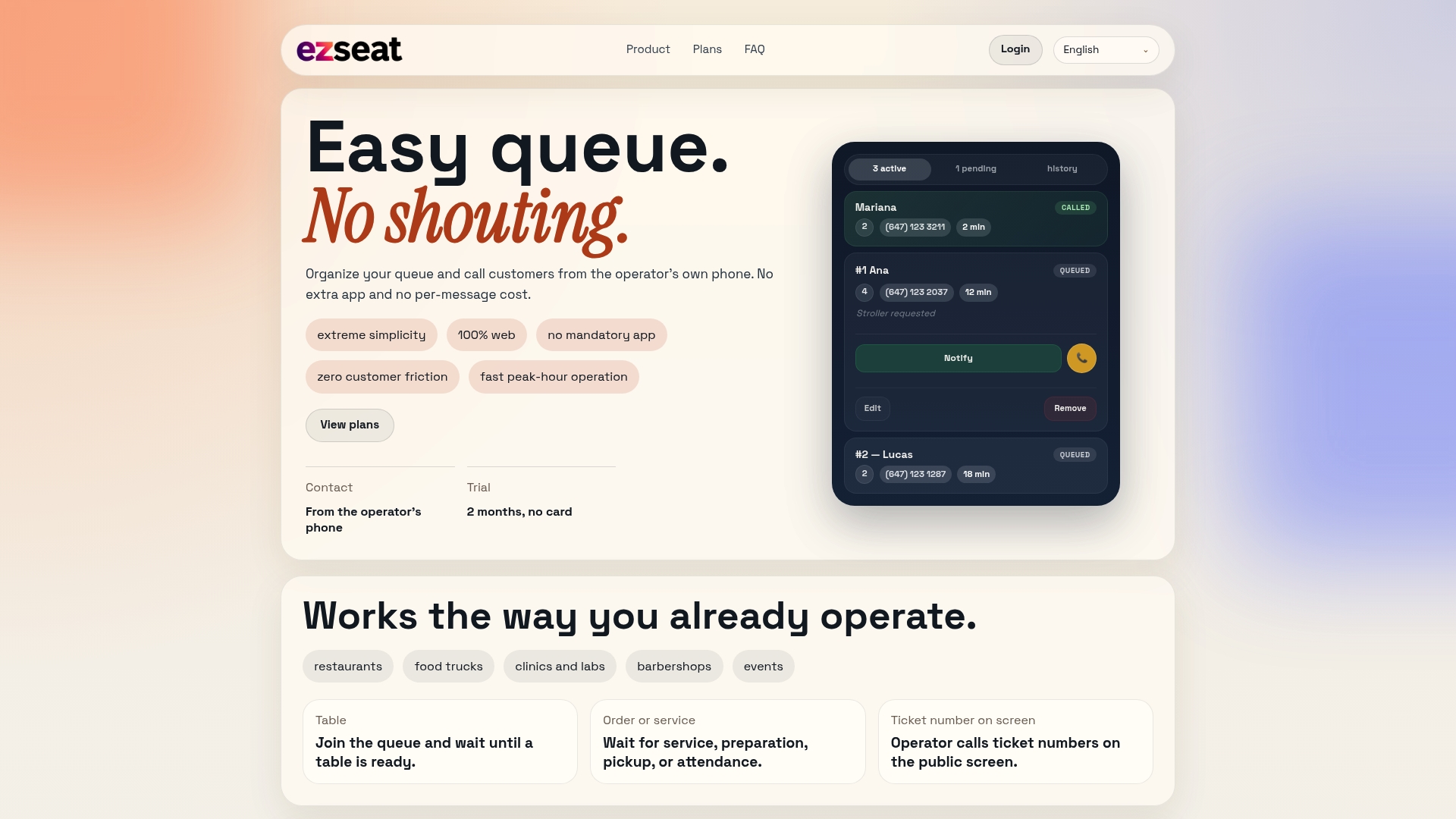
There's no long contract to sign just to find out if a browser-first queue fits your operation. Head to Ezseat to start your trial, generate your first QR code, and have a working no-app waitlist in place before your next shift.
Where These Recommendations Came From
This guide draws on hosted queue examples from Simply Online's virtual queue tool, pricing models from providers like Waitspot, and no-code setup guidance from SaaS Launchpad's roundup of alternatives. For hosted-page use cases beyond restaurants, see how event and launch pages apply the same no-download principle. Ezseat's own QR setup guide and kiosk documentation cover the step-by-step implementation details in full.
Sources
- Free Virtual Queue - No Signup Required | Simply Online
- Waitspot — Launch your waitlist in 60 seconds