
The best outdoor queue management approach in 2026 is app-free and browser-based: customers join by scanning a QR code or tapping a link, and operators run the line from a phone or tablet. Ezseat is built around exactly that model. The payoff is concrete: less crowding at the entrance, waits customers can actually predict, and far fewer arguments about who was next.
TL;DR:
- A browser-based queue system works outdoors by using QR codes or tap links, managing the line from phones or tablets without app downloads.
- Critical features include multi-device operator management, push and SMS notifications, offline caching, and a public display option for customers without smartphones.
- Proper outdoor deployment requires testing Wi-Fi, provisioning cellular backup, fully charging devices, and creating clear runbooks for contingencies.
- Effective no-show mitigation relies on setting clear expectations, automating reminders, and controlling call cadence during peak times.
- Key metrics for measuring success are average wait time, no-show rate, throughput, and join-to-serve time, informing staffing and procedural adjustments.
Table of Contents
- What Is App-Free Outdoor Queue Management, and Why Does It Fit Outdoor Venues?
- What Features Should You Require From an Outdoor Queueing Solution?
- How Do You Set Up an Outdoor Queue Deployment?
- How Do You Cut No-Shows and Keep an Outdoor Line Moving?
- Which Metrics Actually Prove Outdoor Queue Efficiency Is Working?
- What Should Pricing Look Like for a Single Site vs. Multiple Locations?
- How Do You Choose and Launch This Week?
- Ezseat's Field Notes on Outdoor Deployments
- Start an Outdoor Queue Pilot With Ezseat This Week
- Sources
What Is App-Free Outdoor Queue Management, and Why Does It Fit Outdoor Venues?
App-free outdoor queue management means the entire line lives in a browser. A customer scans a code or taps a short link, gets a spot in line, and watches their position update on their own phone. No download, no account, no friction. On the operator side, a single cockpit screen lets staff call the next name, mark no-shows, and add walk-ins manually, all from a device already in their pocket.
This matters more outdoors than indoors. A restaurant patio, a food truck at a festival, a pop-up clinic in a parking lot: none of these have a fixed indoor lobby where a paper sign-up sheet or a numbered ticket dispenser makes sense. People wander, the weather changes plans, and demand spikes without warning. A browser-based system travels with the business instead of being bolted to a wall.
Outdoor venues also face constraints indoor queues rarely deal with:
- Spotty or shared Wi-Fi that degrades the moment a crowd gathers near the router
- Sudden demand spikes, like a lunch rush or a festival gate opening all at once
- Customers without a place to sit or wait comfortably, who need to roam and still keep their spot
- No fixed signage location, since pop-ups and food trucks relocate by the day or the hour
A system built for this has to assume the network will wobble and the crowd will surge, then keep working anyway.
What Features Should You Require From an Outdoor Queueing Solution?
Not every queue tool built for a retail counter will survive a food truck line in July. Before you commit to any platform, run this checklist:
- Browser-only customer join. QR code, short URL, or tap-to-join, with zero app downloads required.
- Mobile call-next for operators. Staff should manage the whole queue from a phone, including manual entry for customers who can't scan anything.
- Multi-device operator cockpit. More than one staff member can call, recall, or reassign customers at once during peak hours.
- Push notifications with SMS fallback. A browser-only queue architecture that pairs push alerts with SMS backup catches customers who closed the browser tab, which happens constantly outdoors.
- Configurable recall and grace windows. You decide how long a called customer has before their spot opens up.
- A public display or kiosk option. Not every customer outdoors has a smartphone charged and in hand; a screen or printed QR stand covers that gap.
- Offline caching and cellular backup. The system should keep functioning through a Wi-Fi dropout, not just crash.
- Wait time, no-show, and throughput analytics. Configurable, controlled flow only helps if you can measure whether it's working.
Pro Tip: Ask any vendor for a live demo on a phone with the Wi-Fi turned off. If the operator side breaks, that's your answer about outdoor readiness.
How Do You Set Up an Outdoor Queue Deployment?
Outdoor deployment is less about software settings and more about physical logistics. Get the hardware and connectivity right first, and the software mostly takes care of itself.
Before the shift starts:
- Test the venue's Wi-Fi under load, not just when it's empty. If it's shaky, plan on it failing.
- Provision a 4G or 5G hotspot as backup. Event and pop-up deployments should assume weak venue Wi-Fi and build cellular redundancy into the plan from day one, not as an afterthought after the first outage (source).
- Charge every device fully, and bring a portable battery pack for anything running more than four hours.
Hardware kit for a single outdoor site:
- One operator phone or tablet for calling and managing the queue
- One display tablet, TV, or printed QR stand for customers to check in and see their position
- A charging setup or battery bank for both
- Printed QR signage as a backup if the display screen ever goes dark
For customers who can't or won't scan a code, train one staff member to add walk-ins manually from the operator device. Set your notification policy before service starts, not during it. A short recall window is a reasonable starting point: long enough for someone to walk back from their car, short enough that the line keeps moving.
Write down a one-page runbook: who switches to cellular backup if Wi-Fi drops, who manually re-enters customers if a device dies, and who owns the printed signage as a fallback. A simple hardware kit paired with a short runbook is what actually lets a small team deploy this reliably at a temporary site, not the software's feature list.
How Do You Cut No-Shows and Keep an Outdoor Line Moving?
No-shows are the single biggest threat to a smooth outdoor queue, and most of the fix is procedural, not technical.
- Set expectations at the moment of joining. Tell customers their estimated wait and any party-size rules up front, so nobody joins expecting something the line can't deliver.
- Automate the reminder, then give a real recall window. A short grace period, somewhere in the range operators typically test, gives a called customer time to walk back before their slot opens to someone else.
- Give staff four simple controls. Call next, mark served, mark no-show, pause new joins. That's the entire operator vocabulary needed during a rush.
- Cap the virtual queue during true peaks. If the wait stretches past what's reasonable, stop new joins temporarily rather than letting expectations collapse.
- Dedicate one device to calling during rushes. Splitting that job across three phones creates duplicate calls and confused customers.
Pro Tip: Stagger your call cadence during peak minutes instead of calling three names back to back. It gives each customer a real chance to hear the alert and walk over before you mark them a no-show.
Operators consistently underestimate how often virtual queue slots get abandoned. A configurable grace period combined with a timely status update recovers most of those slots without frustrating the people still waiting behind them.

Which Metrics Actually Prove Outdoor Queue Efficiency Is Working?
Four numbers tell you almost everything about whether your setup is working:
- Average wait time, tracked separately for lunch rush, dinner rush, or event peak, since one blended number hides the real problem hours.
- No-show rate, the clearest signal that your recall window or notification timing needs adjusting.
- Throughput, or customers served per hour, which tells you if staffing matches demand.
- Join-to-serve time and abandonment rate during peak, which flags whether people are giving up before they're even called.
Combining join rate, served rate, and no-show rate turns a gut feeling into a staffing decision. If no-shows spike between 1 and 2 p.m. every day, that's not bad luck. That's a scheduling problem you can fix with one look at the dashboard.
What Should Pricing Look Like for a Single Site vs. Multiple Locations?
Before you sign anything, get clear answers on four things:
- Trial length and cost for your busiest window. A free trial or a low-cost pilot during peak hours tells you more than any sales pitch.
- Per-location vs. multi-location licensing. If you run more than one truck, clinic, or storefront, ask whether analytics roll up into one dashboard or stay siloed per site.
- Variable costs. SMS notifications are often billed per message, and public display features sometimes carry a separate license. Get these numbers in writing.
- Room to scale. Ask specifically whether you can add a second location or a second queue type without renegotiating the whole contract.
A multi-site queue management platform is one example of how vendors structure tiered plans for operators managing more than one venue, which is worth comparing against whatever quote you're handed.
How Do You Choose and Launch This Week?
You don't need a month of planning to get this running. Here's the realistic timeline:
- Day 1: Confirm your expected peak size and connectivity constraints for the site.
- Day 2: Run a one-day pilot with printed QR signage and a single operator device. Nothing else.
- Day 2, same day: Configure notifications with a roughly 90-second recall policy, and give staff a five-minute walkthrough.
- Day 3: Pull the metrics from day one. Adjust your call cadence and grace period based on what actually happened, not what you assumed would happen.
- Day 4 and beyond: Once the pilot hits your goals, add the public display screen and permanent signage, then repeat the process at your next location.
Ezseat's Field Notes on Outdoor Deployments
Every outdoor rollout we've studied breaks the same way when it breaks: Wi-Fi holds up fine at 11 a.m. and buckles the moment a real crowd shows up. Provision cellular backup before day one, not after the first outage. It's the cheapest insurance you'll buy all season.

No-show mitigation isn't a technology problem, it's a policy problem. A recall window with two-stage alerts, push then SMS, catches the customers who wandered off and closed their browser tab. Skip that step and you'll blame the software for what's actually a settings gap.
The single fastest fix we keep seeing work: one visible QR code plus one operator phone eliminates entrance clustering within a single busy shift. For the deeper mechanics, our queue display screen guide, phone queue management breakdown, and food truck queue strategies all walk through specifics we couldn't fit here.
— Ezseat
Start an Outdoor Queue Pilot With Ezseat This Week
Ezseat is the app-free alternative to hardware ticket dispensers and downloadable queue apps: customers join from a browser, no install required, and you run the whole line from a phone or tablet. That means no app-store friction for your customers and no separate kiosk hardware to maintain outdoors.
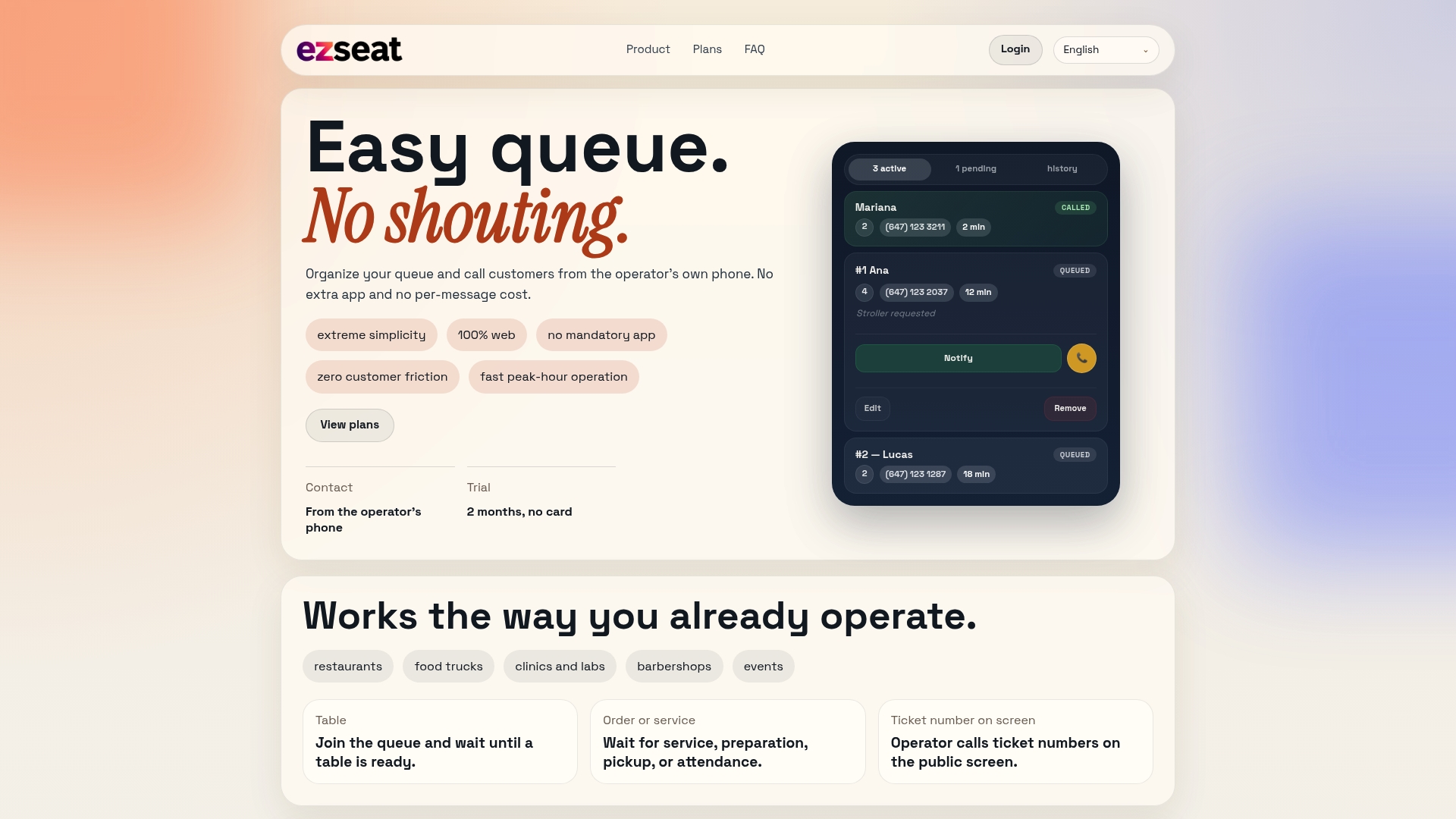
The platform includes an operator cockpit for calling and recalling customers and optional public display support for your storefront or truck window, with plans that can scale as you add locations or queue types. Check the provider's site for details about trials and pricing to find an option that fits your needs.
Set up your QR code join page and start your trial at Ezseat to see how it handles your next busy day.
Sources
- Virtual Queuing for Events & Pop-Ups | Zeour Ltd
- Nishanth7m/Queue-Craft
- Online Queue Systems: Everything You Need to Know