
Multi-queue management is the practice of running multiple simultaneous service lines, each with its own routing rules, staff assignments, and customer flow, so that different service types are handled in parallel rather than funneled through a single line. If you're choosing a system today, start with a web-based platform that requires no customer app download, supports multiple queues from one dashboard, and offers a free trial long enough to validate real-world performance. Ezseat fits that description and is covered in detail below.
Key Takeaways
Multi-queue management works when routing rules match customer demand to the right counter, staff are trained on handovers, and KPIs are reviewed regularly rather than set and forgotten.
| Point | Details |
|---|---|
| Define your queues before setup | Map every service type and its average duration before configuring routing rules. |
| Web-based join reduces abandonment | Browser-based queue entry removes the app-download barrier that causes customers to leave before joining. |
| Track three KPIs first | Average wait time, abandonment rate, and staff call time tell you whether routing is working before you add complexity. |
| Pilot before full rollout | A 1–2 week single-location pilot surfaces routing gaps and peak-load issues that pre-launch planning misses. |
| Ezseat fits small and mid-size venues | Ezseat's no-app web join, multi-queue dashboard, and two-month free trial make it a practical starting point for operators. |
Table of Contents
- How multi-queue systems actually work
- What business owners actually gain from parallel queues
- How to implement a multi-queue system step by step
- What to look for when choosing a multi-queue system
- Hardware options and integrations you need to plan for
- KPIs and reporting: how to know your system is working
- Common use cases and short industry examples
- Typical costs and realistic deployment timelines
- Why Ezseat is a practical fit for multi-queue management
- What operators get wrong about managing multiple queues
- Ezseat makes it easy to run your first multi-queue pilot
- Sources
How multi-queue systems actually work
At its core, a multi-queue system separates customer demand into distinct channels, each governed by its own rules. Think of a clinic that needs one queue for walk-in triage, a second for scheduled appointments, and a third for prescription pickups. A single-queue setup forces all three into one line, creating bottlenecks and frustrating patients who only need 90 seconds at the pharmacy counter. Multi-queue management solves that by routing each customer to the right channel from the moment they arrive.

Core features to expect
A production-ready system typically includes:
- Kiosk and printed ticketing: Physical or tablet-based check-in that prints or displays a ticket number, with no smartphone required for the customer.
- Web and mobile join: Customers scan a QR code and join via a browser, no app install needed. This removes the single biggest friction point in digital queuing.
- Multiple simultaneous queues: Each service type runs independently, with its own counter assignments, capacity limits, and wait-time estimates.
- Appointment scheduling integration: Pre-booked slots merge with walk-in queues so staff see a unified view of upcoming demand.
- Counter and staff panels: Each agent sees only their assigned queue, reducing cognitive load and call errors.
- Digital display screens: Public-facing screens show ticket numbers being called, reducing the need for staff to shout or walk the floor.
- SMS and email notifications: Customers receive an estimated wait time and a call notification, letting them wait off-site.
- API and webhooks: Events like "customer joined," "ticket called," or "queue abandoned" fire to external systems, enabling POS sync, CRM updates, and custom analytics.
Routing logic and scheduling
Routing is where multi-queue systems earn their keep. The most common patterns are service-type routing (customer selects a service category at check-in and is placed in the matching queue), priority lanes (VIP or fast-track customers skip ahead within a queue), and skill-based routing (the system assigns the customer to the next available agent who holds a specific qualification). Round-robin assignment distributes customers evenly across counters; capacity-aware assignment sends the next customer to whichever counter has the shortest projected wait.

Overflow queues handle the scenario where a primary queue exceeds a threshold. Rather than turning customers away, the system holds them in a virtual waiting room and pulls them forward as capacity opens. Research on parallel queue fairness confirms that naive parallelization can introduce unfairness unless the scheduler exposes throttling and prioritization controls, which is why vendor-configurable priority rules matter more than raw queue count.
For multi-site or multi-location operations, a manager/worker dispatch model simplifies central coordination while letting each location enforce its own admission and capacity rules. The MultiKueue dispatching model illustrates this pattern well: a manager cluster coordinates worker clusters using either AllAtOnce or Incremental dispatch modes, and each worker site retains local admission authority.
One technical consideration worth flagging: when jobs split across parallel queues and must rejoin before completion (a fork-join pattern), synchronization challenges can increase waiting time beyond what independent-server models predict. For service businesses, this translates to a practical rule: avoid designs where a customer must complete steps in two separate queues before receiving their final service. Keep each queue self-contained where possible.
Pro Tip: Bundle all services under two minutes into a dedicated express lane. Customers with quick needs clear faster, your main queue shortens, and staff at the primary counter spend more time on complex cases.
What business owners actually gain from parallel queues
The benefits of running parallel queues are concrete and measurable, not just theoretical.
Lower perceived wait time. Customers in a moving queue feel they are waiting less than customers in a static one, even when the clock time is identical. Separating service types means each queue moves at a pace appropriate to that service, so customers see progress rather than a frozen line.
Higher throughput. A restaurant running a single waitlist for both dine-in and takeout creates artificial bottlenecks. Splitting into two queues lets the kitchen and front-of-house serve both channels simultaneously. The same logic applies to a retail store running returns and checkout as separate lanes.
Better staff utilization. When routing rules match customer demand to the right counter, agents spend less time redirecting customers and more time delivering service. A barbershop with three chairs and one queue often has one barber idle while another has a three-person backlog. Capacity-aware routing corrects that imbalance automatically.

Fewer walkaways. Customers who can see their position in a queue and receive an SMS when they are next are far less likely to leave. Abandonment typically spikes when customers have no information about their wait. Visible queue status and proactive notifications address both causes.
Stronger peak-day performance. A single-queue system degrades linearly as volume increases. A multi-queue system with overflow routing and priority lanes can absorb demand spikes without the experience collapsing. That resilience directly protects revenue on your busiest days.
The intangible benefits compound over time. Customers who had a smooth, informed wait are more likely to return and more likely to recommend the venue. Staff who aren't managing crowd chaos perform better and stay longer.
Stat note: Ezseat operators report measurable reductions in customer walkaway rates after switching from manual name-calling to SMS-notified queue management. Specific figures vary by venue type and volume; request current performance data directly from Ezseat.
How to implement a multi-queue system step by step
A phased rollout reduces risk and gives you real data before you commit to full configuration.
- Map your services and service times. List every service type, its average duration, and its peak demand window. This determines how many queues you need and which counters to assign to each.
- Identify your busiest counters. Start the pilot at the location or counter with the highest volume. Success there is the most convincing proof point for the rest of your team.
- Prepare hardware and accounts. Set up display screens, kiosk tablets, and staff accounts before go-live. Assign each staff member to their queue. Configure notification channels (SMS sender ID, email template) and test delivery.
- Run an ADA and accessibility check. Confirm that kiosk height, font size on displays, and audio cues meet ADA requirements. For web join, verify that the browser-based flow works with screen readers.
- Complete a data privacy review. Under CCPA and general U.S. data handling best practices, confirm what customer data the system collects (phone number, service type, timestamp), where it is stored, how long it is retained, and whether customers can request deletion.
- Run a mock pilot. Walk five to ten mock customers through every queue path. Test kiosk join, web join, SMS delivery, counter call, and display update. Identify any routing gaps before real customers arrive.
- Go live on a limited scope. Run the pilot for one to two weeks at the target counter. Track abandonment rate, average wait time, and staff call time daily.
- Measure pilot KPIs and decide on rollout. If abandonment drops and wait time holds steady or improves, expand to additional counters. If a queue is consistently empty or overloaded, adjust routing rules before scaling.
- Train staff on shift handover. Each shift should start with a 60-second review of current queue states. Staff need to know how to transfer a ticket, how to pause a queue, and who to contact if the system has an issue.
- Schedule a 30-day post-launch review. Pull the first month's KPI report, collect staff feedback, and tune routing rules. Set a calendar reminder for a 90-day review to catch seasonal patterns.
Pro Tip: For the pilot, track just three KPIs: average wait time, abandonment rate, and staff call time. Those three numbers tell you whether the routing is working before you add complexity.
The implementation owner is typically the operations manager or venue manager for configuration and staff training, with IT or the vendor's support team handling hardware setup and integrations. Most cloud-based systems require no on-site IT infrastructure beyond a stable Wi-Fi connection and a display screen.
What to look for when choosing a multi-queue system
Not all queue management tools are built for the same use case. Here is a prioritized checklist for evaluating options.
Must-have criteria:
- Multi-queue and multi-device support from a single dashboard
- Flexible routing rules (service type, priority, skill-based, overflow)
- Web-based customer join with no app required
- Kiosk and public display screen support
- Reporting on wait time, abandonment, throughput, and staff utilization
- SMS and email notification with customizable templates
- API or webhook access for integrations
- ADA-compliant customer-facing interfaces
- Clear data retention and deletion controls (CCPA-ready)
- Transparent pricing with no hidden per-ticket fees
Red flags to watch for:
- No API or webhook access (locks you out of custom integrations and analytics)
- Abandonment rate not tracked or not exportable
- Opaque pricing that changes with SMS volume or queue count without warning
- No accessibility documentation or ADA compliance statement
- Data stored indefinitely with no customer deletion option
- Vendor requires a multi-year contract before you can run a pilot
A web-first, no-app approach is particularly well-suited to small and mid-size venues. Customers at a food truck or barbershop are unlikely to download a dedicated app for a single visit. Browser-based join removes that barrier entirely, which directly reduces abandonment at the point of entry.
Hardware options and integrations you need to plan for
The hardware footprint for a multi-queue setup can be as minimal as a tablet and a TV, or as extensive as a full kiosk enclosure with a thermal ticket printer. Here is a practical breakdown.
Hardware options
- Public display screens: Any HDMI-capable TV or commercial display works. Mount at eye level near the service counter. For multi-counter setups, one screen per zone reduces customer confusion.
- Reception kiosks and tablets: An iPad or Android tablet in a floor stand or counter mount serves as the check-in point. Ruggedized enclosures are worth the cost in high-traffic venues.
- Thermal ticket printers: Useful when customers are not comfortable with digital-only confirmation. Most queue platforms support standard ESC/POS thermal printers via USB or Bluetooth.
- Staff tablets: Each counter agent can use a phone or tablet to call the next customer, view queue status, and transfer tickets.
- Mounting and power: Plan cable management before installation. A loose power cable behind a kiosk is a safety issue and a maintenance headache.
For a detailed guide on configuring public displays, the queue display screen setup guide covers mounting options, screen resolution choices, and common configuration mistakes.
Integration examples
- POS systems: Sync ticket close events with transaction records to measure service time per transaction type.
- Calendar and appointment systems: Pull scheduled appointments into the queue so walk-ins and booked customers share one unified view.
- SMS and email gateways: Most platforms use Twilio or a similar gateway. Confirm per-message pricing before launch, especially for high-volume venues.
- CRM and analytics tools: Webhook events feed customer visit data into tools like HubSpot or a custom data warehouse for lifetime value analysis.
- Digital signage players: Platforms like BrightSign or a Raspberry Pi running a browser can drive display screens without a dedicated PC.
The Linux kernel's multiqueue networking documentation illustrates why per-queue management functions matter at the hardware level: each queue needs its own allocation and control path to avoid bottlenecks. The same principle applies to service queue software: a system that manages all queues through a single processing thread will degrade under load, while one with per-queue handling scales cleanly.
Pro Tip: For a low-cost pilot, start with a $10/month tablet stand, a spare TV, and web-based join via QR code. That configuration supports a fully functional multi-queue pilot for under $200 in hardware.
KPIs and reporting: how to know your system is working
Tracking the right metrics is what separates a system that runs from a system that improves.
| KPI | Definition | How to collect | Alert threshold |
|---|---|---|---|
| Average wait time | Mean time from join to first call | System log, per queue | Greater than your service SLA |
| Abandonment rate | Tickets joined but never served / total tickets | System log or webhook | Greater than 10% in any 15-minute window |
| Throughput | Customers served per hour, per counter | System log | Below baseline for the shift type |
| Staff utilization | % of shift time an agent is actively serving | Call log vs. clock-in time | Below 70% or above high thresholds |
| Time-to-service | Time from call to service start | Counter panel log | Greater than 2 minutes consistently |
| Notification engagement | % of SMS/email recipients who return after notification | SMS delivery + return scan | Below 60% suggests notification timing is off |
Collect these from system logs and webhook events where possible. For perceived wait time, a brief exit survey (one question on a tablet at the counter) adds a human signal that log data misses.
Set automated alerts for abandonment spikes. Catching it in real time lets you reassign staff before the problem compounds.
The blk-mq block layer architecture demonstrates a relevant design principle: per-CPU staging queues and hardware dispatch queues avoid single-lock bottlenecks and achieve higher throughput. In service queue terms, this means your reporting system should pull data per queue, not aggregate everything into one stream, so you can isolate which queue is underperforming.
Common use cases and short industry examples
Multi-queue patterns appear across nearly every service industry. The adaptations that matter are specific to each context.
- Retail: A store running returns, exchanges, and standard checkout as three separate queues eliminates the frustration of a customer waiting 20 minutes for a return only to discover the returns counter is two aisles away. Each lane moves at its own pace, and staff are assigned to the lane that matches their authorization level.
- Restaurants and food trucks: A waitlist queue for dine-in and a separate pickup queue for online orders let the host manage both channels without confusion. SMS notification lets dine-in customers wait at the bar or outside, freeing physical space during peak hours.
- Healthcare clinics: A reception queue for check-in, a triage queue for nurse assessment, and a separate queue for prescription pickup reflect the actual patient journey. Appointment slots merge with walk-in demand so the front desk sees one unified view. For HIPAA-aware configuration in clinical settings, the clinic queue management guide covers triage integration and data handling considerations.
- Events and multi-booth venues: A conference with five registration booths runs one queue per booth type (general admission, VIP, press). Overflow routing holds attendees in a virtual line and calls them forward as booths open.
- Government and customer service offices: Specialized counters for licensing, permits, and general inquiries each run independently. A customer who arrives for a permit is never routed to the licensing counter, and wait-time estimates are accurate because each queue has its own throughput data.
For peak-day overflow, a virtual waiting room holds customers who have joined but cannot yet be assigned to a counter. They receive SMS updates and return when called, rather than physically crowding the entrance. This pattern works particularly well for food trucks at festivals and pop-up retail events.
Typical costs and realistic deployment timelines
Pricing for queue management software in the U.S. market generally follows a subscription model, with costs driven by the number of locations, queues, and SMS volume.
| Deployment scope | Typical timeline | Primary cost drivers |
|---|---|---|
| Single-location pilot | 1–2 weeks | Software subscription, 1–2 tablets, display screen |
| Multi-location rollout | 4 weeks or longer | Per-location licenses, hardware per site, staff training time |
| Integration-heavy project | 3+ months | Custom API work, POS sync, CRM integration, professional services |
Software subscriptions typically run on a per-location or per-counter basis, billed monthly or annually. Hardware is usually a one-time cost: a tablet stand, a display screen, and optionally a thermal printer. SMS notifications add a per-message fee through the gateway provider, which can add up quickly at high-volume venues during peak periods.
What drives costs up: a large number of physical kiosks (each needs hardware, mounting, and maintenance), high SMS volume (a venue sending 500 notifications per day will see meaningful gateway costs), and custom integrations that require developer time.
Peak-day SMS volume can be two to three times your average daily volume.
Why Ezseat is a practical fit for multi-queue management
Ezseat maps directly to the buyer checklist above. Here is how the critical criteria align:
- Web-based join, no app required: Customers scan a QR code and join via any browser. No download, no account creation. This is the single most important friction-reduction feature for small venues.
- Multiple simultaneous queues: Operators configure as many queues as their service types require, all managed from one dashboard on a phone or tablet.
- Kiosk and display support: Ezseat supports reception kiosks for check-in and public screens that show ticket numbers being called, covering both the arrival and waiting experience.
- SMS and call notifications: Customers receive a notification when their turn approaches, letting them wait off-site and return when ready.
- Custom queue fields: Each queue can capture the specific information relevant to that service type at check-in.
- Multi-device operation: Staff at different counters operate independently from their own devices, with no shared login required.
- Flexible plans: Ezseat offers a free two-month trial before billing begins, with Light and Pro tiers that scale as your operation grows.
Quick-start steps for an Ezseat pilot:
- Sign up at Ezseat and configure your queues (service types, counter names, routing rules).
- Set up your kiosk view on a tablet and your display screen on a TV or monitor.
- Configure SMS notification templates and test delivery to a staff phone.
- Run five mock customers through each queue path.
- Go live and track abandonment rate, average wait time, and throughput for the first two weeks.
Pro Tip: Use Ezseat's two-month free trial to run the full pilot cycle described in the implementation section above. Two months is enough time to validate KPIs, tune routing rules, and collect staff feedback before committing to a paid plan.
What operators get wrong about managing multiple queues
The most common mistake is treating multi-queue setup as a one-time configuration task. Operators spend a week getting the system live, then leave the routing rules untouched for months. Queue behavior changes with seasons, staffing levels, and service mix. A routing rule that worked in January may create a bottleneck in July when your service mix shifts.
The second mistake is under-training staff on the handover process. A queue system is only as good as the humans operating it. If a counter agent doesn't know how to transfer a ticket or pause their queue during a break, customers get stuck and the data becomes unreliable.
Here is a practical operations checklist for the person who owns queue management day-to-day:
Daily:
- Review previous day's abandonment rate and average wait time by queue.
- Confirm all display screens and kiosks are online before opening.
- Brief incoming shift on current queue states and any routing changes.
Weekly:
- Pull throughput by counter and identify any persistent imbalances.
- Review SMS notification engagement rate and adjust timing if below 60%.
- Check for any routing rules that consistently produce empty queues (a sign of over-segmentation).
Monthly:
- Run a full KPI report and compare against the prior month and the pilot baseline.
- Collect staff feedback on routing friction and customer complaints.
- Review data retention settings and confirm compliance with your privacy policy.
The synchronization research on parallel queue networks makes a point that applies directly here: systems where tasks must synchronize across queues before completion create blocking and idleness that independent-server models don't predict. For operators, this means testing peak-load scenarios before full rollout is not optional. It is the step that catches the problems no amount of pre-launch planning will surface.
Ezseat makes it easy to run your first multi-queue pilot
Running parallel queues without the right system means staff chaos, missed customers, and no data to improve on. Ezseat gives you a web-based queue management platform that works from your phone, requires no app from your customers, and supports multiple simultaneous queues across counters and locations.
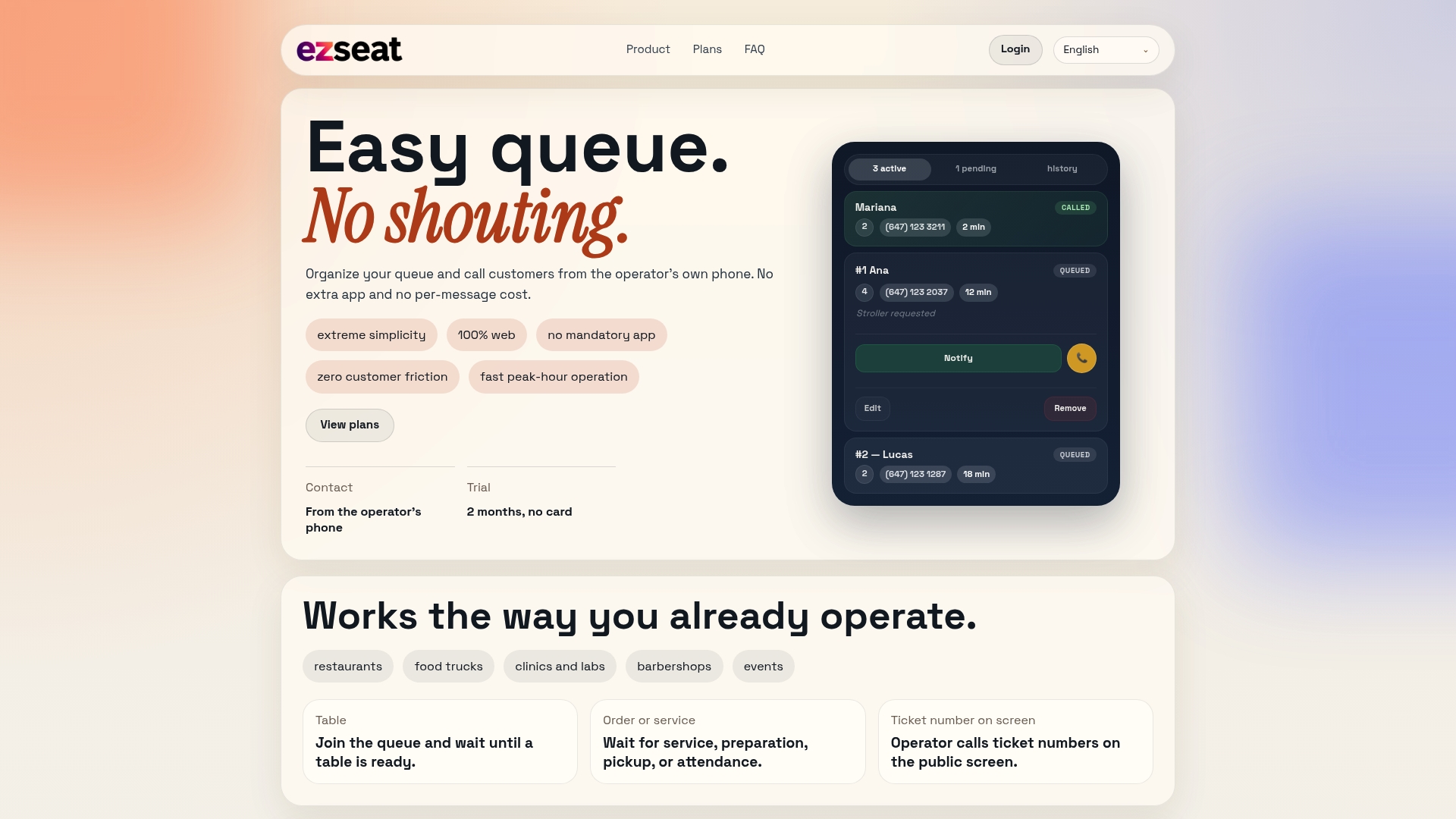
The free two-month trial covers the full pilot cycle: configure your queues, set up a kiosk and display, run your first real customers through, and pull the KPI report before you pay anything. Venues from food trucks to clinics use Ezseat to replace name-calling and paper lists with a system that actually scales.
Start your pilot at Ezseat and have your first queue live within the hour.
Sources
- Multi-Queue Fair Queueing (USENIX ATC '19)
- MultiKueue | Kueue
- HOWTO for multiqueue network device support — The Linux Kernel documentation
- Synchronization and waiting time analysis for queueing networks (SyncQueues paper)