
The fastest way to cut your food truck queue is a virtual queue: post a QR code or short URL, let customers join from their phones, and text them when their order is ready. No app download required. You can have this running in under 30 minutes.
Three quick actions to take right now:
- Post a QR code linked to your queue or pre-order page at the front of your truck and at the end of the physical line.
- Open pre-order slots for the next 30–60 minutes so customers lock in their spot before they arrive.
- Create a dedicated pickup zone with a sign, separate from the ordering window, so fulfilled orders don't block incoming customers.
Within one service period, you should see a shorter visible line, fewer people walking away before ordering, and staff who can focus on cooking instead of crowd management.
Key Takeaways
A virtual queue with QR/web entry and SMS notifications is the single highest-impact change a food truck operator can make to cut visible lines, reduce walkaways, and increase orders per service period.
| Point | Details |
|---|---|
| Launch a virtual queue first | Post a QR code at the line entry point and let customers join via browser — no app needed. |
| Cap items and queue size | Prevent oversell and kitchen overload by limiting active orders and high-demand items in real time. |
| Set pickup slots by scenario | Use pre-order slots for catering and weekday lunch; use real-time queue caps for festivals. |
| Measure four KPIs | Track wait time, abandonment rate, throughput, and orders per staff-hour over a one-week pilot. |
| Ezseat for the pilot | Ezseat's app-free, browser-based system with SMS notifications and a multi-device dashboard is built for exactly this setup. |
Table of Contents
- Why food truck queues are harder to manage than restaurant lines
- How does a virtual queue work for food trucks?
- Tactics by scenario: weekday lunch, festival, and catering
- What equipment do you actually need to run a virtual queue?
- How do you know the virtual queue is actually working?
- What operators see when they run a short Ezseat pilot
- The part of this most operators underestimate
- Ezseat fits this problem without the usual friction
- Frequently asked questions about food truck queues
- Sources
Why food truck queues are harder to manage than restaurant lines
A restaurant has a fixed address, a reservation system, and a lobby. A food truck has none of that. The core problem is the combination of no fixed location, wildly variable demand, a service window measured in hours (not days), and a physical footprint that fits in a parking space.
At a weekday lunch spot, you might serve 80 customers in 90 minutes. At a weekend festival, that same truck might face 300 people in the same window, with no way to predict the surge. Detroit's Downtown Street Eats runs a large rotating fleet of trucks on weekdays from mid-morning to mid-afternoon, April through October. Even with that many trucks, individual operators face intense, compressed demand spikes with no buffer.
The space constraint compounds everything. A 10-foot service window can only serve one customer at a time. A line of 15 people stretching across a parking lot is visible from 50 yards away, and that visibility cuts both ways.
A long visible line signals popularity — but past a short psychological threshold, it signals "not worth it." Operators consistently report losing sales when the line looks too long, even when actual wait times are reasonable. Reducing visible crowding, not just actual wait time, is the real lever.
That behavioral reality is why virtual queues work so well for food trucks specifically. The line disappears from view. Customers wander, sit, or browse nearby. They come back when their phone buzzes.
How does a virtual queue work for food trucks?
The mechanic is simple: a customer scans a QR code or visits a short URL, joins the queue or places a pre-order through their browser, and receives an SMS when their order is ready for pickup. No app. No paper ticket. No shouting names across a parking lot.
Customer steps:
- Scan QR code or visit the link on a posted sign
- Enter name and phone number (30 seconds)
- Browse the menu and optionally pre-order
- Receive an SMS when their order is 2–3 minutes from ready
- Walk to the pickup window
Operator steps:
- Customer appears in the dashboard on your phone or tablet
- Kitchen sees the order (or takes it verbally at the window)
- Mark order as "ready" — SMS fires automatically
- Customer picks up at the dedicated window
The honest trade-offs:
- Requires a phone and mobile signal — not every customer or location has reliable connectivity
- Network dependency — SMS delivery can lag in crowded festival environments
- Upside: no app install, works on any smartphone browser, and the visible line shrinks immediately
At a busy downtown lunch site, a virtual queue essentially turns a 15-person visible line into a 3-person pickup cluster. The rest of the customers are sitting on a bench or grabbing a coffee next door — and they come back when their phone tells them to.
QSR Magazine's operational breakdown of food truck wait-time tactics confirms that pre-orders and workflow fixes are among the highest-impact changes operators can make. Setting up a QR code waitlist is the fastest entry point into that workflow.
Tactics by scenario: weekday lunch, festival, and catering
Not every food truck situation calls for the same approach. Here is what works in each context.
1. Weekday lunch (high predictability, short window)
Core objective: maximize throughput in 90 minutes.
The Navy Yard's published lunch-truck schedule is a good model: operators post their location and hours in advance, and customers plan around it. That predictability makes pre-order slots viable. Open slots 24–48 hours ahead, cap them at a number your kitchen can handle, and let walk-ups fill remaining capacity on the day.
Staffing split: one person on the queue dashboard and window, one on cooking, one on packing and calling pickups. That three-person model keeps the window moving without a bottleneck.
Quick decision rule: if your average prep time per order exceeds 4 minutes, cap your active queue at 12–15 orders and pause new joins until you clear the backlog.
2. Festival or market (high variability, space constraints)
Core objective: reduce crowding and prevent oversell.
Festival events like the Food Truck Round Up at Perkins Rowe pack multiple trucks into a compact footprint with shared pedestrian space. Your physical line directly competes with neighboring trucks' lines for the same square footage.

Cap item quantities before the event starts. If you sell out of a high-demand item mid-service, update the menu in your queue system immediately. A customer who joins the queue for a sold-out item and discovers it at pickup is a worse outcome than a customer who never joined.
Signage placement matters more here than anywhere else. Post your QR code at eye level at the end of the physical line, not just at the truck window. If someone is already walking away, a sign 20 feet back gives them a reason to stop.
3. Catering or corporate event (guaranteed orders, fixed headcount)
Core objective: serve every confirmed order on time.
Pre-orders are not optional here — they are the entire model. Collect orders 24–48 hours ahead, batch them by pickup time slot (e.g., 12:00 p.m., 12:20 p.m., 12:40 p.m.), and prep in waves. SMS notifications tell each group when to come to the window.
The risk in catering is overpromising prep time. Build in a 10-minute buffer per slot and communicate it clearly. A corporate client who waits 5 minutes past their slot is annoyed. One who waits 20 minutes past it doesn't rebook.
| Scenario | Best for | Setup complexity | Staffing implication | Customer friction |
|---|---|---|---|---|
| Weekday lunch | Predictable demand, repeat customers | Low | 3-person split works | Minimal with pre-order |
| Festival/market | High-volume, variable demand | Medium | Add a dedicated pickup person | Low if signage is clear |
| Catering/corporate | Fixed headcount, guaranteed orders | Low to medium | Pre-batch prep reduces pressure | Near-zero with SMS slots |
What equipment do you actually need to run a virtual queue?
The minimum viable setup is one device (phone or tablet), a printed QR code sign, and a mobile data connection. That's it.
Full checklist:
- Signage: minimum A4 size, laminated, posted at the end of the line and at the truck window. Include the URL in text below the QR code for customers who can't scan.
- Device: any smartphone or tablet with a browser. A dedicated tablet on a stand at the window keeps your personal phone free.
- Power: a 20,000 mAh portable battery bank covers a full service day. Don't rely on the truck's inverter for your queue device.
- Connectivity: a dedicated mobile hotspot (separate from your POS) prevents queue notifications from competing with payment processing for bandwidth.
- POS integration: check whether your queue system can push order details to your POS or kitchen display. If not, a shared tablet visible to the cook works fine.
- Offline contingency: pre-printed numbered tickets as a fallback. If connectivity drops, hand out tickets and call numbers manually until the signal returns.
Pro Tip: Place your QR sign at the point where a customer would naturally stop and consider whether to join the line — not at the window where they've already committed. That placement captures the hesitant customer who would otherwise walk away.
For festival setups where multiple trucks share a space, a queue display screen visible from a distance lets customers track their position without checking their phones repeatedly.
How do you know the virtual queue is actually working?
Measure four things: average wait time, abandonment rate, throughput (orders per service period), and orders per staff-hour. QSR Magazine's tactics guide supports these as the right levers to track.
Run a one-week pilot. Record your baseline numbers in week one (before the virtual queue), then compare against week two with the system live.
| KPI | Definition | How to measure | Target direction |
|---|---|---|---|
| Average wait time | Time from queue join to pickup | Timestamps in queue dashboard or SMS logs | Decrease |
| Abandonment rate | Customers who join but don't pick up | Queue joins minus completed orders, divided by joins | Decrease |
| Throughput | Orders completed per service period | POS end-of-day report | Increase |
| Orders per staff-hour | Total orders divided by total staff-hours worked | POS report + shift log | Increase |
You don't need analytics software. A notes app with timestamps and your POS daily summary gives you enough data to evaluate a pilot honestly.
What operators see when they run a short Ezseat pilot
Operators who run a two-week Ezseat pilot typically report three changes: the pickup area gets calmer, staff spend less time managing the physical line, and the number of customers who leave without ordering drops.
The practical implementation tips that matter most:
- Set realistic prep times in your queue settings. If your burger takes 6 minutes, set the notification to fire at 5 minutes, not 3. Customers who arrive before their order is ready cluster at the pickup window and recreate the crowding you were trying to eliminate.
- Cap your active queue during peak periods. Ezseat's dashboard lets you pause new joins when the kitchen is at capacity, which prevents the queue from growing faster than you can serve it.
- Use the multi-device setup so the cook and the pickup person each have a screen. The cook marks orders as "in progress"; the pickup person marks them "ready" and triggers the SMS.
- Place signage at the line entry point, not just at the window. The customer who is deciding whether to stay or leave is the one you most need to reach.
Common pitfalls to avoid:
- Overpromising prep time in the queue confirmation message
- Not capping high-demand items before they sell out mid-service
- Posting the QR code only at the window, where it's too late to change customer behavior
- Skipping the offline ticket fallback and having no plan when connectivity drops
What to look for in any web-based queue system: browser-only entry (no app install for customers), SMS notifications, a multi-device operator dashboard, and the ability to cap queue size or item quantities in real time.
The part of this most operators underestimate
The virtual queue is not primarily a technology problem. It's a signage and communication problem. The best queue system in the world fails if customers don't know it exists, don't trust it, or can't figure out how to join in under 10 seconds.
Operators who struggle with virtual queues almost always have the same issue: the QR code is posted at the window, where the customer has already committed to waiting in the physical line. The sign needs to be at the decision point, which is 15–20 feet back from the truck, where a customer is still deciding whether to stay.
The second underestimated factor is staff buy-in. If the person at the window keeps calling names out loud and ignoring the SMS system, customers lose confidence in the virtual queue fast. The system works when the staff works it consistently, every service period, not just when it's convenient.
For event organizers specifically, email marketing before the event is one of the most effective ways to prime attendees to use a virtual queue before they arrive. A single pre-event email explaining how the queue works cuts confusion on the day significantly.
Ezseat fits this problem without the usual friction
Ezseat is browser-first and app-free, which means your customers join the queue from any smartphone without downloading anything. That single fact removes the biggest adoption barrier at a food truck, where a customer standing in a parking lot is not going to install a new app to order a taco.
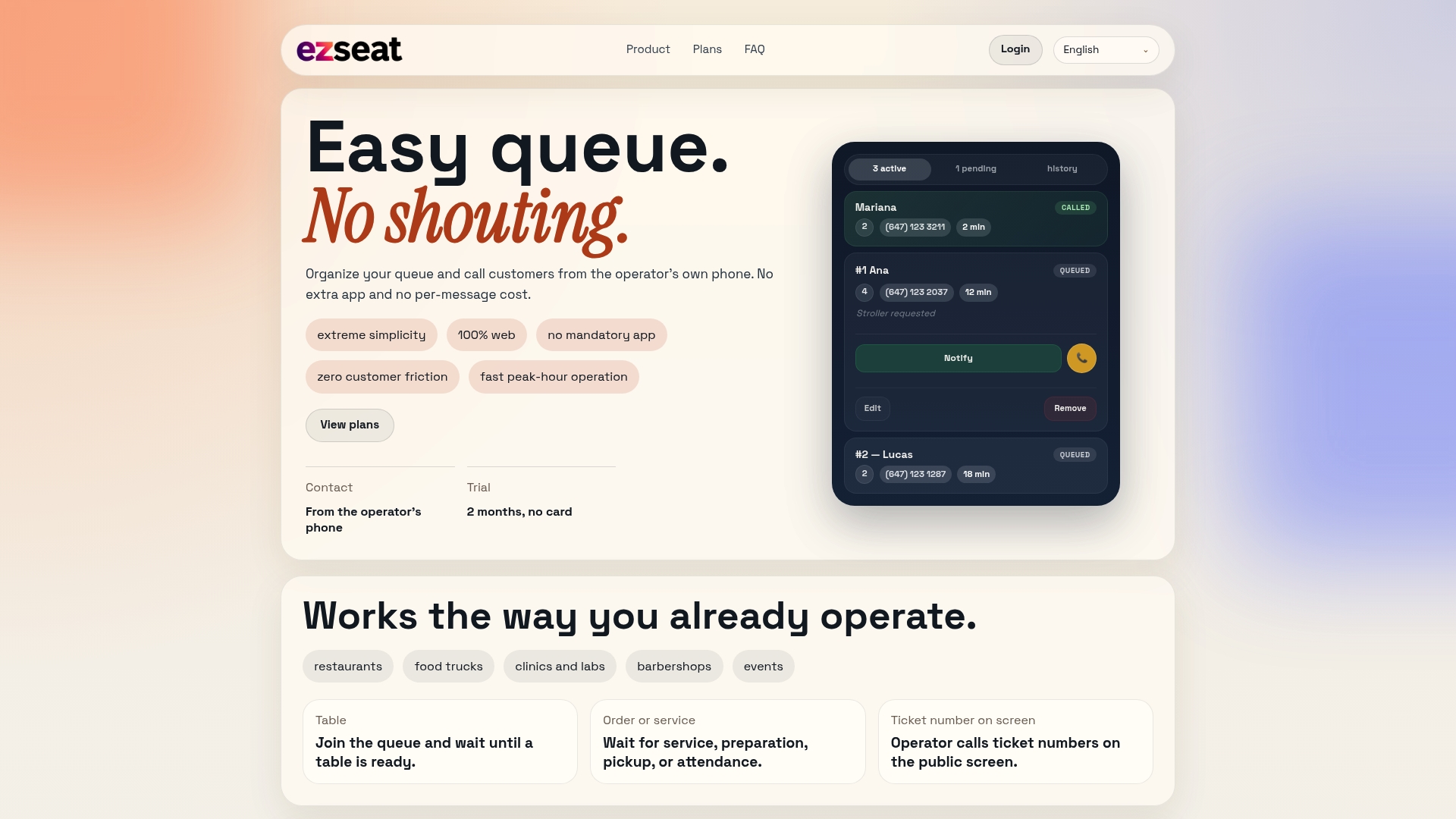
The two-week pilot plan is straightforward: pick one location or event, set your baseline KPIs in week one, launch the virtual queue in week two, and compare. Ezseat's SMS notifications, multi-device dashboard, and queue-cap controls give you everything you need to run that pilot without a technical team. Ezseat and have the system live before your next service.
Frequently asked questions about food truck queues
Do customers need to download an app to join a virtual queue? No. Browser-based systems like Ezseat let customers join from any smartphone browser by scanning a QR code or typing a short URL. No download, no account creation.
What if mobile signal is weak at my location? Keep a stack of pre-numbered paper tickets as a fallback. Hand them out manually and call numbers until connectivity returns. A dedicated mobile hotspot separate from your POS reduces the risk of signal competition.
How many orders can a virtual queue handle per service period? That depends on your kitchen speed, not the software. The queue system should let you cap active orders to match your prep capacity. A common starting point is 12–15 active orders at a time for a two-person kitchen.
Will customers actually use a QR code at a food truck? Adoption is highest when the sign is placed at the decision point (before the customer commits to the physical line) and when the join process takes under 30 seconds. Customers who are facing a 10-person line are highly motivated to scan.
How do I measure whether the virtual queue improved my service? Compare average wait time, abandonment rate, and total orders per service period before and after the pilot. One week of baseline data and one week with the system running is enough to see a directional result.

Can I use a virtual queue for a catering or corporate event? Yes, and it works especially well there. Collect pre-orders 24–48 hours ahead, batch them into pickup time slots, and use SMS notifications to call each group to the window. It eliminates the lunchtime rush entirely.
Sources
- 7 Key Ways for Food Trucks to Reduce Wait Times | QSR Magazine
- Food Trucks in Downtown Detroit | Downtown Detroit Partnership
- Lunch truck lineup | Navy Yard — food & drink
- Food Truck Round Up at The Rowe | Perkins Rowe