
Yes. Connecting your point of sale to your waitlist system is one of the highest-leverage operational upgrades a busy restaurant can make: it automates seating, sharpens wait estimates, and cuts walkaways. The payoff shows up fastest in table turns and guest data syncing automatically between systems. Skip to the setup checklist below once you're ready to move.
TL;DR:
- Bidirectional POS and waitlist integrations automatically update table status, check payments, and guest profiles in real time, reducing manual host work.
- Proper setup requires accurate floor plans, mapping table IDs, and running staged tests during slow periods to prevent errors during peak hours.
- Mismatched table IDs and lack of timely updates are common setup issues, which can cause delays and increase guest walkaways.
- Small venues can start with QR entry and SMS alerts before investing in full bidirectional sync and predictive wait features.
- Ezseat offers a browser-based waitlist system that simplifies setup and operation, with support for multiple devices and no app downloads needed.
Table of Contents
- What Pos Waitlist Integration Actually Changes on the Floor
- One-Way Vs. Bidirectional Sync: The Distinction That Actually Matters
- Setup Checklist: Getting POS and Waitlist Talking to Each Other
- Where Integrations Go Wrong (and How to Avoid It)
- How Ezseat Handles POS Integration During Peak Service
- Which Features to Turn on First, by Venue Size
- Try Ezseat's No-App Waitlist Built for Real Service Nights
- Sources
What Pos Waitlist Integration Actually Changes on the Floor
Once your POS and waitlist talk to each other, the host stand stops running on guesswork. Instead of a host eyeballing which tables look free, the system shows real table status pulled straight from what's happening at the register and in the dining room.
The visible changes show up fast:
- One shared floor plan. Hosts, servers, and managers see the same table map instead of three different mental versions of the room.
- Automated guest texts. Parties get a text or web notification when their table is ready instead of crowding the host stand waiting for their name to be called.
- Guest profiles that remember people. A dining waitlist integration can attach visit history and spend data to a guest's profile automatically, so a regular who always orders the same bottle of wine gets recognized the moment they're seated.
That last point matters more than most operators expect. A host who knows a guest is a Tuesday-night regular who tips well and orders the tasting menu treats that table differently than a walk-in. When the system builds that context without anyone typing it in manually, service gets more personal without adding a single task to anyone's plate.
One-Way Vs. Bidirectional Sync: The Distinction That Actually Matters
Not all integrations are built the same, and the difference between "connected" and "actually useful" comes down to one technical detail: does data flow in one direction or both?
One-way sync typically pushes reservation or waitlist data into the POS so servers see who's seated and what they ordered. It's better than nothing, but it's passive. The waitlist doesn't know anything the POS discovers after the fact.
Bidirectional sync is where the real automation happens. When a check gets paid at the register, that event flows back to the waitlist system, which can then automatically mark the table dirty or ready for the next party. No host has to notice the payment, walk over, and manually update a chart. The system does it the instant the transaction closes.
Statistic Callout: Vendors offering bidirectional POS/waitlist connections point to this exact check-to-table-status link as the mechanism behind automated turnover, according to SalesVu's reservations platform documentation — the kind of automation a one-way feed simply cannot replicate.
For that automation to work, several data objects need to move between systems reliably:
- Table status (open, seated, dirty, ready)
- Party size and seating preferences
- Guest profile and spend history
- Check status and payment timestamps
- Floor-plan and table ID references
Live POS metrics also feed something guests notice immediately: wait-time accuracy. Systems that pull kitchen ticket times and historical turnover patterns from the POS can calculate a predicted wait that adjusts in real time, rather than relying on a static guess that often proves inaccurate.
Setup Checklist: Getting POS and Waitlist Talking to Each Other
Before you touch a settings menu, get your documentation in order. Most integration delays trace back to skipping this step.
- Document your floor plan. Write down every table number, seating capacity, and server section exactly as they exist on the floor right now.
- List your guest-data fields. Decide what information matters (name, phone, party size, notes, spend history) before you map it anywhere.
- Enable the integration. Turn on the connection flags in both the POS and waitlist dashboards, following your vendor's specific activation steps.
- Map every table ID. Match each physical table to its digital counterpart in both systems. This is the step people rush, and it's the one that breaks things later.
- Configure notification channels. Decide whether guests get texts, a web link, or a QR code, and set those channels up before your first live test.
- Set data-sharing permissions. Confirm which staff roles can see spend history, contact info, and visit notes.
- Run a staged test. Add a fake party, seat them, close a check, and confirm the table status updates automatically on both ends.
- Train staff and set a rollback plan. Walk hosts through the new workflow and agree on a manual fallback if the sync goes down mid-shift.
Pro Tip: Run your staged test during a slow lunch, not five minutes before Friday dinner rush. If table IDs are mismatched, you want to find out when the dining room is half empty, not when you have a 40-minute wait.
Where Integrations Go Wrong (and How to Avoid It)
The most common failure point isn't the software. It's mismatched table IDs and floor plans that go stale the moment a restaurant rearranges seating for a private event and forgets to update the map on both systems.
A few other issues show up repeatedly:
- Notification throughput limits. Some SMS providers cap how many texts you can send per minute during a rush, which matters if you're seating a 40-person wait at 7 p.m. on a Saturday.
- Vendor mapping delays. Recreating a full dining room digitally is often the single largest time investment in the whole setup, so schedule vendor-assisted mapping time well before your target launch date rather than the week of.
- One-way sync masquerading as full integration. Ask vendors directly whether table status updates flow back from the POS or only forward into it.
Statistic Callout: Vendor and platform materials tied to tightly integrated POS and table-management systems report reductions in guest abandonment and faster seating times when the connection between systems is genuinely bidirectional, rather than just a data export running on a schedule.
Best practice is straightforward: insist on bidirectional status updates before you sign anything, put mapping time on the calendar with your vendor's support team rather than doing it solo at midnight, and track turn time, walkaways, and host labor minutes for the first 30 days after go-live. Those three numbers tell you within a month whether the integration is actually working.
How Ezseat Handles POS Integration During Peak Service
Ezseat's approach starts from a simple observation: the fewer steps between "guest wants a table" and "guest is seated," the better your night runs. That's why guests join the queue through a browser or QR code with no app download required. At the host stand, that means one less barrier between a walk-in and a confirmed spot on the list, especially during a rush when every extra tap costs you time.
Setup support includes hands-on help mapping your floor plan and table numbers, a trial period to test the workflow before committing, and staff training so hosts aren't relearning their job mid-shift. Ezseat also supports multiple devices at the host stand, so a manager on a tablet and a host on a phone see the same live queue without stepping on each other.

Which Features to Turn on First, by Venue Size
Not every restaurant needs the full stack on day one, and turning on too much at once is how launches go sideways.
Small cafés and counter-service spots should start with QR entry, SMS alerts, and a single table map. Bidirectional sync and predictive waits can wait until volume justifies the setup time.

Full-service restaurants with multiple sections and higher covers benefit from bidirectional sync and predictive wait times from day one, since a static estimate falls apart fast once you're running 200 covers a night across three dining rooms.
Schedule vendor-assisted table mapping if you have more than a dozen tables or irregular seating; DIY it if you're running fewer than that with a simple layout. As a decision flow: get QR entry and notifications live immediately, invest in bidirectional sync and floor-plan mapping within the first month, and layer in predictive wait calculations once you have baseline data to calibrate against.
— Ezseat
Try Ezseat's No-App Waitlist Built for Real Service Nights
Ezseat gives you a browser-first waitlist that skips the app-download friction guests hate and hosts dread explaining. Guests join from a phone browser or QR code, hosts run the queue from any device at the stand, and your table map stays visible without a second screen to manage.
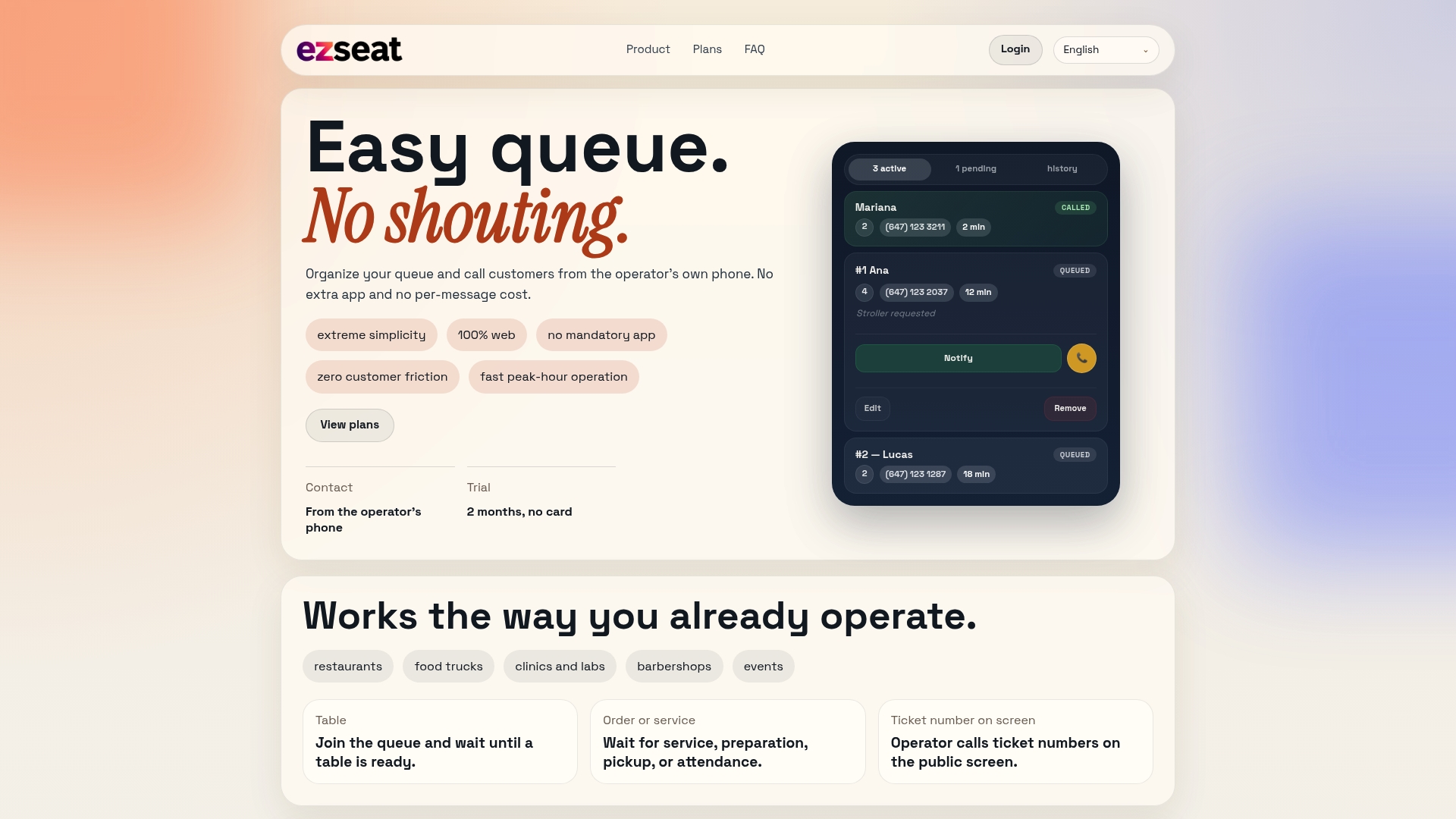
The trial period includes hands-on help mapping your floor plan and table numbers, support during your first few live shifts while staff get comfortable with the workflow, and enough runway to see whether turn times and walkaways actually improve before you pay anything. If you're also rebuilding your guest outreach around the visit data your waitlist captures, pairing it with solid restaurant social media practices turns that data into return visits instead of a spreadsheet nobody opens.
Check out the free trial details and get your dining room mapped before your next rush.
Sources
- Get Started With the Yelp for Restaurants Integration — Toast support
- Reservations and waitlist platform — SalesVu
- Restaurant Waitlist Software | SpotOn