
A web-based waitlist is the fastest way for restaurants, clinics, and walk-up venues to manage customer flow without forcing guests to install an app. Browser entry means guests join by scanning a QR code or tapping a link, no download required, which is why it wins for any business with one-time or infrequent visitors. Start now: set up a QR code and short link, run it on one service lane for a day, and see how many guests join without asking a single question.
It fits almost anywhere people wait in line:
- Restaurants with walk-in dinner rushes
- Clinics managing patient check-in and appointment overflow
- Food trucks with a single service window
- Barbershops and salons with rotating stylists
- Event venues handling registration or will-call
Pro Tip: Test your QR code on three different phones (iPhone, budget Android, an older device) before launch. A code that opens the wrong browser or a slow-loading page kills adoption in the first five minutes.
| Point | Details |
|---|---|
| No app required | Guests join by scanning a QR code or opening a short link in their phone's browser. |
| Works on any device | Browser-based entry runs on iPhones, Android phones, and older devices without compatibility issues. |
| Fastest path to test | Print one QR code, place it at the door, and pilot a single queue before committing to a full rollout. |
Key Takeaways
A browser-based waitlist reduces front-desk interruptions and cuts average wait times by making queue status visible without requiring an app download.
| Point | Details |
|---|---|
| Skip the app store | QR codes and short links let guests join from any browser in seconds. |
| Transparency cuts interruptions | A visible Now Serving display stops repeated "how much longer" questions at the counter. |
| Usability data is strong | The QKlinik study reported a 4.78/5 usability score and roughly a 28% wait-time reduction in trials. |
| Start small, scale fast | Launch with web-only join and a staff dashboard, then add SMS and integrations as volume grows. |
| Ezseat fits mixed-frequency venues | Ezseat offers browser join, QR codes, kiosk mode, and SMS alerts with a two-month free trial before any paid tier. |
Table of Contents
- Why an Online Waitlist System Beats the Clipboard
- What Features Should You Require in a Waitlist Tool?
- How Do You Set Up a Browser-Based Waitlist Fast?
- How Do You Run the Queue Without Losing Control?
- What Does a Waitlist Tool Cost, and How Fast Can You Roll It Out?
- Which Metrics Prove the Waitlist Is Working?
- What Privacy and Accessibility Basics Should You Cover?
- Web-Based vs. App-Based vs. Kiosk: Which Fits Your Business?
- Does the Evidence Actually Support Browser-Based Queuing?
- Try a Browser-Based Waitlist Without the App-Store Detour
- Frequently Asked Questions
- Sources
Why an Online Waitlist System Beats the Clipboard
The math on friction is simple: every extra step between "I want to wait" and "I'm in line" costs you walk-ins. A clipboard requires a pen, a name, and a staffer to manage it. A digital waitlist system requires a phone camera. Guests who might have walked away instead join from their car, from the sidewalk, or from a nearby coffee shop, and your host stops fielding "how much longer?" every ninety seconds.
The evidence backs this up. A simulated evaluation of a web-based queue system called QKlinik reported an average usability rating of 4.78 out of 5, with trial data showing roughly a 28% reduction in average wait time. That's not a marginal improvement. It's the difference between a lobby that feels chaotic and one that feels controlled.
Beyond usability, digital waitlists tend to reduce no-shows and cut staff interruptions in documented case examples, because guests get status updates without walking up to ask. The tradeoff: a browser-based waitlist alone won't help if most of your guests don't carry smartphones or don't have reliable signal indoors, which is when you'll want a kiosk or staff-assisted backup alongside it.
- Lower friction for one-time visitors who won't download an app for a single visit
- Fewer front-desk interruptions during peak hours
- Flexible waiting, since guests can leave and get notified remotely
- Lower no-show rates when wait estimates are visible and accurate
What Features Should You Require in a Waitlist Tool?
Not every online waitlist management platform is built the same, and demos tend to hide the gaps. Before you sign anything, run through this checklist and ask vendors to show you each item live, not in a slide deck.
- Browser join with no account required. A short URL and QR code should be all a guest needs; forcing signup kills conversion.
- Public queue display. A "Now Serving" board or ticket number screen sets expectations and cuts repeat questions.
- Notification fallback. SMS or a phone call should back up any app notification, since not every guest has data on.
- Staff dashboard and kiosk mode. Your team needs a one-tap way to check guests in and call the next party forward.
- Multi-queue support. A clinic might run separate lines for walk-ins and scheduled patients; a restaurant might split bar seating from dining room tables.
- Basic integrations. POS or reservation system syncing matters more as you scale past a single location.
- Operational controls. Look for no-show handling, manual overrides, and capacity limits you can adjust on the fly.
- Support and uptime commitments. Ask what happens if the system goes down during your Friday dinner rush, and get the answer in writing.
Most vendors in this space now run cloud/browser-first deployments with notifications, live wait estimates, and reporting baked in as standard, not premium add-ons.
Pro Tip: During any demo, ask the vendor to simulate a dropped SMS notification. How the system recovers, or fails to, tells you more than any feature list.
| Point | Details |
|---|---|
| Browser join | No account or app download; a QR code or link should get a guest into the queue in under 10 seconds. |
| Public display | A visible "Now Serving" screen reduces walk-up questions and sets wait expectations. |
| Notification backup | SMS or call fallback matters because not every guest has app notifications enabled. |
How Do You Set Up a Browser-Based Waitlist Fast?
You can go live with a basic browser based waitlist in an afternoon. Here's the order that avoids the most common rollout headaches.
- Create your account and configure one queue. Set realistic service-time estimates based on your actual average, not your best-case scenario. Overpromising a five-minute wait that turns into twenty erodes trust fast.
- Generate your QR code and short URL. Print signage for the entrance, host stand, or waiting room, and add the link to your Google Business listing so guests can join before they even walk in. The QR setup guide covers signage placement that actually gets scanned.
- Set up the staff dashboard and public display. A tablet behind the counter and a TV or monitor showing "Now Serving" gives staff control and guests visibility at the same time. Full display configuration is covered in the queue display screen guide.
- Test the full flow yourself. Join from your own phone, confirm the SMS notification arrives, and walk through the staff call-forward steps out loud with your team before opening day.
- Run a one- to two-day pilot during a slower shift. Collect feedback from both guests and staff before rolling it out during your busiest hours.
Most virtual queue tools support multiple join methods beyond QR codes, including SMS and staff-assisted entry, so build a manual fallback for guests who can't or won't scan.
Pro Tip: If a QR code opens the wrong page, it's almost always a stale print run pointing to an old URL. Reprint from the current dashboard link, not a saved PDF from last month.
Common quick fixes: a wrong-page scan usually means outdated signage; a failed SMS often traces back to a typo'd area code or a carrier delay you can't control; display lag is typically a Wi-Fi issue on the display device, not the software itself.
How Do You Run the Queue Without Losing Control?
Software alone doesn't fix a chaotic lobby. The habits your staff builds around it do.
Transparency does most of the heavy lifting here. When guests can see their position and an estimated wait, they stop walking up to ask "how much longer?" every few minutes, which is exactly the kind of interruption that live queue visibility is built to eliminate. Train your team to use consistent call-forward language ("Party of four for Sarah, please head to the host stand now") and give guests a defined window, usually two to three minutes, before marking a no-show.
- Display Now Serving and estimated wait times prominently
- Set conservative wait estimates first, then tighten them after your pilot days
- Offer staff-assisted or kiosk check-in for guests without smartphones
- Capture only what you need at join time (party size, service type) to keep the form fast
Pro Tip: Revise your estimated service times weekly for the first month. Most businesses guess too optimistically at launch, and inflated promises do more damage than a longer, honest wait.
What Does a Waitlist Tool Cost, and How Fast Can You Roll It Out?
Pricing for waitlist software solutions typically follows one of three models: a flat per-location monthly fee, tiered plans based on features and queue volume, or a base fee plus per-message SMS charges. The biggest cost drivers are the number of locations you're running, how heavily you use SMS notifications, whether you need public displays or additional hardware, and how deep your POS or CRM integration goes.
A realistic rollout looks like this: one to two weeks on a free trial testing a single queue, one to two weeks piloting during real service, then two to six weeks for a full rollout if you're adding integrations or multiple locations. Keep costs down early by launching with browser-only join and a staff dashboard before layering on SMS volume or POS connections. Choosing between short code and 10DLC messaging also affects your ongoing SMS costs, which is worth reviewing before you scale notifications.
- Per-location monthly pricing scales with your footprint
- SMS usage fees add up fastest at high volume, not at launch
- Public displays and kiosks are typically one-time hardware costs
- Integrations extend your timeline more than they extend your budget
Which Metrics Prove the Waitlist Is Working?
Track a handful of numbers before and after rollout so you're not guessing at impact. Average wait time and throughput (customers served per hour) tell you whether the line is actually moving faster. No-show rate and customer satisfaction scores tell you whether guests trust the estimates you're giving them.

| Metric | What it tells you |
|---|---|
| Average wait time | Whether estimated waits match actual waits |
| Throughput per hour | How many guests you're serving during peak periods |
| No-show rate | Whether notification timing and estimates are accurate |
| Staff interruptions per shift | Whether transparency is actually reducing front-desk questions |
Run a simple A/B pilot: compare a "waitlist on" day against a comparable "waitlist off" day and track the same metrics side by side. Ask managers for a weekly snapshot of these four numbers rather than a raw activity log.
- Compare same-weekday data (a Friday against a Friday) to control for volume swings
- Watch no-show rate closely during the first two pilot weeks
- Track staff interruptions manually if your dashboard doesn't log them automatically
What Privacy and Accessibility Basics Should You Cover?
Collect only what you need: a name and one contact channel is enough for most queues. Make notification opt-in clear at the join screen, log the consent timestamp, and give guests an easy way to opt out. On the technical side, confirm your vendor uses TLS encryption on public-facing pages and ask directly how long they retain guest data after a visit.
Accessibility matters just as much as privacy. Large buttons, clear labels, and sufficient contrast on the join page help older guests and guests with visual impairments join without frustration, and a staff-assisted or kiosk fallback covers anyone who can't use a smartphone at all.
- Collect minimal data: name and one contact method
- Log consent timestamps and offer a one-tap opt-out
- Build in a kiosk or staff-assisted path for non-smartphone guests
Pro Tip: Ask your vendor for their data retention policy in writing before signing. "We delete it eventually" is not a policy.
Web-Based vs. App-Based vs. Kiosk: Which Fits Your Business?
The right entry point depends on how often the same guest comes back and how tech-comfortable your crowd is.
| Business pattern | Best fit |
|---|---|
| Mostly one-time or infrequent visitors | Web-based (browser join, no app) |
| High-frequency repeat visitors wanting loyalty perks | App-based with CRM ties |
| Many guests without smartphones or strict on-site rules | Kiosk-first or hardware ticketing |
| Mixed crowd of regulars and walk-ins | Hybrid: web join plus optional app or kiosk fallback |
Most restaurants, clinics, and event venues fall into the first or last row, which is why a browser-based waitlist tends to be the right starting point rather than the fallback option.
Does the Evidence Actually Support Browser-Based Queuing?
The QKlinik study is the strongest data point here: a 4.78 out of 5 usability rating alongside an estimated cut in average wait time in simulated trials. Industry-wide, cloud and browser-first tools now dominate the category, not because they're trendy, but because they remove the adoption barrier an app creates. Practitioners consistently report the same pattern: visible, live queue status cuts down on repeated interruptions and lets staff focus on the guest actually in front of them.
A Practical Note From Ezseat
We built Ezseat around a simple bet: for restaurants, clinics, and food trucks with mixed-frequency guests, a browser is a better front door than an app store. Our setup guides reflect what actually gets adopted on day one.
Try a Browser-Based Waitlist Without the App-Store Detour
If you're running a restaurant, clinic, food truck, barbershop, or event venue, Ezseat gets you a working queue without asking a single guest to download anything. Guests join through a browser using a QR code or short link, you manage the whole flow from your phone or a tablet at the counter, and a public display shows Now Serving so your front desk stops fielding the same question all shift.
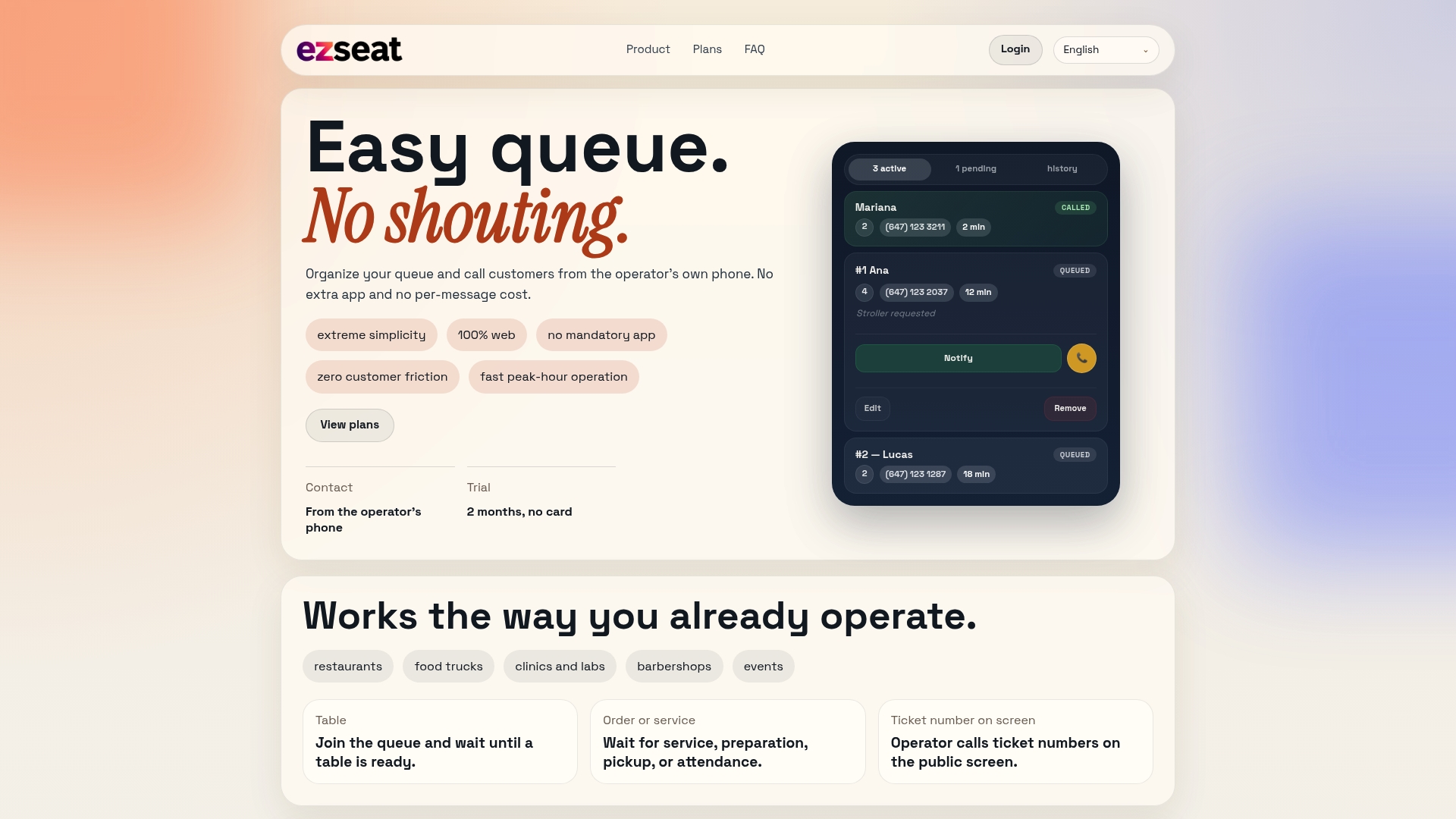
Ezseat covers the full must-have list: browser join, QR codes, public queue displays, kiosk mode for guests without smartphones, and SMS notifications with call fallback. Plans scale from a single-location Light tier to a Pro tier built for multi-queue, multi-location operations, and every account starts with a two-month free trial, no credit card commitments locking you in before you know it works for your floor. If you want the deeper walkthrough first, the QR code setup guide covers signage placement and short-link setup step by step. Otherwise, start your free trial today and run your first live queue before your next shift starts.
Frequently Asked Questions
Do guests need to download an app to join a web-based waitlist? No. A browser based waitlist works entirely through a phone's web browser. Guests scan a QR code or tap a short link, enter basic details, and join the queue without installing anything.
How much does an online waitlist system typically cost? Pricing usually runs on a per-location monthly tier, with additional fees tied to SMS notification volume. Costs rise with the number of locations, integrations, and public display hardware you add.
Can a web-based waitlist handle multiple service lines at once? Yes. Most digital waitlist systems support multi-queue setups, so a clinic can separate walk-ins from scheduled patients, or a restaurant can split bar seating from dining room tables.
What happens if a guest doesn't have a smartphone? A well-designed automated waitlist tool includes a kiosk or staff-assisted check-in option, so guests without a phone can still join the same queue guests are using online.

Is a web-based waitlist secure enough for clinics handling patient information? Look for vendors using TLS encryption on public pages, minimal data collection, and clear retention policies. Confirm compliance details directly with the vendor before handling sensitive patient data.
Sources
- Design and evaluation of QKlinik: a web-based queue management system for outpatient clinics
- 7 best waitlist management software for 2026 - Guideflow Blog
- Waitlist management solution: 7 Ways to Win