
Prioritize automated, simultaneous waitlist outreach paired with a 48/24/2-hour reminder cadence. That single change fills more cancelled slots, faster, than any staffing decision you could make. Manual phone trees force patients to wait their turn while a slot sits empty; automated systems text five or ten waitlisted patients at once and lock the slot for whoever confirms first.
Here's what to flip on this week, in order:
- Turn on two-way SMS reminders at 48, 24, and 2 hours before every appointment, with a one-tap confirm/reschedule link.
- Build a real waitlist at intake: capture provider preference, appointment type, and available time windows, not just a name and phone number.
- Set up simultaneous outreach for cancellations, batching 5 to 10 matched patients per open slot instead of calling one at a time.
- Set a short acceptance window (typically 10 to 15 minutes for same-day slots) so unclaimed offers roll to the next batch automatically.
- Start tracking baseline no-show rate and time-to-fill before you change anything, so you can prove the lift.
Clinics that automate this workflow typically see fill times measured in minutes rather than hours, based on operational reports from healthcare scheduling teams. Watch for one constraint as you roll this out: message throughput. If you're sending high volumes of SMS, you'll need proper short code or 10DLC registration to avoid carrier filtering that silently kills your delivery rate.
Key Takeaways
Reducing no-shows depends on automating simultaneous waitlist outreach, tightening reminder cadence, and tracking fill-rate as your core success metric.
| Point | Details |
|---|---|
| Automate simultaneous outreach | Replace sequential phone calls with batch SMS to matched patients; watch time-to-fill drop from hours to minutes. |
| Layer a 48/24/2 reminder cadence | Escalate reminder frequency for high-risk appointments identified by history or appointment type. |
| Set short acceptance windows | Use 10 to 15 minute claim windows for same-day offers to create urgency without double-booking. |
| Track fill-rate and time-to-fill weekly | Review trends weekly, not daily, and validate any policy change with a two to three week pilot. |
| Use a browser-based tool like Ezseat | Ezseat handles SMS notifications, multi-queue matching, and kiosk check-in without requiring a patient app download. |
Table of Contents
- Why Patients No-Show and Waitlists Fail to Fill
- What Actually Reduces No-Shows: The Tactical Menu
- How to Build a Waitlist That Actually Fills Itself
- What to Measure: The KPIs That Prove It's Working
- Rolling This Out: A 30/60/90-Day Plan
- Choosing Waitlist and Scheduling Software That Won't Slow You Down
- What Clinics That Actually Fix This Do Differently
- How Ezseat Fits Into This Playbook
- Sources
Why Patients No-Show and Waitlists Fail to Fill
Most clinics blame no-shows on "forgetful" or "unreliable" patients. The evidence tells a different story: the biggest drivers are administrative friction and delay, not patient character.

Peer-reviewed research on appointment attendance consistently points to a small set of fixable causes: reminder gaps, long scheduling lead times, and slow manual outreach when slots open up. A widely cited synthesis on no-show interventions found that reminder systems and shorter waiting times reliably reduce no-show rates across care settings, from primary care to specialty clinics. The mechanism isn't complicated. A patient who booked six weeks ago and never heard from you again has had six weeks to forget, deprioritize, or find another provider.
Queue visibility matters just as much once the patient is physically present or waiting on a callback. A Wharton empirical study on queue abandonment found that seeing new arrivals join a line increases the odds someone abandons it, while watching others get served (visible departures) reduces abandonment, an effect roughly equivalent to 9 to 19 minutes of perceived wait time. Related research on patient behavior found that giving people real-time information about queue progress reduces both abandonment and perceived wait, which is why a waiting room with no status updates feels so much longer than one with a visible ticket display.
Patients don't abandon queues because they lack patience. They abandon queues because they lack information. A silent wait feels arbitrary. A wait with a visible number and a moving line feels fair, even when it's exactly as long.
The failure mode most clinics never diagnose is simpler than any of this: they treat backfilling a cancelled slot as a staffing problem. They hire another front-desk person to make more calls, faster. But sequential phone calls can't outrun the clock the way simultaneous automated outreach can. Adding headcount to a manual process just makes the manual process marginally less slow. It doesn't make it fast.
What Actually Reduces No-Shows: The Tactical Menu
Reminders work, but timing and channel decide how well. A cadence of reminders at 7 days, 3 days, 24 hours, and 2 hours before an appointment catches patients at different decision points: the 7-day reminder lets them reschedule before you lose the slot to someone else, and the 2-hour reminder catches the "I forgot" no-show before it happens. Two-way texting, where the patient can reply CONFIRM or RESCHEDULE instead of just receiving a notice, meaningfully raises confirmation rates because it turns a passive alert into an action the patient has to take, according to operational guidance on reminder and texting workflows.

Predictive risk flagging adds a second layer. Rather than treating every appointment identically, clinics that identify high-risk patients (based on history of late cancellations, appointment type, or time-of-day patterns) can escalate those specific reminders to a tighter 48/24/2-hour pattern while leaving low-risk patients on the standard cadence. Operational benchmarking on predictive interventions shows measurable drops in no-show rates when escalation is tuned to local patient data rather than applied as a blanket policy.
Accountability tools, deposits, and no-show fees, belong in the mix, but selectively. They fit procedural and specialty appointments (imaging, elective procedures, dental work) far better than routine primary care visits, where a fee can create access barriers for lower-income patients without meaningfully changing behavior. Use them where the appointment has real opportunity cost and a clear cancellation window, not as a blanket policy across every visit type.
Message templates matter more than most clinics assume. A confirmation text that includes the provider's name, the exact time, and a one-tap link performs better than a generic "You have an appointment" notice, and the same logic applies to waitlist offers.
Sample confirmation text (SMS, under 160 characters): "Hi [First Name], this is Dr. [Last Name]'s office confirming your visit Tue 3/17 at 2:00 PM. Reply C to confirm or R to reschedule."
Sample waitlist offer text: "A 10:30 AM slot with Dr. [Last Name] just opened for tomorrow. Reply YES within 15 min to claim it."
Sample reschedule link text: "We noticed you couldn't make your appointment. Pick a new time here: [link]. No call needed."
Pro Tip: Include a short claim window ("within 15 minutes") in every waitlist offer. Open-ended offers get ignored because there's no urgency; a visible countdown gets a same-day decision, and it mirrors the fairness signal that reduces queue abandonment in the first place.
How to Build a Waitlist That Actually Fills Itself
A waitlist only works if it's "active," meaning it captures enough information at intake to match patients automatically. A list of names and phone numbers with no provider preference, appointment type, or time-window data is not a waitlist. It's a phone book you'll call in order and mostly fail to reach.
The backfill workflow that actually converts cancellations into filled slots runs in five steps:
- Detect the open slot. A cancellation, no-show, or provider schedule change triggers an automated event, typically via an EHR webhook.
- Match by criteria. The system filters the waitlist for patients who match provider, appointment type, and time window.
- Fire simultaneous outreach. Instead of calling one patient and waiting for a callback, the system texts a batch of matched patients at once.
- Lock on first confirm. Whoever responds first claims the slot; everyone else's offer expires automatically.
- Update the schedule. The confirmed patient is booked, the rest stay on the waitlist for the next opening.
Timing rules change depending on how much notice you have:
| Notice Window | Batch Size | Acceptance Window | Best For |
|---|---|---|---|
| Same-day (under 4 hours) | 5 to 10 patients | 10–15 minutes | Last-minute cancellations, urgent backfill |
| 24–72 hours | several patients | moderate acceptance window | Standard cancellations |
| 72+ hours | some patients | longer acceptance window | Non-urgent rescheduling, low-risk slots |
Batch size and acceptance windows should be sized based on expected reply rates according to call-center operational research, since outreach that's too narrow wastes the slot and outreach that's too broad creates double-booking risk. If your batches consistently underfill, widen them. If you're getting duplicate confirmations, tighten the acceptance window or reduce batch size.
There's a minimum viable depth question too. For same-day fills to work reliably, most practices need a substantial active, opted-in patient base per provider on the waitlist. Shallower lists can still work for 72-plus-hour backfill, where you have time for multiple outreach rounds, but they won't save you when a slot opens two hours before the appointment.
Fallback matters when backfill fails. If no one claims a same-day slot within the acceptance window, route it into the next-day queue automatically rather than letting front desk staff chase it manually, and consider offering it through your public queue display for walk-in visibility.
What to Measure: The KPIs That Prove It's Working
You can't manage what you don't track, and no-show reduction is one of the easiest interventions in a clinic to measure cleanly because every metric ties directly to dollars and minutes.
Here are the core numbers, how to calculate them, and realistic short-term targets:
| KPI | Formula | Target/Benchmark |
|---|---|---|
| No-show rate | No-shows ÷ Total scheduled appointments | Track baseline first; automation typically drives meaningful reductions within 60–90 days |
| Cancellation rate | Cancellations ÷ Total scheduled appointments | Watch for a shift from no-shows to cancellations (a good sign; cancellations can be backfilled) |
| Backfill fill-rate | Slots filled from waitlist ÷ Total open slots | Higher fill-rate signals a healthy, well-matched waitlist |
| Time-to-fill (median) | Time from slot-open to confirmed booking | Minutes, not hours, once simultaneous outreach replaces sequential calling |
| Revenue recovered per slot | Filled slots × average visit revenue | Direct dollar impact, useful for justifying the program to leadership |
| Staff time saved | Manual outreach time before vs. after automation | Manual backfill calls often take substantially longer per fill than automated outreach, which can reduce staff time per fill significantly |
Operational guidance on appointment access consistently recommends anchoring improvement efforts to no-show rate and fill-rate as the two headline KPIs, because they're the numbers that translate directly into both patient access and clinic revenue.
Measure daily for the dashboard, but review trends weekly. A single bad day (a snowstorm, a staff callout) shouldn't trigger a policy change. A four-week downward trend in fill-rate should. If you want to validate a specific change, like moving from a 24-hour reminder cadence to a 48/24/2 pattern, run it as a simple before/after comparison on one provider's schedule for two to three weeks before rolling it out clinic-wide. A partner resource on data dashboards for tracking abandonment patterns offers a useful framework if you're building this out from scratch.
Rolling This Out: A 30/60/90-Day Plan
You don't need a six-month IT project to see results. Most of this can start with tools you already have.
- Week 1 to 2 (Quick wins). Turn on automated 24-hour and 48-hour SMS reminders through your existing scheduling system. Add a simple waitlist opt-in checkbox at the point of booking, whether online or over the phone. Front desk owns collecting provider and time-window preferences from new opt-ins.
- Week 3 to 4 (Baseline and cadence). Extend reminders to the full 7-day/3-day/24-hour/2-hour cadence. Start tracking baseline no-show rate and time-to-fill in a shared spreadsheet or dashboard. Clinical ops owns identifying which appointment types have the highest no-show history for early predictive flagging.
- Day 30 to 60 (Automate backfill). Configure simultaneous outreach for cancellations, starting with one provider or department as a pilot. Map EHR webhook events (cancellation, no-show, reschedule) to trigger the outreach automatically. IT owns the webhook integration; front desk owns testing message templates for tone and clarity.
- Day 60 to 90 (Scale and tune). Roll simultaneous outreach out clinic-wide. Introduce escalating reminders for flagged high-risk appointments. Fine-tune batch size and acceptance windows based on your fill-rate data from the pilot. Clinical leadership reviews KPI trends monthly and adjusts policy (deposits, fee structures) based on what the data actually shows, not assumptions.
Set a recurring 30-minute governance meeting, biweekly during rollout and monthly after, with front desk, clinical ops, and IT represented. That's the group that catches the small breakages (a webhook that stopped firing, a template that reads oddly) before they become a quarter of missed data.
Choosing Waitlist and Scheduling Software That Won't Slow You Down
The software decision matters less for its feature list and more for whether it can execute the workflow above without friction. A platform with fifty features and slow, sequential outreach will underperform a simple tool that fires simultaneous SMS the moment a slot opens.
Run every vendor through this checklist:
- EHR integration: Can it receive real-time cancellation and no-show events via webhook, or does it require manual entry?
- Simultaneous outbound messaging: Does it text multiple matched patients at once, or one at a time?
- First-confirm slot lock: Does the system automatically lock the slot and cancel remaining offers the moment someone confirms?
- Configurable matching logic: Can you set rules by provider, appointment type, and time window, or is matching all-or-nothing?
- Audit logs: Can you see who was offered a slot, when, and whether they responded, for compliance and troubleshooting?
Nonfunctional requirements deserve equal weight. Message throughput and carrier compliance (10DLC or short code registration) determine whether your texts actually land in patients' inboxes or get filtered as spam. Privacy safeguards around patient data need to meet your clinic's compliance obligations. Uptime and support responsiveness matter more here than in most software categories, because a scheduling outage during business hours has an immediate, visible cost.
| Basic Reminder Tools | Full Waitlist + Backfill Platforms | |
|---|---|---|
| Reminder automation | Yes, single-channel typically | Yes, multi-channel with two-way reply |
| Simultaneous backfill outreach | Rarely included | Core feature |
| EHR/webhook integration | Limited or none | Standard |
| Matching logic (provider/type/time) | Not available | Configurable |
| Best fit | Small practices with low cancellation volume | Multi-provider clinics with regular cancellations |
For implementation, test the webhook connection first, before you configure a single template. Map your actual appointment types into the matching logic, build two or three message templates, and run a two-week pilot with a single provider before expanding. Measure time-to-value by how quickly that pilot provider sees a measurable jump in fill-rate, not by how many features got turned on.
Pro Tip: When comparing vendors, prioritize the speed and matching intelligence of outreach over the length of the feature list. A tool with ten extra dashboards but slow, sequential texting will lose more slots than a lean tool that fires instantly to the right five patients.
What Clinics That Actually Fix This Do Differently
The clinics that see real, lasting improvement rarely start with the biggest technology purchase. They start by fixing the intake conversation: asking every patient at booking whether they'd take an earlier slot if one opened up, then actually recording the answer somewhere the system can use it.
The pattern shows up again and again in how rollouts unfold. A clinic turns on automated reminders in week one and sees a modest bump. Then it hits a wall, not because the technology fails, but because front-desk staff keep defaulting to the old habit of calling waitlisted patients one at a time "just to be safe." The technology only pays off once the team trusts it enough to let the automation run without a manual double-check on every offer. That trust takes weeks to build, not days, and it's a training and change-management problem far more than a software problem.
One recurring before-and-after story looks like this: a multi-provider clinic goes from a paper waitlist kept at the front desk, where filling a cancelled slot meant flipping through index cards and making calls in order, to an automated system that texts five matched patients the moment a cancellation posts. The slot that used to sit empty for the rest of the day now typically fills within the same hour. The technology change is the visible part. The invisible part is a front-desk team that stopped viewing the waitlist as a chore and started viewing it as the fastest way to end their day with a full schedule instead of gaps.
How Ezseat Fits Into This Playbook
If you're running a multi-provider clinic and still managing your waitlist with sticky notes or a shared spreadsheet, Ezseat gets you to automated, simultaneous outreach without months of IT work. It's browser-based, so patients join a queue or waitlist from any phone without downloading an app, and your front desk manages the whole flow from a phone or tablet instead of a phone-tree.
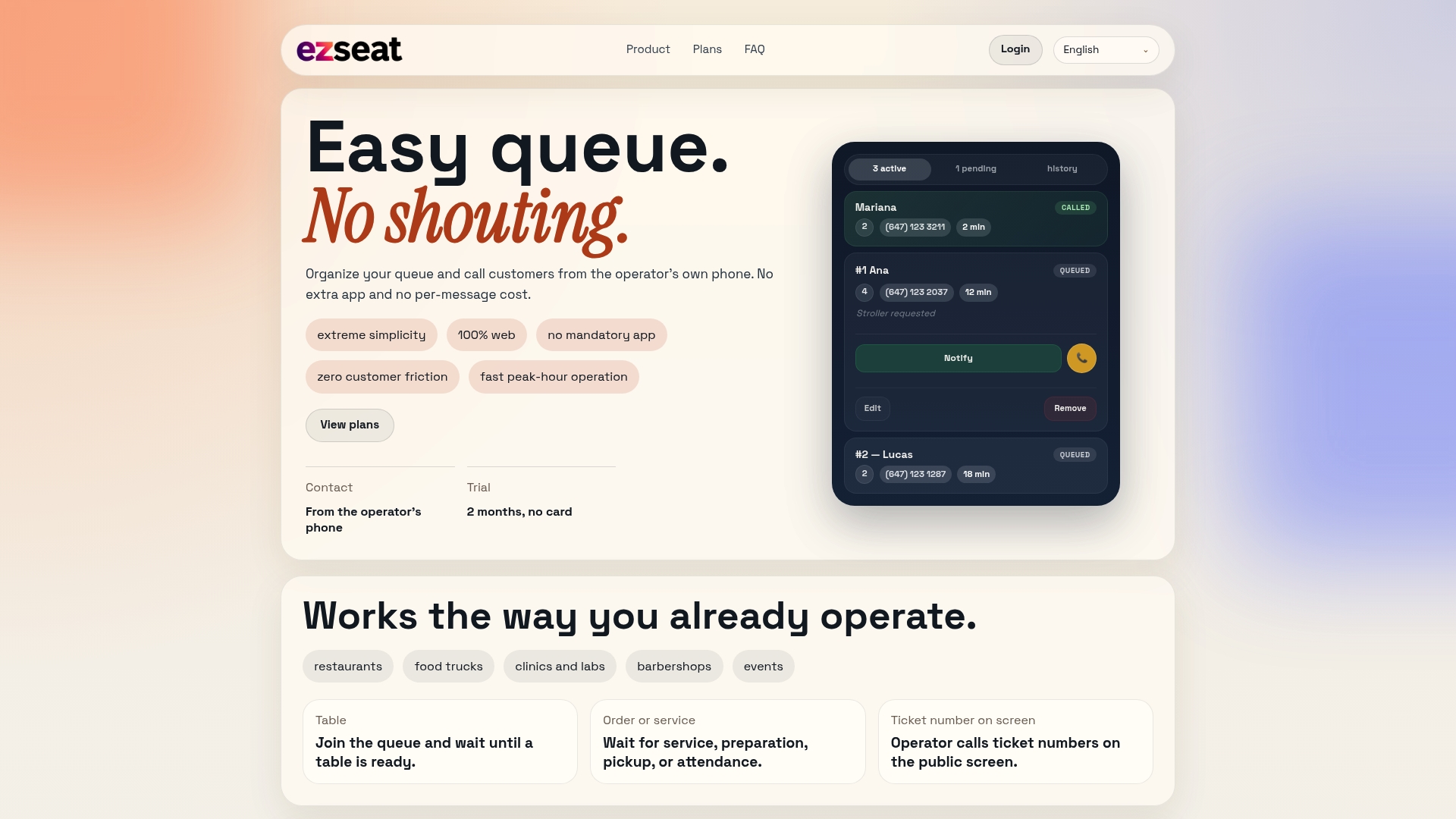
The features map directly to the tactics in this guide: SMS notifications for reminders and waitlist offers, multi-queue support so you can separate providers or appointment types, and kiosk check-in options for patients who arrive without a smartphone handy. A public queue display cuts the perceived-wait problem the Wharton research flagged earlier, giving waiting patients a visible sense of progress instead of silence.
Where Ezseat saves the most time versus a manual process is setup speed. There's no lengthy procurement cycle or custom development, you can have a working queue and web-based intake running the same week you sign up, with a QR code entry point patients scan to join from the parking lot or waiting room. Start with the free two-month trial, configure one provider's queue as a pilot, and track your fill-rate and time-to-fill for two weeks before deciding whether to expand clinic-wide. Set it up at Ezseat and see how quickly an empty slot turns into a filled one.
Sources
- Reducing Appointment No-Shows: Going from Theory to Practice
- Waiting Patiently: An Empirical Study of Queue Abandonment Behavior (Wharton faculty paper)