
The fastest way to shorten checkout lines is to combine mobile checkout, active queue management, and faster payment methods, then measure what happens. Retailers who pair mobile POS with self-checkout and BOPIS options see the biggest drop in wait times, especially when trained staff back up the tech during rushes. The stakes are real: 7 in 10 shoppers forced to wait in line leave within five minutes. Tools like Ezseat's browser-based queueing add a low-cost layer on top of whatever hardware you already run.
TL;DR:
- Mobile POS and web-based queueing solutions can reduce wait times and abandonment rates without requiring significant new hardware installation.
- Strategies like curbside pickup and off-register checkout help divert traffic from main lines, especially effective when peak hours are predictable.
- Using real-time metrics such as wait time and throughput for measurement ensures targeted improvements and avoids unnecessary technology or staffing costs.
- Browser-based queue management systems like Ezseat offer quick setup, no app downloads, and integrate seamlessly with existing operations for small and large businesses alike.
- Proper staff training and staggered implementation of new tactics maximize their effectiveness and prevent new bottlenecks caused by unprepared personnel.
Table of Contents
- What Line Busting Strategies Actually Solve
- Core Line Busting Strategies: What to Try and When
- Which Payment and Device Features Actually Speed Up Transactions?
- How Should You Staff and Train for Line Busting Shifts?
- How Do You Measure and Improve Line Busting Over Time?
- Does Browser-Based Queueing Actually Work for Small Businesses?
- Three Priorities for Operators Starting Line Busting
- A No-App Way to Manage Peak-Hour Lines
- Sources
- FAQ
What Line Busting Strategies Actually Solve
Line busting means pulling transactions or check-ins away from a single fixed point, whether that's a cash wrap, a host stand, or a pickup counter. A grocery clerk scanning items with a handheld while customers stand mid-aisle is line busting. So is a restaurant that seats walk-ins through a web-based waitlist while phone reservations flow through the same system. So is a curbside pickup lane that never touches the front register at all.
You probably need it if you're seeing any of these signals:
- Customers abandoning carts or walking out during peak hours
- The same queue backing up at the same times every day, not just on holidays
- A checkout area too cramped to add a second fixed register
Before you invest in fixes, get a baseline. You can't tell if a tactic worked without knowing your average wait time before you tried it, which is where the measurement section later in this guide comes in.
Core Line Busting Strategies: What to Try and When
Not every tactic fits every business. A boutique with two employees does not need the same setup as a 40,000 square foot supermarket. Here's how the main approaches break down.
- Mobile POS. Handheld devices let staff ring up sales anywhere on the floor. This works best on medium to large floors where employees can physically walk to customers, think big-box retail, garden centers, or crowded pop-up events. It struggles in tiny footprints where there's nowhere to "walk to."
- Self-service kiosks and automated checkout. These shine for high-volume, low-assistance purchases, a coffee shop, a convenience store, a stadium concession stand. Automated checkout systems are still maturing and carry real rollout costs, so most retailers pair kiosks with a staffed lane for exceptions rather than going all in.
- BOPIS, curbside, and ship-to-home. Routing pickup traffic away from the register entirely is one of the cheapest wins available, since it removes transactions from the line before they ever start. A seven-day curbside pickup fix is often enough to get this running without new hardware.
- Pre-checkout prep and dedicated return stations. Bagging groceries in the aisle or routing returns to a separate desk shortens the average time each customer spends at the main register.
- Hybrid virtual queueing. Blending appointments with walk-ins, common in clinics, barbershops, and busy restaurants, keeps flow predictable instead of reactive.
Pro Tip: Don't roll out more than two new tactics in the same week. Stagger them so you can tell which one actually moved your numbers.
Combining operational fixes with technology, rather than leaning on automation alone, tends to produce the most durable results.
Which Payment and Device Features Actually Speed Up Transactions?
The hardware and payment stack you choose determines whether line busting saves seconds or just moves the bottleneck somewhere else. Before buying anything, check your mobile POS units for:
- Reliable barcode scanning that works in low light and on damaged labels
- A card reader that accepts contactless and chip without a fumbling reconnect step
- Offline mode, so a dead Wi-Fi signal doesn't freeze the whole line
- Back-office sync that updates inventory and sales in real time, not on a delay
Contactless cards and digital wallets shave real seconds off every transaction. Kiosk hardware needs the same scrutiny, plus a clear support plan for when a touchscreen glitches mid-rush. The biggest trap is integration: self-service tools can create new bottlenecks if staff still have to re-enter data manually because the kiosk and your main POS don't talk to each other. Any tool you add should remove a manual step, not create one.
How Should You Staff and Train for Line Busting Shifts?
Staffing rules of thumb: add a dedicated line buster once your average wait crosses a few minutes during predictable peaks, and use a floater when the peak is short and unpredictable, like a lunch rush that spikes for 40 minutes.
Roles worth defining explicitly:
- Line buster: handles mobile transactions on the floor, nothing else during the rush
- Returns specialist: absorbs exchanges so they never touch the main register queue
- Floater: roams to whichever line is longest, filling gaps
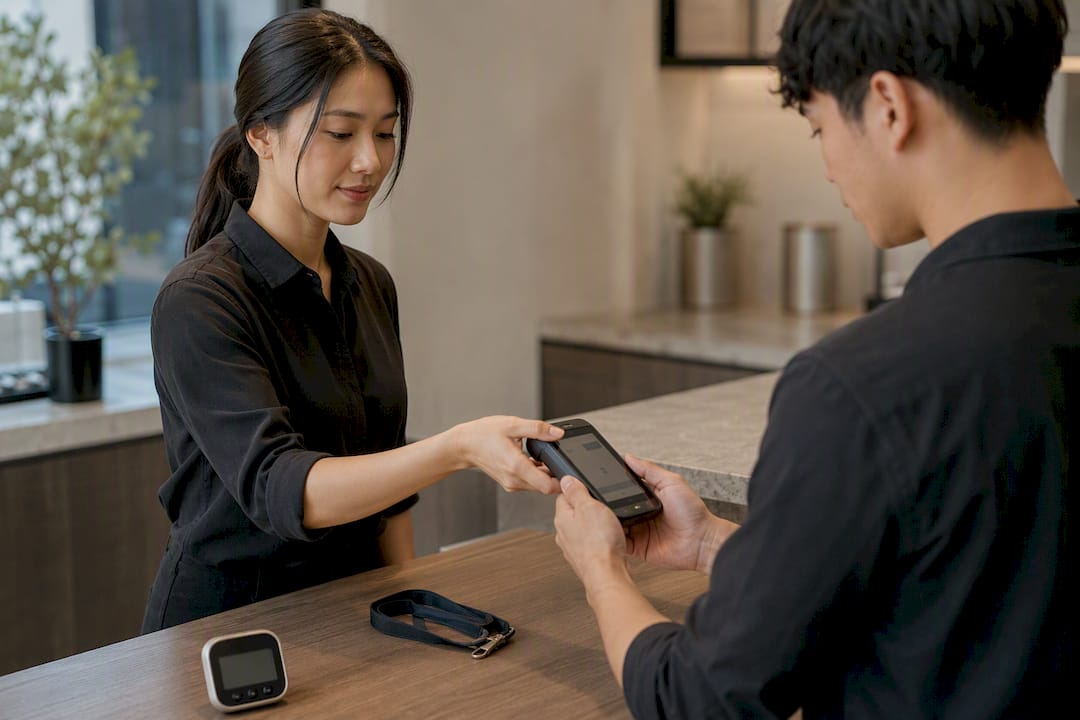
Training should cover device operation until it's second nature, quick hospitality skills for interacting with customers while holding a handheld, and basic data security practices for handling cards away from a fixed terminal. Smaller operations often combine the returns specialist and floater roles rather than hiring separately.
Pro Tip: Run a five-minute device drill before every peak shift for the first two weeks. Muscle memory on a handheld is what actually prevents new bottlenecks.
How Do You Measure and Improve Line Busting Over Time?
Track four numbers: average wait time, abandonment rate, throughput per hour, and, for restaurants, table turnover minutes. These four tell you almost everything about where the friction actually lives.
Run a one-week baseline before you change anything. Then test one tactic, mobile POS during the afternoon rush, for instance, and compare the same metrics against your baseline week. Fast-track process interventions in emergency departments cut length of stay by roughly 20 to 22 minutes in a systematic review, a useful reminder that focused, measured process changes move the needle more reliably than sweeping overhauls.
- Watch for wait times climbing at the same hour daily; that's a staffing signal, not a tech signal
- Watch for throughput flat despite added devices; that's usually an integration problem
- Use queue analytics to forecast peaks before they happen, not just react to them
Does Browser-Based Queueing Actually Work for Small Businesses?
Ezseat's approach centers on one idea: customers join a queue through a web browser, no app download, no account setup. That removes the single biggest friction point in most queueing systems, the moment a customer decides installing something is not worth a table.
Internal results back this up in practical terms:
- Restaurants using web-based waitlists during peak hours have reported table-turn improvements of 10 to 30 minutes without adding headcount
- Hybrid setups let phone-in, walk-in, and web-joined customers sit in the same queue, which matters for clinics and food trucks juggling multiple entry points
- Fixing the queue experience itself, not just the technology behind it, tends to matter as much as the hardware choice
For a business with a few staff and no IT department, the appeal is simple: nothing to install, nothing to maintain beyond a browser tab.
Three Priorities for Operators Starting Line Busting
Start with your worst peak hour, not your whole day. Keep the first tactic simple, one change, one week, measured against a real baseline. Skip the instinct to buy every kiosk and handheld at once; undertrained staff on new hardware create slower lines, not faster ones. A one-week test, one tactic, four KPIs tracked daily, tells you more than a quarter of guessing.
— Ezseat
A No-App Way to Manage Peak-Hour Lines
Ezseat is the alternative to buying extra hardware or hiring extra staff just to survive your rush: customers join your queue from a browser on their own phone, you manage the flow from yours, and nothing requires an app download on either end. Setup runs fast enough that most operators are live before their next peak shift, and the system handles hybrid queues, walk-ins, phone-ins, and web joins together, without forcing you to pick one channel.
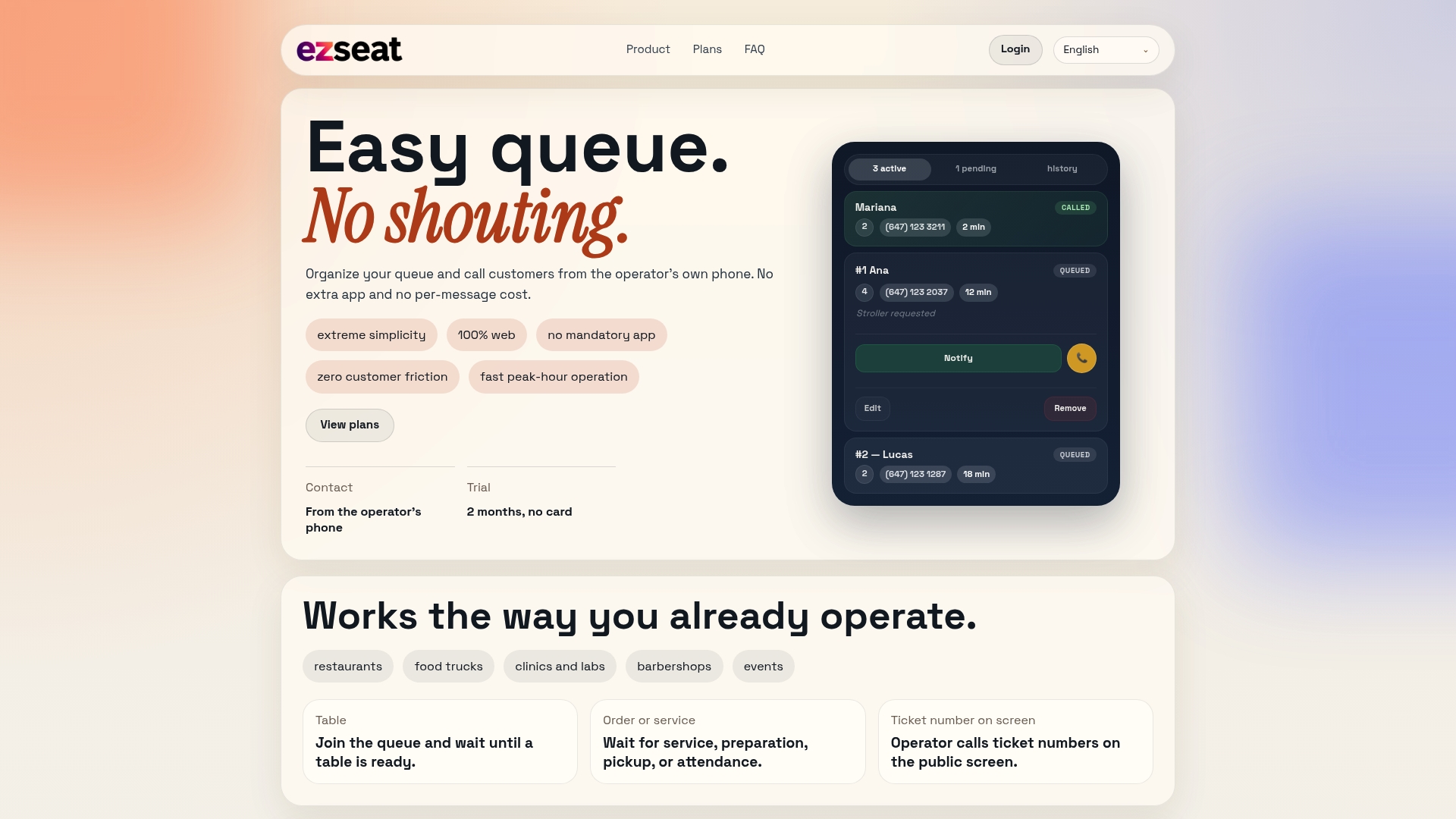
A demo typically shows go-live in minutes and quick peak-hour relief soon after implementation. Ezseat offers a free two-month trial before you commit to a paid tier: the Light plan runs $3.90 per month or $39.00 per year, and the Pro plan runs $14.90 per month or $149.00 per year for growing operations that need more queues or devices. If your busiest hour is costing you customers right now, start the trial and see what your line looks like without it.
Sources
- Effective strategies for reducing patient length of stay in the emergency department: a systematic review and meta-analysis | BMC Emergency Medicine
- Line Busting in Retail: What It Is and How to Implement It - Lightspeed
- Line Busting for Retailers: Everything You Need To Know - Shopify
FAQ
What Is Line Busting?
Line busting is any tactic that moves transactions or check-ins away from a single fixed point, using mobile devices, kiosks, or off-register pickup options, to shorten how long customers wait. Retail guidance points to mobile POS, self-checkout, and BOPIS as the most common versions.
What Is a Line Buster?
A line buster is a staff member equipped with a mobile device, usually a handheld POS unit, who processes transactions directly on the sales floor instead of at a fixed register. The role is most useful in stores with enough floor space for staff to walk to waiting customers.
How Much Does Ezseat Cost?
Ezseat offers a Light plan at $3.90 per month or $39.00 per year and a Pro plan at $14.90 per month or $149.00 per year, both preceded by a free two-month trial. Pricing scales with business size rather than requiring a jump to enterprise software.
Does Line Busting Actually Improve Customer Satisfaction?
Yes. Shorter waits directly reduce abandonment, since most shoppers forced to wait leave within five minutes, and customers rarely notice the technology behind a smooth queue, only that it moved fast.
Can Small Businesses Implement Line Busting Without an App?
Yes. Browser-based tools like Ezseat let customers join a queue without downloading anything, which lowers the barrier for smaller operators who lack the budget or staff to support app-based systems.