
The fastest fix for a chaotic curbside pickup queue is a web/QR check-in that feeds a real-time queue straight to staff alerts on the POS or KDS, not a separate device. Customers scan a code, confirm they've arrived, and the runner gets a ping on the same screen they already use to close orders. Stores that set this up correctly cut handoff errors, shorten waits, and keep the parking lot from turning into a scavenger hunt.
TL;DR:
- Using a web or QR code check-in eliminates app download barriers, increasing customer participation and reducing setup friction at curbside pickup locations.
- Including vehicle details and parking bay information in the check-in process significantly decreases lost customers and order misplacements.
- Integrating alerts directly into the POS or kitchen display, with automated status updates, minimizes manual input and streamlines staff workflow.
- Setting clear pickup time windows aligned with actual fulfillment speed and staffing capacity prevents order delays and customer dissatisfaction.
- Conducting a quick, collaborative dry run helps identify missing fields and workflow gaps before fully launching curbside operations.
Table of Contents
- What Belongs in a Curbside Pickup Queue System
- How the Handoff Actually Should Flow
- Staffing, Peak Hours, and Setting Realistic Pickup Windows
- Connecting Curbside to Your POS, Kitchen Display, and Notifications
- Getting Curbside Live in Seven Days
- Why the No-App Approach Actually Holds Up
- Three Rollout Mistakes That Waste the First Month
- Get Curbside Running Without Asking Customers to Download Anything
- Sources
What Belongs in a Curbside Pickup Queue System
Not every feature marketed as "curbside technology" earns its place. Some are essential. Others are noise.
Check-in method matters more than most managers realize. A QR code taped to a parking sign that opens a web page beats a dedicated app almost every time, because customers don't have to download anything before they're annoyed and waiting. Requiring an app install adds friction at the exact moment you're trying to remove it. A browser-based "I'm here" button works on any phone, in any lot, with zero setup.
Beyond check-in, a handful of fields and functions separate a working system from a glorified notepad:
- Order ID and vehicle details (make, color, license plate or just "silver SUV") so staff aren't circling the lot guessing.
- Parking bay or spot number, mapped directly into the staff-facing queue view so runners filter by location instead of scanning every car.
- Real-time queue position and ETA, with a busy-mode toggle that widens ETAs honestly during rushes instead of quietly falling behind.
- Notifications at three moments: order ready, arrival confirmed, and any ETA change, sent by SMS or web push so customers aren't refreshing a page.
- A verification step at handoff (a short PIN, order code, or visual ticket) to stop the wrong bag from going to the wrong car.
Pro Tip: If your abandonment rate creeps up, the fix usually isn't more staff. It's an extra required field at check in. Vehicle color and parking bay alone solve most "where is my customer" problems.
How the Handoff Actually Should Flow
The technology only helps if the underlying workflow is disciplined. Every curbside order should move through four visible states, and every staff member should know what triggers each one.
- Picked. The order is pulled from shelves or the kitchen line begins prep.
- Packed. Items are bagged, boxed, or plated and staged for pickup.
- Ready. The customer gets notified; the order sits in a marked staging zone.
- Collected. A runner confirms handoff and closes the ticket.
On the customer side, the flow is simpler: they tap "I'm here" from the confirmation text or email, the queue updates instantly, and an alert routes to whichever runner is free. That runner locates the vehicle using the spot and vehicle data already on file, then verifies the order with the code or PIN before handing it over.
Route the alert to the POS or kitchen display system first, not a standalone staff tablet buried in a back office. A separate device is one more screen someone has to remember to check, and it's the first thing that gets ignored during a rush.
Staffing, Peak Hours, and Setting Realistic Pickup Windows
Curbside only works if your promises match your capacity. Retailers commonly advertise readiness "in as little as 30 minutes" for eligible items, and Walgreens holds curbside orders for up to 72 hours in some cases, while Sam's Club caps its hold window at 24 hours. Neither is universally correct. Pick a window that reflects your actual fulfillment speed, publish it clearly at checkout, and stick to it.
Staffing should scale with queue depth, not the clock. A simple trigger works well: once more than three orders sit in "ready" status simultaneously, pull a second runner. During predictable rushes, lean on busy-mode controls to extend ETAs before customers start piling up. Operations teams use these manual extensions specifically to protect staff from burnout while resetting expectations honestly.
Three numbers tell you whether the system is working: average handling time from check-in to handoff, abandonment rate (customers who leave without checking in), and queue length at peak. Track them weekly, not quarterly. Small drifts compound fast when nobody's watching.

Connecting Curbside to Your POS, Kitchen Display, and Notifications
Integration decisions made early save weeks of manual reconciling later. Ask any vendor three questions before signing: does it support webhooks or a native API, does it push alerts directly into your existing POS or KDS, and does it handle status transitions automatically?
That last point matters more than it sounds. Manual status updates (a staffer typing "ready" into two systems) create the exact double-work you're trying to eliminate. Standardized events for picked, packed, ready, and collected keep third-party queue tools and your POS in sync without anyone touching a keyboard twice.
POS or KDS-first alerts beat standalone staff phones because they land on the screen employees are already watching. A phone buzzing in someone's apron pocket during a lunch rush gets missed. A flash on the kitchen display doesn't.
- Demand webhook or API access, not a closed black box.
- Route every notification to the primary operational screen, not a secondary device.
- Automate state changes; don't rely on staff to manually flag "ready."
- Collect only the data you'll actually use at handoff. Vehicle color and a code, not a full ID scan.
Getting Curbside Live in Seven Days
You don't need a quarter-long rollout plan. Most of this fits into a week if you work through it in order.
- Designate two or three curbside bays and put up visible numbered signage.
- Map each bay ID into your queue system so staff see it on the runner screen.
- Generate and print QR codes linking to your web check-in page, one per bay or one at the entrance.
- Add vehicle make/color and parking spot as required check-in fields.
- Configure notification triggers and route arrival alerts into your POS or KDS.
- Run a dry test during a slow hour and watch for missing fields or misrouted alerts.
- Adjust required fields based on what confused testers.
- Document your hold-time and readiness policy in one short paragraph, then post it at checkout.
- Train staff on the verification code process and how to close a collected order.
Pro Tip: Run that dry test with a coworker pretending to be a difficult customer. Fake a wrong vehicle color, arrive early, arrive without checking in. Whatever breaks in that test will break for real within your first week live.
Why the No-App Approach Actually Holds Up
Requiring a downloaded app to join a queue quietly kills participation before a single order ships. A browser-based, QR-triggered check-in removes that barrier entirely. Customers scan, tap "I'm here," and they're in the queue, no login, no update prompt, no storage warning.
Retail case studies back the underlying pattern. A large retailer deployment that paired check-in with SMS updates and a live countdown reported measurable gains in both pickup efficiency and customer satisfaction. That's the same logic behind Ezseat's QR setup guide: lower the barrier to entry, and adoption follows.
Plans should flex with volume, too. A food truck running weekend festivals needs different queue capacity than a clinic with steady weekday traffic, and a system locked into one tier for both is a system that eventually fails one of them.

Three Rollout Mistakes That Waste the First Month
Every curbside rollout I've seen hits the same three snags, and none of them require new technology to fix.
Missing arrival details top the list. If abandonment climbs, the fix is almost always a required vehicle or spot field you skipped adding at launch. Second, teams wait too long to flip busy mode. The moment your actual pickup times start drifting more than a few minutes from your published ETA, switch it manually rather than letting the app's estimate quietly go stale. Third, verification chaos at the window. One visible order code, checked every time, cuts handoff disputes faster than any staff training session does.
— Ezseat
Get Curbside Running Without Asking Customers to Download Anything
Every fix in this article points to the same underlying need: a queue system customers can join from a browser and staff can monitor without leaving their existing screens. That's the whole design behind Ezseat. Customers check in through a web link or QR code, no app store required, and orders route straight to alerts on whatever device your team already watches during a shift.
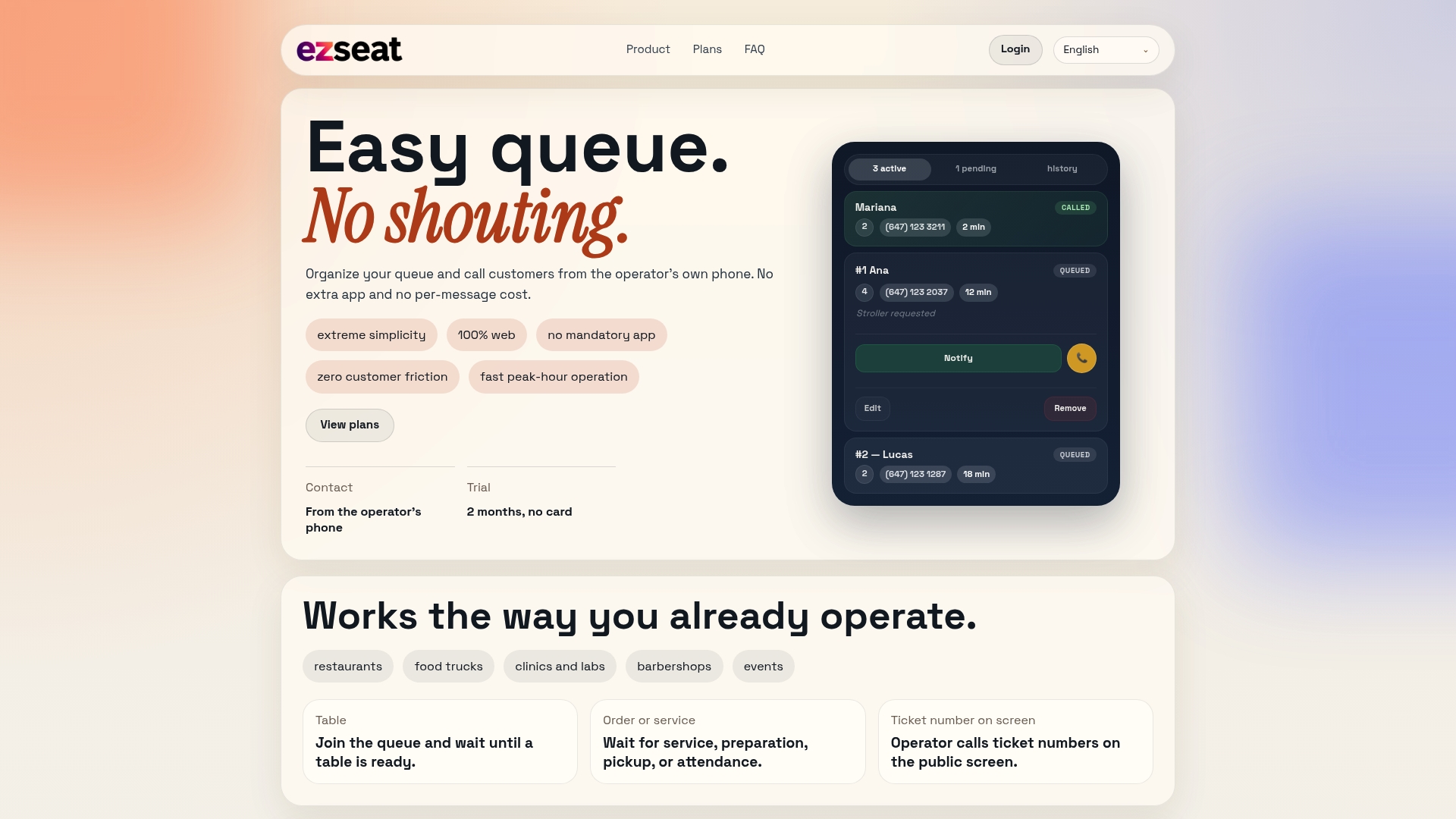
Some queue management systems support multi-queue and multi-device setups, so a restaurant running curbside alongside a walk-in line, or a food truck bouncing between festival stops, doesn't need separate tools for each. Some queue management plans expand with pickup volume, which matters most during the exact peak hours this article covers. If you're running a restaurant, food truck, clinic, or small retail location and want to see the check-in flow before committing, you can start a free trial and configure your first curbside queue today.
Sources
For policy examples on hold windows and readiness claims, see Walgreens' pickup FAQ and Sam's Club's curbside overview. For a documented case study on check-in and SMS updates, read Verint's Currys deployment. For the standard customer-facing flow, see Instacart's curbside pickup page.
- Order Pickup - Curbside, Drive-Thru & In-Store | Walgreens
- Pickup manager overview | Deliverect support
- Currys improves the curbside pickup experience | Verint