
The fastest, most reliable pop-up event queue combines an app-free virtual waitlist with a clearly marked physical staging area and trained marshals. Ezseat and similar browser-based systems let attendees join by scanning a QR code, no download required, while staff control admission from a phone. Before doors open, cap your capacity, pick your join method, and assign marshal roles.
TL;DR:
- Use a hybrid system combining app-free virtual waitlists with physical staging and trained marshals to handle unpredictable demand spikes effectively.
- Set a strict capacity limit based on realistic estimates and prepare backup overflow areas for sudden surges, especially during viral pop-up moments.
- Opt for browser-based joining, SMS callbacks, and public ticket displays, especially when Wi-Fi connectivity might be unreliable, to ensure resilience and control.
- Staff should include marshals at entry points, queue monitors, overflow overseers, and safety leads, with clear signage and communication protocols for smooth operations.
- Complete all permits and safety preparations at least 30 days in advance, and plan a rapid, lean setup from days to hours for quick turnarounds.
Table of Contents
- What Is a Pop-Up Event, and Why Do Its Queues Behave Differently?
- Pre-Event Checklist: Layout, Capacity, and Permits
- Should You Use a Physical Line, a Virtual Waitlist, or Both?
- What Technology Features Actually Matter for a Temporary Event?
- How Should You Staff and Signal the Queue on the Ground?
- What Permits and Safety Rules Apply to Temporary Events?
- How Fast Can a Pop-Up Actually Go Live? A Real-World Timeline
- Your Hour-by-Hour Day-Of Runbook
- What I've Learned From Watching Pop-Ups Succeed and Fail
- Ready to Run Your Next Pop-Up Without the Chaos?
- Sources
What Is a Pop-Up Event, and Why Do Its Queues Behave Differently?
A pop-up event is a temporary, limited-time activation, a store experience, a brand roadshow, a limited-inventory drop, built specifically to create urgency and heavy foot traffic. That built-in urgency is exactly what makes pop-up queues so unpredictable. A weekly farmers market queue barely fluctuates. A pop-up queue can go from twenty people to two hundred in fifteen minutes because a food account posted a story.
An event queue, in the operational sense, is just the system, physical or digital, that controls who get in and when. For a pop-up, that system has to absorb sudden demand spikes with almost no warning and no history to plan against. Ignore that reality and you get scenes like the one outside an Edinburgh shopping center in 2026, where a limited-run pop-up drew crowds that overwhelmed the site with no overflow plan in place. The lesson from that kind of incident isn't "expect fewer people." It's "expect more than you think, and build for it."
Pre-Event Checklist: Layout, Capacity, and Permits
Start with a number, not a hope. Estimate realistic turnout using past events, follower counts, or comparable activations nearby, then set a hard capacity cap with margin built in for a viral moment or a slow news day that sends foot traffic your way unexpectedly.
From there, work through this sequence:
- Sketch the footprint. Mark entry, staging, overflow space, and a clear egress route that never crosses the entry line.
- Assign staff posts on that sketch: a door marshal, a queue marshal, an overflow monitor, and a designated safety lead.
- Confirm permits early. Temporary food and vendor licensing timelines vary by jurisdiction and can take weeks to clear.
- Run a staff briefing the day before, covering roles, escalation steps, and what "full" actually means for your space.
A simple milestone timeline keeps this from turning into a scramble:
- T minus 30 days: File permits and licenses.
- T minus 14 days: Lock logistics, rentals, and staffing commitments.
- T minus 7 days: Test signage and any QR code waitlist technology.
- T minus 1 day: Walk the full site with staff and run a dry admission.
Should You Use a Physical Line, a Virtual Waitlist, or Both?
A simple physical line works fine when turnout is small, predictable, and contained, think a neighborhood coffee pop-up expecting fifty visitors over an afternoon. Keep it safe with stanchions, shade, and a marshal who can see the whole line at once.

A virtual waitlist earns its place the moment you expect a crowd. Letting people join remotely by browser or QR code, instead of physically standing in a line, mirrors a core idea from event-driven programming: non-blocking processing. Attendees "queue" without occupying physical space, wander nearby shops, sit down, or grab coffee, and get called when their spot opens.
Timed reservations or ticket windows fit a different problem: limited inventory. If you're dropping 100 units of a product at noon, a reservation window controls demand better than any line ever could.
Most real pop-ups need a hybrid: virtual entry to absorb the predicted peak, plus a physical lane for walk-ins who didn't plan ahead.

Pro Tip: Match your method to your weakest constraint, not your strongest one. If your space is tiny but your staff is strong, lean virtual. If your tech comfort among attendees is low (an older demographic, a rural location), keep a physical backup lane visible at all times.
What Technology Features Actually Matter for a Temporary Event?
Skip the feature checklist that sales pages love and focus on what breaks in practice. You need browser-based joining with no download, a public ticket screen so nobody has to ask "am I close," SMS or email callbacks, and a staff interface simple enough that a volunteer can learn it in five minutes.
Resilience matters more at a pop-up than almost anywhere else, because you're often on a temporary Wi-Fi hotspot in a parking lot or a borrowed retail space. Look for offline fallbacks and a control panel that survives a dropped connection without losing the queue.
Scaling behavior is the quiet killer. Systems built on FIFO-style event queue structures can throttle admissions deliberately, letting people in at a controlled pace instead of mass-admitting everyone the second a slot opens and collapsing your service line. That admission-worker approach, admitting from the queue at a steady cadence with short-lived tokens rather than all at once, is what keeps a pop-up from turning into the scene outside that Edinburgh shopping center.
One more thing: collect only what you need at join (name and phone number, maybe party size) and say so in one short line. Before go-live, run staff mock-joins, check the public display, test the SMS callback, and confirm what happens if the connection drops.
By the numbers: temporary food licenses in some jurisdictions require 30 to 60 days of advance processing, which means your tech testing timeline should never be the bottleneck; your paperwork usually is.
How Should You Staff and Signal the Queue on the Ground?
Get the human layer right and the technology mostly takes care of itself. Here's a minimum staffing structure:
- One door marshal per entry point, managing the pace of admission.
- One queue marshal per roughly 75 to 100 attendees in line, watching for confusion or tension.
- One overflow monitor once your line exceeds your marked staging area.
- One safety lead with first-aid basics and a direct line to venue security or local emergency services.
Signage needs to answer four questions before anyone asks a staff member: how do I join, how long is the wait, is this space accessible, and when's my entry window. Add directional arrows. Add shaded waiting where possible. A QR code join flow posted at eye level cuts down staff interruptions dramatically.
Build a communication cadence: an in-queue update every 10 to 15 minutes, a short PA script for delays, and a clear escalation path if someone becomes aggressive or unwell. Families and attendees with mobility needs deserve a visible, separate fast-track lane, called out on signage, not buried in a policy page nobody reads. Guidance on inclusive event design is worth a look if this is new territory for your team.
What Permits and Safety Rules Apply to Temporary Events?
Permit rules are jurisdiction-specific, and assuming last year's paperwork still applies is how organizers end up shut down mid-event. Verify temporary-event permits, food licensing, and sales-tax registration separately, since they often run through different offices on different clocks.
Timelines vary widely. Some regions want 30 to 60 days for temporary food licenses. Washington State, by contrast, issues Temporary Registration Certificates with rules on how early you can apply, sometimes as much as six months ahead. Pennsylvania treats a retail food activation running 14 days or fewer as a distinct temporary-event category with its own license process.
Beyond the paperwork:
- Confirm egress routes meet local crowd-density limits, not just your own guess.
- Have a first-aid presence on-site, even for a small activation.
- Verify event insurance covers the specific address and date.
- Keep permit copies and regulator contact numbers in a physical binder on-site, not just in someone's inbox.
How Fast Can a Pop-Up Actually Go Live? A Real-World Timeline
A pop-up restaurant or outdoor food activation can move from sign-up to a fully working queue in a matter of days, not weeks, using a browser-based system. Ezseat's Go Live in Four Days case walks through exactly that kind of compressed timeline for an outdoor setup.
The operational setup is lean: a QR code posted at the entrance for joining, a public screen showing ticket numbers so nobody has to shout, and an SMS callback when a table or slot opens. Staff briefing takes under an hour because there's no app for anyone to install or troubleshoot.
The payoff shows up in the details that matter most on a busy day: fewer people crowding the door, fewer walkaways from folks tired of waiting in the sun, and a smoother, more predictable flow from arrival to seating. For a step-by-step version of this exact setup, Ezseat's pop-up restaurant waitlist guide breaks down the afternoon build in detail.
Your Hour-by-Hour Day-Of Runbook
- T minus 90 minutes: Confirm connectivity, power, and the public display; check staff in.
- Opening hour: Post marshals, run the join flow with the first five real attendees, and set your admission cadence.
- Peak window: Throttle admissions deliberately, open the overflow area, and rotate staff every 60 to 90 minutes so nobody burns out on a hot post.
- Surge protocol: If demand spikes past plan, pause new admissions, post a clear public message, and open overflow or a designated safe waiting zone immediately.
- Post-event: Capture attendance data, handle lost and found, and run a five-minute debrief with staff while the details are still fresh.
Pro Tip: Write your surge protocol on a laminated card and hand it to every marshal before doors open. In the moment, nobody remembers the plan from the briefing three hours earlier.
What I've Learned From Watching Pop-Ups Succeed and Fail
The organizers who struggle almost always make the same mistake: they plan for the turnout they expect, not the turnout that's possible once momentum builds. FOMO is a genuine crowd multiplier, and treating your capacity estimate as a ceiling rather than a target saves you from the chaos of a line that outgrows its space in twenty minutes.
The fixes that actually move the needle aren't complicated. App-free entry removes the single biggest point of friction between a curious passerby and a joined queue. A public display replaces the shouted-name system that frustrates everyone within earshot. Short, defined admission windows beat vague "we'll call you" promises every time. None of this is theoretical. It's what separates a pop-up that runs smoothly from one that ends up as a headline about an unmanaged crowd.
— Ezseat
Ready to Run Your Next Pop-Up Without the Chaos?
A modern queue system offers what a printed sign-up sheet or a walkie-talkie system can't: a browser-based join flow, a public ticket display, and SMS callbacks, all running from a phone your staff already has in their pocket.
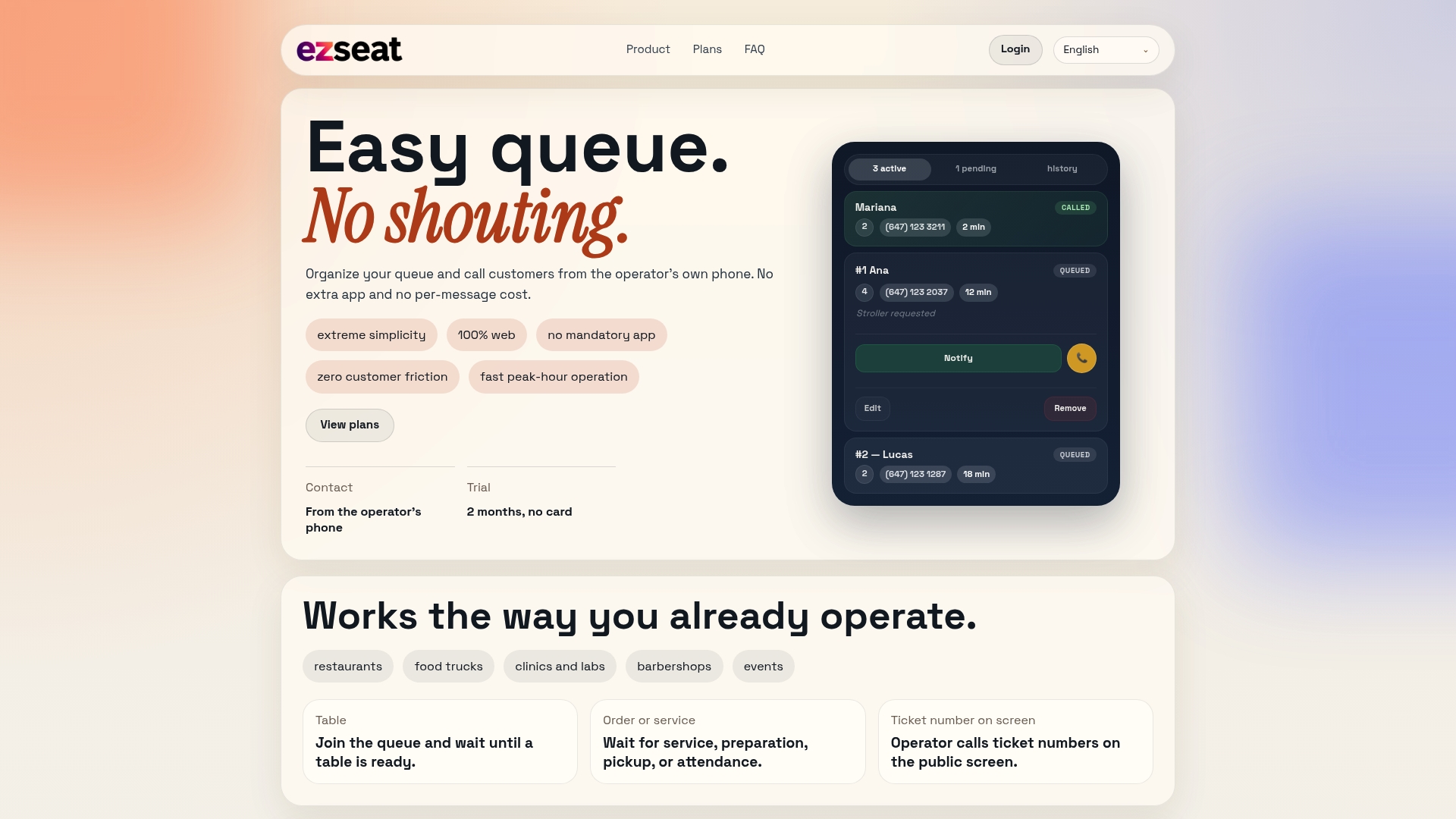
There is no app for guests to download and no hardware to rent. You post a QR code, your team manages admission from a simple screen, and attendees get a text when it's their turn instead of straining to hear their name over crowd noise. For a full walkthrough of setting this up before an event, the Go Live in Four Days guide covers the exact build, and the web-based queue overview breaks down which setup fits your space. If staffing your activation is the harder piece, staffing guidance for brand activations pairs well with the queue side of the plan.
Head to the Ezseat landing page to start your trial and get your queue configured before your next pop-up date.
Sources
- What are pop-up events — Guidebook glossary
- Temporary food establishments & events — Iowa DIAL
- Temporary businesses — Washington Department of Revenue
- Edinburgh locals in huge weekend queues outside shopping centre for pop-up event — Edinburgh Live