
For pop-up restaurants, the fastest way to run an app-free waitlist is a browser-first virtual queue: QR or short-link joins, SMS nudges, and a simple host dashboard that runs on any phone. That setup cuts walk-aways, keeps your host doing hospitality instead of crowd control, and Ezseat can have it running before your first service. Most operators finish setup in an afternoon, not a launch cycle.
TL;DR:
- Setting conservative caps based on kitchen throughput avoids overwhelming staff, especially during peak hours, and should be adjusted after initial debriefs.
- Manual host fallback procedures are essential for guests without smartphones or with poor signals, ensuring smooth operation despite inevitable technical issues.
- Tracking five key metrics daily—walk-away rate, table turn time, recovered covers, average party size, and marketing opt-in rate—guides effective adjustments during the residency.
- Building the waitlist system in an afternoon involves generating QR codes, deciding join channels, configuring caps, and rehearsing fallback routines before opening.
- Properly managing guest expectations through realistic wait estimates and timed notifications significantly reduces abandonment and increases guest satisfaction.
Table of Contents
- What a pop-up restaurant waitlist actually needs
- How to set up your waitlist before opening night
- Setting expectations without frustrating your guests
- Running the floor at peak without overselling seats
- What to measure during a short residency
- Notes from the field: what actually breaks first
- Get your waitlist running before your first guest arrives
- Sources
What a pop-up restaurant waitlist actually needs
A pop-up doesn't need enterprise reservation software. It needs a handful of features that hold up under one night of chaos and zero training time.
- Browser/QR join with a kiosk fallback. A guest scans a code at the door or taps a short link, types a name and phone number, and joins the line, no app store required. Not every guest has a working phone or wants to use it, so QR codes or web links let people join without downloads, while a tablet kiosk or staff member handles the rest. Pop-ups also benefit from offering more than one join channel since guests discover you differently. Someone walking past reads a sandwich board; someone from a food-hall app reads a table tent.
- SMS or call notifications with a nudge sequence. Guests wander off. Texts bring them back at the right moment instead of leaving a host yelling a name into a crowd.
- A host dashboard that lives on a phone. Seat a party, mark a no-show, let someone rejoin the line, or manually add a walk-up who can't use a smartphone.
- A public ticket screen or simple staff-facing display. Guests can see where they stand without asking, which cuts down on the "how much longer?" interruptions every host dreads.
- Operational caps and routing. Party-size limits, join caps per window, and split lanes so pre-orders and walk-ups don't collide.
- Minimal data capture with clear opt-in. Collect a name and phone number, nothing more, and give guests an explicit choice before adding them to any marketing list.
That last point matters more for a pop-up than a permanent restaurant. You're handling guest data for a few days or weeks, and you won't be around long enough to build trust the slow way. Keep the ask small.
How to set up your waitlist before opening night
You can build this whole system in a single afternoon if you work through it in order; for deeper integration on reservation and floorplan management, check out Canada's top restaurant reservation management systems.
- Generate your QR code and short link, then get signage printed. Put the code at the entrance, on menus, and anywhere guests already stop to read something.
- Decide your join channels. Browser/QR is your default, but define a staff-assisted fallback (a tablet at a host stand works fine) for guests without a working phone.
- Set conservative caps and party-size rules, then run one or two test check-ins with staff acting as guests before doors open.
- Configure your SMS timing. A first nudge around 20 minutes out, a reminder around 8 minutes out, and a final "table's ready" message with a 4-minute grace window before you move to the next name.
- Assign host devices and rehearse the fallback. Someone needs to know how to manually add a guest to the queue when the QR code doesn't cooperate, because it eventually won't.
Pro Tip: Run your soft open with real friction, not a clean test. Have someone join with a flip phone, someone join twice by accident, and someone show up without a phone at all. If your system survives those three, it'll survive a Friday night.
Ezseat's QR code setup guide walks through code generation and signage placement in more detail if you want a second pass before launch.
Setting expectations without frustrating your guests
Never quote your best-case estimate. Operators who pad their quoted wait by five to ten minutes consistently see happier guests, because being seated early feels like a win and being seated late feels like a broken promise. Tell someone "30 to 40 minutes" and seat them at 32, and they'll remember the pop-up fondly. Tell them "20 minutes" and seat them at 32, and they won't.
The nudge sequence does the emotional labor for you:
- First notice, about 20 minutes out: "You're getting close! We'll text again soon."
- Reminder, about 8 minutes out: "Almost there, start heading back to the entrance."
- Table ready, with a grace window: "Your table is ready. Please check in within 4 minutes."
Virtual queueing built this way typically drops abandonment from a physical line's 18 to 32 percent down to single digits, often 4 to 7 percent, because guests know exactly when to come back instead of guessing.
Your first two weeks will be your least accurate for wait-time prediction, and that's fine. Estimates tighten fast once you have real data to work from, so quote a wider range on day one and narrow it as the residency goes on.

Running the floor at peak without overselling seats
Peak hour is where pop-ups fall apart, usually because caps were set by optimism instead of kitchen throughput.
- Start conservative on caps per 15-minute window. Trucks and short-run kitchens commonly start around 8 to 15 orders per window and adjust up after a debrief, not down mid-service.
- Split lanes when pre-orders and walk-ups compete for the same kitchen. Assign one person to expedite each lane so neither backs up the other.
- Use single-queue routing for food-hall or multi-stall setups. One line feeding several stalls keeps groups who want different vendors seated together instead of splitting up.
- Name tickets with something searchable, like a first name plus the last four digits of a phone number and the arrival window. Makes handoffs between hosts painless.
- Build in a crisis lever. If the kitchen falls behind, close the join link, push out a broadcast text to everyone waiting, and pull a server over to run food instead of tables.
It's better to sell out a window and extend hours than to let the line stretch past what your kitchen can actually deliver.
What to measure during a short residency
You don't need a dashboard full of metrics for a five-day pop-up. You need five numbers, tracked daily, that tell you whether the operation is working.
| Metric | Why it matters |
|---|---|
| Walk-away rate | Direct signal on whether wait times and messaging are working |
| Table turn time | Shows whether seating pace matches kitchen output |
| Recovered covers | Parties who would have left but stayed because of the queue |
| Average party size | Helps recalibrate caps and lane splits mid-run |
| Marketing opt-in rate | Tells you if your data capture is actually converting |
Digital waitlists tend to run about 25% fewer walk-aways and roughly 15% faster table turns than a paper sign-in sheet, and virtual queueing's abandonment drop of roughly 22 percentage points at the midpoint gives you a rough way to model recovered covers against your average check. If you're running 40 covers a night and cutting walk-aways by a fifth, that's real revenue you'd have otherwise lost to someone giving up and leaving.
Pull this from your host dashboard export each morning, or tally it by hand if you're keeping things simple. Either way, review it daily during the residency and roll it up weekly to adjust caps and message timing before the next weekend.

Notes from the field: what actually breaks first
The most common failure isn't the technology, it's the caps. Operators consistently set them based on how the kitchen performs during a calm Tuesday prep, then get surprised when Saturday night doesn't behave the same way. Set caps low for the first service and raise them only after a debrief.
The second most common mistake is assuming every guest has a smartphone and a signal. They don't. A pop-up in a parking lot or a warehouse space often has patchy coverage, and someone always shows up with a dead phone. Build the manual fallback into your host's routine from day one, not as an afterthought you improvise mid-rush.
Browser-first flows work because they remove the biggest point of friction: nobody has to download anything to stand in your line. That frees your host to actually host, rather than manage a queue by shouting over a crowd. If you want more detail on the display side, Ezseat's queue display screen guide covers how to set up a public ticket board that does some of that communication work for you.
— Ezseat
Get your waitlist running before your first guest arrives
Every checklist in this guide maps directly to something Ezseat already does: QR-to-web joins so guests never touch an app store, SMS nudges timed to your service pace, a host dashboard built for a phone screen, and multi-queue support if you're running more than one stall or lane.
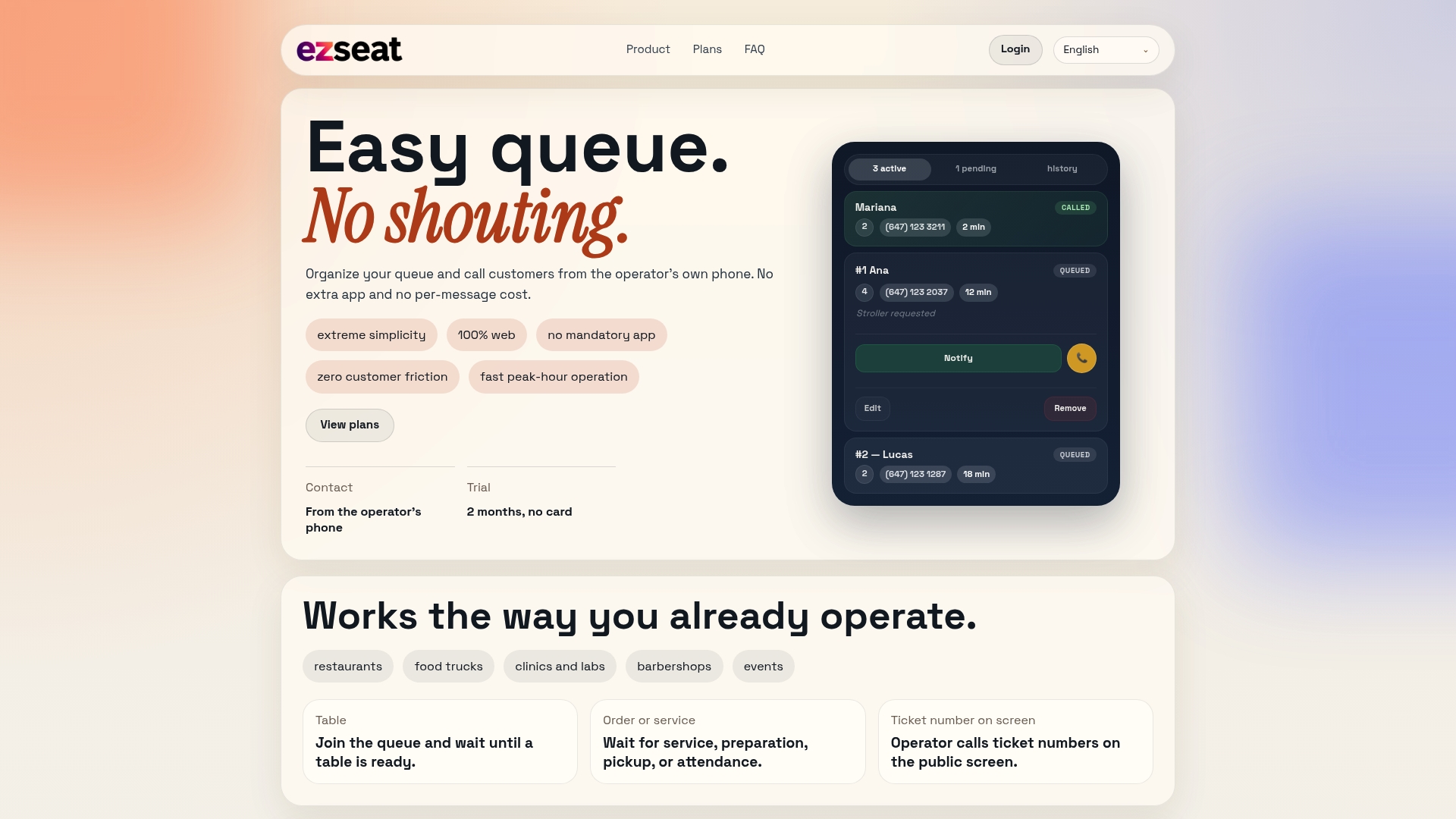
You get a free two-month trial before choosing between the Light and Pro plans, so there's no cost pressure while you're testing it against your actual opening weekend. If your pop-up runs longer or adds locations, the plan grows with you instead of forcing a switch mid-residency. For guidance on setting up SMS channels correctly from the start, Ezseat's short code versus 10DLC breakdown is worth a read before you configure notifications.
Generate your QR code, send yourself a test SMS, and run one practice check-in with staff before doors open. Start your trial at Ezseat and have the whole system live before your first guest walks in.
Sources
- Virtual Queueing for Restaurant Pop-Ups UK | Zeour Ltd
- How to Optimize Your Restaurant Waitlist in 2026 | Toast POS (On The Line)
- Do Customers Need an App to Join a Virtual Queue? | VizitorApp
- Don't Get Flat-Topped by Your Own Pre-Orders: Kitchen Flow, Caps, and Pick-up Lines | Outbites