
A restaurant virtual queue replaces the clipboard and shouted names with a ticketless, phone-first system: guests join from a QR code or web link, watch their position or ETA update in real time, and get notified when their table is ready. The immediate payoff is fewer walkaways and steadier table turnover during peak hours. This guide covers the features that matter, setup steps, the metrics worth tracking, and the operational habits that keep the system honest.
TL;DR:
- A virtual queue with no download requirements reduces walkaways caused by app download friction and improves guest flow management during peak times.
- Real-time ETA updates, hold windows, and two-way messaging decrease no-shows, enhance experience, and allow better staffing decisions.
- Successful setup takes from a few minutes to two weeks, with core features including POS sync, flexible entry channels, and guest notifications.
- Tracking key metrics like average wait time, walkaway rate, and notification delivery rate helps identify bottlenecks and improve system performance.
- Consistent communication, clear rules, and staff training are essential to maintaining guest trust and operational efficiency.
Table of Contents
- What Is a Restaurant Virtual Queue and How Does It Work?
- Key Features Restaurant Owners Should Prioritize
- Benefits and Measurable ROI Restaurants Can Expect
- Setup and Integration Steps to Go Live Quickly
- Operational Best Practices and Guest Expectation Rules
- Analytics and KPIs: What to Track and How to Act on It
- Common Pitfalls and Troubleshooting Checklist
- Ezseat in Practice: Implementation Highlights
- Getting Started Checklist and Pricing Considerations
- Publisher Perspective: What Actually Moves the Needle
- Try Ezseat for Your Next Service Rush
- Sources
What Is a Restaurant Virtual Queue and How Does It Work?
The mechanics are simple enough to explain in one breath: a guest joins, the system estimates a wait, the host manages the flow, and a notification tells the guest when to walk back in. But the details inside each step decide whether the system actually reduces friction or just digitizes the same chaos.

Guests can enter a queue several ways. A QR code taped to the host stand is the most common, but web links (shared via text or posted on social media), SMS, and self-service kiosks all work too. The advantage of browser-based entry is that nobody downloads anything. That single detail matters more than it sounds, because app-download friction is one of the biggest reasons walk-in tools fail to get adopted at the exact moment they're needed most: a Friday night rush with a line out the door.
On the host side, the workflow looks like this: add the walk-in party, log the size and any notes (high chair, allergy, celebration), and let the system generate an ETA based on current table turnover and party size. As tables open up, the host calls or notifies the next eligible party, and the guest gets a set window to arrive before their spot lapses.
Notification mechanics run on three moments: the initial ETA when a guest joins, a "getting close" heads-up partway through the wait, and the "your table is ready" alert with a hold window, typically a short grace period, before the party is skipped. Some restaurants prefer strict position-in-line systems, where guests see "you're 4th," while others favor time-slot style reservations layered on top of the walk-in queue for parties who call ahead. Either model works, but mixing them without clear rules confuses staff and guests alike.
Key Features Restaurant Owners Should Prioritize
Not every queue tool is built the same, and the gap between a barebones digital list and a real operational tool shows up fast during a busy Saturday. When evaluating a system, or auditing the one you already have, prioritize features that actually change guest behavior and staff workload, not ones that just look good in a sales deck.
- No-download entry: QR code, web link, or a kiosk at the host stand, so guests never have to install anything to get in line.
- Two-way messaging: guests can reply to confirm they're on their way or cancel, which frees up the spot faster than silence does.
- Dynamic ETA prediction: wait estimates that adjust as tables actually turn over, not a static number set once at 6 p.m.
- Multi-queue and floor mapping: separate lines for the bar, patio, and dining room, with section-level table tracking so hosts aren't guessing which server has room.
- Hold windows and party notes: a configurable grace period for late arrivals, plus fields for allergies, high chairs, or accessibility needs.
- POS and reservation sync: walk-ins and reservations feeding into one view so a host isn't toggling between two systems.
- Pre-arrival join via search or maps: letting guests join before they even leave home shortens the in-person wait and smooths arrival timing.
Some platforms built for large-scale operations, like Qmatic Orchestra, add kiosks, waiting-area displays, and appointment booking on top of the basics. Most independent restaurants don't need that level of infrastructure, but the underlying features (accurate ETAs, reliable notifications, multi-location admin) are worth the same scrutiny whether you're running one dining room or ten.
Pro Tip: Test your notification delivery rate before opening night, not during it. Send yourself ten test messages across different carriers and phone types; if more than one fails to arrive, fix that before you trust the system with a real line.
Benefits and Measurable ROI Restaurants Can Expect
The business case for a virtual queue rests on one behavioral fact: people wait longer, and complain less, when they can see their status and roam freely instead of standing in a doorway. That single shift changes several numbers at once.
Walkaways drop because guests aren't staring at a static line wondering if they've been forgotten. Table turnover improves because hosts spend less time physically tracking down parties and more time seating them the moment a table clears. And no-shows fall because a two-way notification, rather than a one-way name call, gives the host a chance to confirm someone is actually still coming before holding a table open.
What the ROI actually looks like: a restaurant running a substantial average Friday wait with a moderate walkaway rate could plausibly cut walkaways into the high single digits just by giving guests visibility and freedom to wait elsewhere, since restaurant queue tools built around walk-away capture are specifically designed to turn those abandoned spots into recoverable, notifiable guests rather than lost covers.
Practical outcomes owners tend to see within the first month or two:
- Fewer guests leaving the building or driving off once they see an estimated wait, because they can wander to a nearby shop instead of hovering by the door.
- More consistent seating pace during peak hours, since hosts aren't manually re-explaining wait times to every new arrival.
- Better staffing decisions, because host stand data shows exactly when the line spikes and when it's safe to cut a host early.
- A captured list of walk-in guest contacts that can double as a remarketing list for slow Tuesdays.
None of this requires guessing. It requires watching the numbers, which is the next piece.
Setup and Integration Steps to Go Live Quickly
Getting a virtual queue running doesn't require a months-long IT project. Most restaurants can have a basic version live before the next dinner service, and a fully integrated version within a couple of weeks.
- Create an account and generate QR codes (15 to 30 minutes). Set your restaurant name, party size options, and basic house rules like hold window length.
- Print and place signage (same day). Put QR codes at the host stand, entrance, and any outdoor waiting area, with a one-line instruction: "Scan to join the wait list, no app needed."
- Train hosts on the core flow (30 to 60 minutes). Cover adding walk-ins, adjusting ETAs, sending the "ready" alert, and handling no-response guests.
- Connect POS and reservation systems (a few hours to a day, depending on the platform). This step lets walk-ins and reservations share one table map instead of two separate guesses about availability.
- Add displays or kiosks if needed (optional, 1 to 2 days for hardware setup). Useful for high-volume spots where a host can't manage every phone-based check-in personally.
- Run a two-shift soft launch. Track how often ETAs miss by more than 10 minutes, confirm sample notifications land on multiple carriers, and adjust the estimator based on real turnover data.
Vendor claims of "live in under five minutes" generally refer to that first step: QR generation and basic account setup, not the fuller integration with POS and reservations. Budget realistically: a bare-bones launch can happen in an afternoon, but a system that talks to your reservation book and floor plan takes closer to one to two weeks of testing to get right. For a step-by-step breakdown suited to smaller footprints, a web-based waitlist setup guide walks through the browser-first version in more detail, and food truck operators facing tighter space and simpler menus can find faster paths in quick-launch queue strategies built for limited-footprint service.
Operational Best Practices and Guest Expectation Rules
A virtual queue only works if the rules around it are consistent. Guests forgive a wait; they don't forgive being told one thing and experiencing another.

Write your signage and host scripts around honesty, not optimism. If the system says 25 minutes, don't let a host verbally promise "just a few more minutes" to smooth over a delay. That gap between digital estimate and spoken reassurance is where trust erodes fastest.
Set clear house rules and repeat them at check-in: how long the hold window lasts once a table is ready (5 to 15 minutes is standard), what happens on a no-response text, and whether a canceled spot can be re-added at the back of the line or loses priority entirely. Post these rules near the QR code so guests read them before they need them, not after they're upset.
- Staff the host stand with a dedicated person during peak windows; a server juggling both jobs will let ETAs drift.
- Offer a small incentive (a drink special, a discount) for guests willing to wait during traditionally slow shoulder hours, which smooths demand instead of just managing it.
- Reassess your hold window monthly. A 10-minute window that works for a casual spot might be too tight for a destination restaurant where guests are parking or walking from a distance.
- Never let a queue run silent for more than 10 minutes without an update, even if the update is just "still on track."
Pro Tip: Give hosts a one-line script for the ready alert: "Your table's ready, we'll hold it for 10 minutes." Specificity in the message reduces the number of guests who show up 20 minutes late assuming they still have time.
Analytics and KPIs: What to Track and How to Act on It
Four numbers tell you almost everything about whether your queue system is actually working: average wait time, seat turnaround, walkaway rate, and notification delivery rate. Track them weekly, not just at the end of a quarter, because problems compound fast during a busy stretch.
- Average wait time: the gap between join and seating; rising trends without a corresponding sales increase usually mean slower table turns, not more demand.
- Seat turnaround: how quickly a table gets bussed, reset, and reseated; this is often the real bottleneck, not the front door.
- Walkaway rate: the percentage of guests who leave the queue before being seated; a spike here often traces back to inaccurate ETAs rather than actual overcrowding.
- Notification delivery rate: what percentage of alerts actually reach guests; a drop usually points to carrier filtering or bad phone number entry, not guest disinterest.
When walkaway rate climbs past your baseline, the first move isn't more staff, it's checking whether ETAs are systematically underestimating wait times, since enterprise platforms built around analytics-driven staffing exist specifically because daypart-level data reveals exactly when a restaurant is understaffed versus simply busy. If delivery rate drops, check whether a recent host stand entry error introduced malformed phone numbers. A deeper walkthrough of these metrics, including how to set realistic weekly targets, lives in this queue analytics guide.
Common Pitfalls and Troubleshooting Checklist
Most virtual queue complaints trace back to one of four causes, and all four are fixable without replacing the system.
Bad ETAs usually come from an estimator trained on stale turnover data. If your average table turn changed after a menu update or seating rearrangement, retrain or manually adjust the estimate until the algorithm catches up, typically within a week of consistent data.
Failed notifications are almost always a data entry problem, not a platform failure: a mistyped digit, a landline entered as a mobile number, or a carrier flagging repeated automated texts as spam. Check the SMS notification setup and confirm message templates avoid spam-trigger language.
Too many custom fields or overlapping queues slow hosts down during rushes. If a host stand screen requires six taps to add a party, cut fields down to what's actually used, not what seemed useful during setup.
When something breaks mid-shift, fall back to a paper list temporarily, log the issue, and escalate to support once service calms down rather than troubleshooting live during a rush.
Ezseat in Practice: Implementation Highlights
Ezseat was built around a simple bet: the fewer barriers between a hungry guest and joining a line, the fewer guests you lose. That's why entry happens entirely in a browser. No app store, no download prompt, no guest hesitating at the door because their phone storage is full.
- Guests join via a scanned QR code or shared web link, no installation required at any point.
- Hosts manage the entire flow, party size, ETA, notifications, from a phone or tablet, without shouting names across a packed waiting area.
- Plans scale from a single food truck window to multi-location restaurant groups, so the system doesn't need replacing as the business grows.
| What matters | Why it counts for owners |
|---|---|
| Browser-based guest entry | Removes the download barrier that causes walkaways before the wait even starts |
| Phone-based host management | Cuts the need for a dedicated podium or paper list during peak hours |
| Flexible plan tiers | Lets a single-location operator start small and expand without switching platforms |
| Free two-month trial | Gives owners a full peak season to validate ROI before paying anything |
Getting Started Checklist and Pricing Considerations
Before committing to any queue platform, walk through a short internal checklist so the pilot actually tells you something useful.
- Define your goal. Are you trying to cut walkaways, speed up turnover, or reduce host stand chaos? Each goal points toward slightly different feature priorities.
- Pick your entry channels. Decide whether QR-only is enough or whether you also need a kiosk for guests without smartphones.
- Map integration needs. List whether POS and reservation syncing matters now or can wait until after a pilot proves the concept.
- Set your reporting cadence. Weekly reviews of walkaway rate and average wait give you enough data to adjust without overreacting to a single slow night.
- Scope a two-week pilot. Run it at one location, track the baseline numbers before and after, and resist the urge to add every feature on day one.
On pricing, expect the cost structure to hinge on a few levers: whether the plan is per-location or scales with seat count, whether SMS messaging carries its own per-message cost, and whether custom integrations (POS, third-party reservation books) require a higher tier. Start on a simple web-based plan and only move toward heavier, enterprise-style features, like the kiosk and multi-site dashboards found in platforms such as Infini-Q, once you've outgrown a single-location setup and need centralized reporting across multiple sites.
Publisher Perspective: What Actually Moves the Needle
Start simple. Most restaurants overbuild their first queue system with fields and integrations nobody uses, then wonder why adoption is slow. Track two numbers first, walkaway rate and average wait, before adding anything else. Reliable notifications and frictionless guest entry matter more than any dashboard feature. Give yourself 90 days, not 90 minutes, to see real movement in those numbers.
— Ezseat
Try Ezseat for Your Next Service Rush
Ezseat gives guests a way into the line without ever touching an app store, and gives hosts a way to run the floor from a single phone screen instead of a clipboard and a shouting match. That combination matters most exactly when it's hardest to manage: a packed Friday night with a line stretching past the host stand.
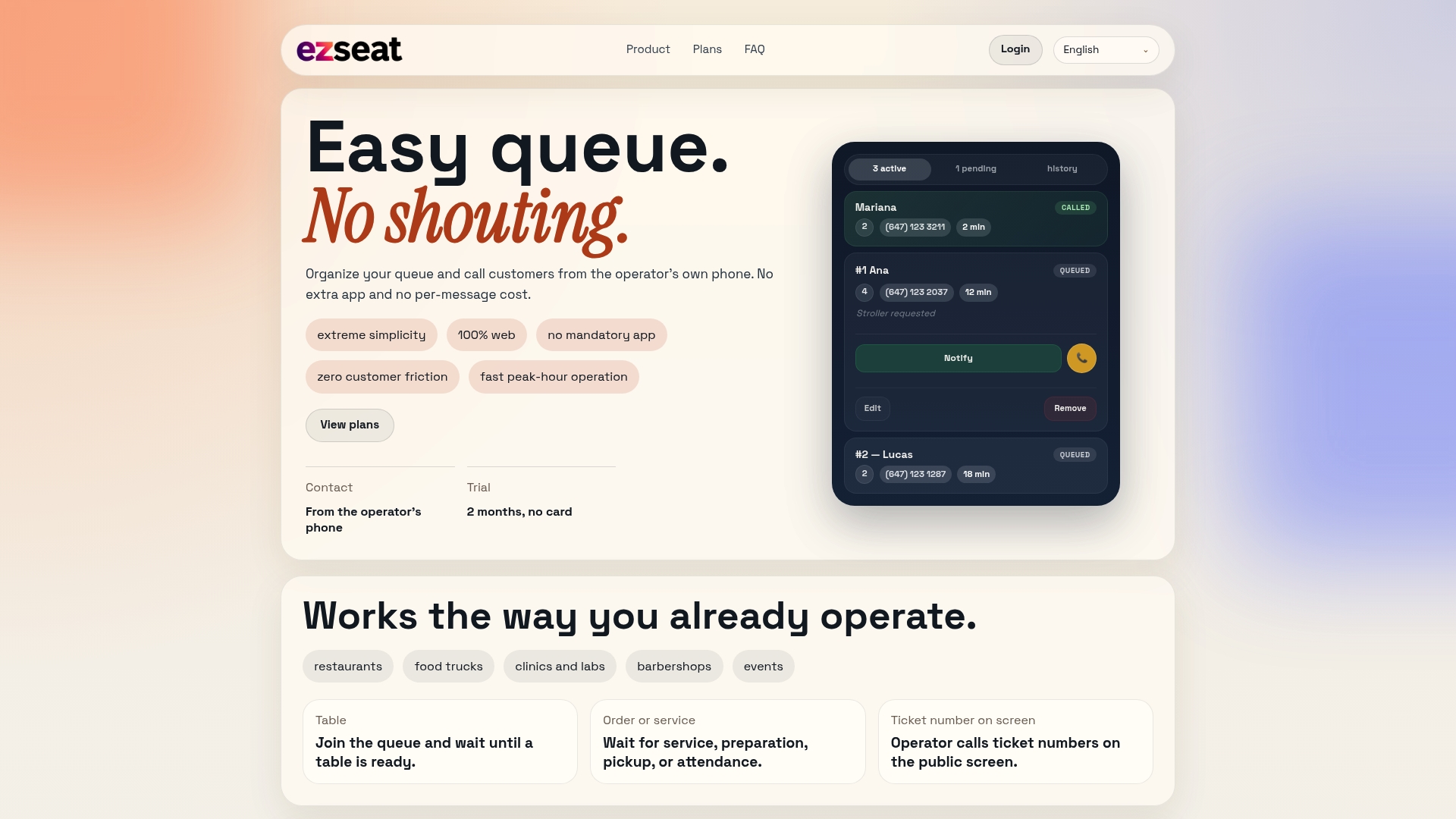
Setup starts with generating a QR code and takes minutes, not days, and the system scales from a single food truck window to a multi-location group without forcing a platform switch later. Every new account starts with a free trial period, long enough to run through a full busy season and see the walkaway and turnover numbers move before spending a dollar. If your POS or reservation book needs to talk to your queue, that connection is part of the setup path, not a separate project.
Ready to see it on your own floor plan? Start your free trial with Ezseat and get your first QR code generated before your next shift.
Sources
- Enterprise Queue Management System - Qmatic Orchestra
- Oddle Queue · Restaurant Queue Management System | Oddle