
A centralized virtual queue with one dashboard and consistent notifications is the fastest, lowest-risk way to coordinate customer flow across multiple sites. It keeps every branch running the same rules while giving managers a single view of load. The two reasons this beats site-by-site queueing: it standardizes the customer experience, and it lets you shift demand to underused locations in real time. Start by auditing what dashboards and notification channels you already run at each site.
TL;DR:
- Standardizing queue management across multiple sites reduces walkaways and shortens wait times by enabling demand shifting and better staffing decisions.
- Key features include a centralized dashboard, multiple check-in channels, real-time routing, role-based access, and customer notifications with ETA estimates.
- Rolling out multi-location queues should follow phased pilots, site audits, and standardized procedures, with contingency plans for offline or connectivity issues.
- Tracking KPIs such as average wait time, walkaway rate, and transfer rate helps optimize operations and trigger timely capacity adjustments.
- Clear customer communication via SMS, browser alerts, and consistent queue logic significantly lowers no-shows and improves overall customer experience.
Table of Contents
- Why Multi-Location Queue Management Matters
- Core Features To Require From A Multi-Location Queue System
- Step-By-Step Rollout Checklist For Multi-Site Deployment
- Monitoring And KPIs: What To Measure And How To Act
- Customer Communications That Cut Walkaways
- Common Pitfalls And Operational Fixes
- What Ezseat Sees Across Multi-Location Operators
- Get Your Multi-Location Queue Running Without The App-Download Friction
- Sources
Why Multi-Location Queue Management Matters
Businesses running several branches lose customers the moment one location gets slammed while another sits half empty. A shared queue system fixes the mismatch and pays off in ways that show up on the P&L, not just the customer-satisfaction survey.
The practical gains stack up fast:
- Fewer walkaways and shorter effective wait times, since staff can see a backlog forming before it becomes a line out the door.
- A consistent check-in and wait experience across every branch, which protects the brand when customers compare locations.
- Staffing decisions based on real demand patterns instead of a manager's gut feeling about "busy Fridays."
- Less scrambling during peaks, because load can shift to a nearby site instead of piling up at one counter.
Cross-location reporting also surfaces staff underutilization that a single-site view never catches. A branch that looks fine in isolation might be quietly overstaffed for its actual traffic, and you only see that when you compare it against sister locations.
Core Features To Require From A Multi-Location Queue System
Vendor demos tend to emphasize the shiny parts. Focus your evaluation on the features that actually determine whether the rollout works at site number four, not just site number one.
- A centralized dashboard with per-location controls. You need a global view for the regional manager and a local view for the front desk, drawing from the same data.
- Multiple check-in channels. Web and QR entry, a reception kiosk, staff-assisted sign-up, and a phone or text option cover almost every walk-in scenario.
- Real-time routing and capacity balancing. The system should let staff transfer or redirect customers between nearby locations when one site is overloaded.
- Role-based access and audit logs. Front-line staff, location managers, and regional admins need different permission levels, and every queue action should leave a record.
- Per-location configuration on top of shared defaults. A clinic branch and a food truck pop-up don't need identical fields, but the underlying logic should stay the same.
- Customer notifications with ETA estimation. SMS or browser alerts tied to a live position or time estimate, plus a public display and simple operator controls at the counter.
The pattern echoes how job queue systems handle priority work: River isolates high-priority queues and reserves worker capacity so urgent jobs never wait behind routine ones. A multi-location queue should do the same for VIP appointments or urgent walk-ins.
Pro Tip: Test the transfer feature before anything else during a demo. If moving a customer from an overloaded branch to a quieter one takes more than two taps, staff won't use it during a real rush.
Step-By-Step Rollout Checklist For Multi-Site Deployment
Rolling out queue software to five locations at once is how good systems get bad reputations. Sequence the work instead.
- Audit each site first. Check Wi-Fi reliability, existing signage, and who actually owns queue duties on a given shift.
- Run a single-location pilot. Pick one branch, set two or three success metrics, and define a rollback plan if it flops.
- Standardize services and SLAs before scaling. Decide what "checked in" and "served" mean the same way everywhere, before a second location goes live.
- Train operators and document SOPs. Write down the exact steps for check-in, transfer, and no-show handling so a new hire can follow them without a manager hovering.
- Set permissions by role. Front desk staff get local controls; regional managers get visibility across sites.
- Review the pilot, then roll out in phases. Don't push to all locations simultaneously. Add sites in small batches and fix issues between waves.
- Plan for offline failure. Kiosks lose connectivity. Decide in advance whether they queue offline and sync later, or fall back to a paper backup.
This mirrors a pattern seen in distributed computing: Kueue's multi-cluster setup requires mirroring configuration across clusters to get predictable results. Queue software across branches needs the same discipline, or behavior drifts from site to site until nobody trusts the numbers.
Monitoring And KPIs: What To Measure And How To Act
Numbers you don't act on are just decoration. Pick a short list of KPIs and tie each one to a specific response.
Track these at the location level:
- Average wait time and service time per counter.
- Walkaway rate (people who leave before being served).
- Counter or staff utilization during peak windows.
Then layer on cross-location numbers:
- Demand share, meaning what percentage of total traffic each site is absorbing.
- Transfer rate between locations.
- Capacity headroom, or how much room a location has before it's overloaded.
Statistic to watch: virtual queueing and SMS-based waiting is consistently framed by vendors as a direct lever on walkaway rates, since customers who can wait remotely are far less likely to abandon the line out of frustration.
Set alert thresholds ahead of time. If wait time crosses ten minutes at one branch while a sister location sits under three, that's your trigger to open an extra counter or reroute new arrivals.

Customer Communications That Cut Walkaways
Nobody likes standing in a line with no information. The fix isn't complicated, it's just consistent.
- Offer SMS and browser push at minimum; add kiosk receipts for walk-in-heavy locations.
- Show a position number or a time estimate, not both competing for attention on the same screen.
- Use reservation holds and short grace windows to cut no-shows without punishing customers who are five minutes late.
- Keep appointments and walk-ins in the same queue logic so a scheduled patient doesn't get bumped by three walk-ins who arrived first.
Clear messaging is the cheapest fix in this entire guide, and it's often the one operators skip because it feels like a UX detail rather than an operational one.
Common Pitfalls And Operational Fixes
Most multi-location rollouts fail from a handful of repeatable mistakes, not from bad software.
- Dual-join and ghost entries. Customers rejoin a queue on two devices, inflating counts. Tie every entry to a session or profile so duplicates get flagged automatically.
- Per-site customization that breaks standardization. Letting each branch manager tweak fields and flows independently turns your analytics into noise within a month.
- No resilience plan for outages. If a kiosk loses signal mid-shift and there's no fallback, that location just stopped taking customers.
- Skipping documented SOPs. Verbal training doesn't survive staff turnover. Write it down.
Pro Tip: Run a monthly audit comparing entry counts against actual foot traffic at each location. A gap of more than a few percent almost always points to duplicate joins or a broken check-in flow, not a traffic spike.
What Ezseat Sees Across Multi-Location Operators
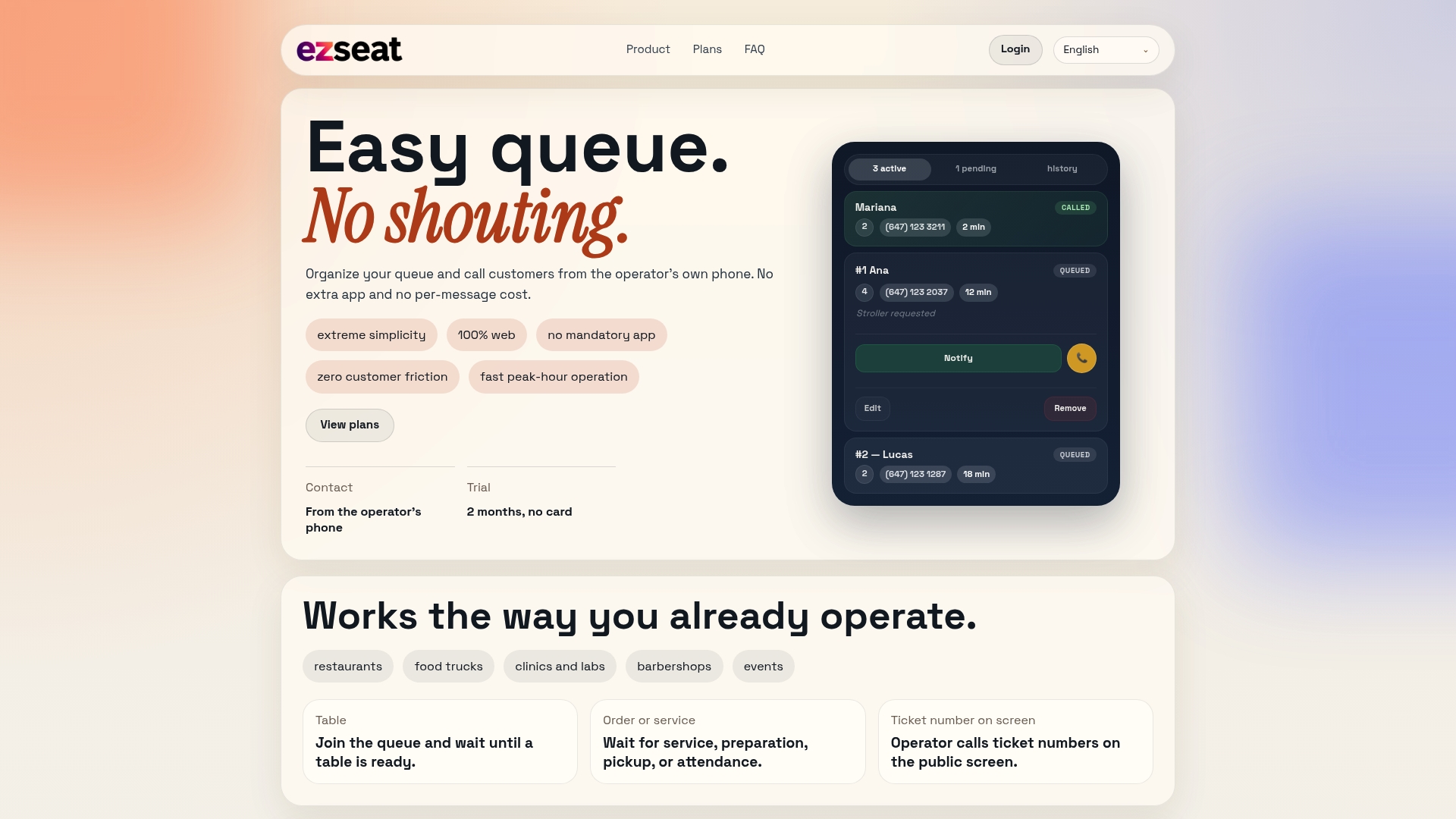
Most SMB operators don't need an enterprise platform with a six-month implementation timeline. They need customers to join from a browser with no app download, and they need a manager to run the whole queue from a phone. That's the gap Ezseat fills for restaurants, clinics, food trucks, and events, with multi-queue support that lets one location or several run side by side.
Start smaller than you think you need to. Pilot one location, track walkaway rate and average wait time for two to three weeks, and let those two numbers tell you whether to scale.
— Ezseat
Get Your Multi-Location Queue Running Without The App-Download Friction
Every feature covered above, the centralized dashboard, the web and QR check-in, the SMS notifications, the per-location configuration, is what Ezseat builds for operators running more than one site. Customers join from a browser on their own phone. No app, no download friction, no lost sign-ups at the door.
The rollout plan is simple: pick one location, run it for a few weeks, watch your wait times and walkaway numbers move, then add the next branch once the pattern holds. Ezseat's web-based queue setup and SMS notification workflows are built for exactly this phased approach, and pair naturally with phone-based intake tools like Wattle's AI voice agents if a location takes a heavy call volume. Start your free trial and set up your first location's queue today.