
For most small and medium businesses, Ezseat is the strongest starting point: browser-first entry, no app required, kiosk fallback built in, and a free two-month trial before you pay anything. If you run a restaurant, clinic, food truck, or event venue and want customers in a queue within a day, that matters more than a feature list three pages long.
The short version of this comparison:
- Ezseat — best for SMBs (restaurants, clinics, food trucks, events) that want browser-based check-in with zero app friction
- Qmatic — best for large multi-location enterprises and banks that need hardware ecosystems and journey management
- Waitwhile — best free-tier entry point for a single-location business testing virtual queues before committing budget
The table below covers all 18 options reviewed here. Per-product detail follows in the next section.
| Tool | Best for | Pricing / free tier | Key features | Deployment | Scalability |
|---|---|---|---|---|---|
| Ezseat | SMBs: restaurants, clinics, food trucks, events | Free 2-month trial; Light and Pro paid tiers | Browser check-in, QR waitlist, kiosk fallback, SMS/call notifications, multi-queue, public display | Cloud (browser-first); optional kiosk hardware | Multi-queue, multi-device; grows with SMB |
| Waitwhile | Single-location SMBs testing virtual queues | Free tier (1 location); paid plans from ~$49/mo | Virtual queue, appointments, SMS, basic analytics | Cloud-only | Limited on free tier; paid plans scale |
| Qminder | Retail and public-sector front desks | Paid; pricing gated by sales | Kiosk check-in, display boards, cross-location reporting | Cloud + kiosk hardware | Strong multi-location reporting |
| Qmatic | Large enterprise, banking, healthcare | Gated by sales | Journey management, hardware ecosystem, signage, appointments | Hybrid (hardware-heavy) | Built for complex, multi-site operations |
| QLess | Campuses, government, healthcare | Gated by sales | Mobile check-in, callback/SMS, virtual lobby | Cloud-first; mobile-heavy | Multi-location; government-grade |
| Qtrac | Multi-location retail and service centers | Gated by sales | Walk-ins + appointments, analytics, location-level pricing | Cloud + optional hardware | Strong centralized multi-location control |
| WaitWell | Government and education, appointment + walk-in sync | Paid; pricing on request | Appointment sync, walk-in queue, Message Hub (SMS), automated workflows | Cloud | Multi-location; enterprise-ready |
| Qwaiting | SMB retail, small clinics on a budget | Low-cost entry; free plan available | SMS notifications, digital signage, cloud queuing | Cloud + signage | Moderate; suited to small operations |
| Skiplino | Analytics-focused physical and virtual service flows | Paid; pricing varies | Online booking, digital ticketing, reporting dashboard | Cloud | Multi-branch analytics |
| Wavetec | Banks, telecoms, large retailers needing hardware | Gated by sales | Kiosks, digital displays, ticketing hardware | Hardware-heavy hybrid | Enterprise-scale hardware deployments |
| Engageware | Financial services and regulated industries | Gated by sales | Intent-based routing, appointment scheduling, queue management | Cloud | Regulated-industry multi-location |
| Queue-it | High-traffic online events, web traffic spikes | Paid; pricing by volume | Virtual waiting room, web traffic management, analytics | Cloud (web-only) | Built for web-scale traffic surges |
| monday service | Teams integrating queue events into work management | Paid; free trial available | Scheduling, task workflows, automation, integrations | Cloud | Scales with monday.com ecosystem |
| Awebstar Queue Management System | Businesses evaluating small-vendor digital ticketing | Pricing varies | Digital ticketing, kiosk options, display boards | Cloud + hardware options | Small to mid-scale |
| Help Scout | Teams measuring support quality alongside queue flow | Paid; free trial available | CSAT tracking, messaging, support best practices | Cloud | SMB to mid-market |
| CloudTalk | Organizations needing telephony/SMS alongside queue tools | Paid; free trial available | Voice, SMS integrations, call-center workflows | Cloud | SMB to enterprise telephony |
| ScanQueue | Single-location counters needing simple digital ticketing | Budget/free options | Digital ticketing, basic queue display | Cloud | Single-location focus |
| NextMe | Restaurants and small businesses wanting minimal waitlists | Free/minimal tier available | Virtual waitlist, mobile-friendly, simple notifications | Cloud | Single-location; minimal setup |
Table of Contents
- What does the best queue management software actually do for your business?
- How do you choose the right queue management software?
- Why browser-first queue systems tend to work better for SMBs
- Which tool should you actually buy?
- Key takeaways
- The gap between queue software demos and real-world adoption
- Ezseat: the web-first queue system built for SMBs
- Useful sources and vendor pages
What does the best queue management software actually do for your business?
Queue management software replaces the clipboard, the shouted name, and the crowded lobby with a system that tells customers where they stand and tells staff who's next. The features that separate good tools from mediocre ones include synchronized display screens, priority routing, and multi-lane capacity controls. Those aren't just nice extras; they're what prevent a system from collapsing on a busy Friday afternoon.

For an SMB, the practical question is simpler: can a customer join your queue without downloading an app, and can your staff manage it from a phone? If yes, you've cleared the two biggest adoption hurdles.
Detailed reviews of each tool
Ezseat is built for exactly the SMB scenario above. Customers scan a QR code or visit a link in a browser, enter their name, and they're in the queue. No account, no download. Operators manage the queue from any device. The kiosk check-in option gives you a tablet-based fallback for customers who miss the QR code, and SMS or call notifications keep people updated without them hovering at the counter. The free trial period is long enough to run a real pilot. Plans split into Light and Pro tiers once the trial ends, so you're not paying enterprise rates for a single-location barbershop.
Waitwhile earns its place on any free-tier shortlist. Its single-location free plan lets you test virtual queuing with real customers before spending a dollar, which G2's free queue management listings confirm as one of the few genuinely usable no-cost options. Paid plans start around $49/month. The tradeoff: the free tier caps you at one location and limited monthly visits, so it's a proof-of-concept tool, not a long-term free solution.
Qminder shines in environments where the check-in experience needs to look polished. Retail chains and government service desks use it for kiosk-first flows with centralized reporting across locations. Pricing is gated behind a sales conversation, which is a signal that it's aimed at buyers with a budget to match.
Qmatic is the enterprise standard for banks, large healthcare networks, and multi-site retailers that need hardware: ticket printers, digital signage, and full journey-management orchestration. Guideflow's 2026 roundup flags Qmatic specifically for hardware-heavy deployments. If you're running a single restaurant, it's overkill. If you're managing 40 bank branches, it's probably the right conversation.
QLess pulls customers out of physical lobbies by letting them join a queue remotely via mobile and receive a callback when it's their turn. Campuses and government agencies use it heavily. The mobile-first model works well where customers are spread across a large area, less so for a small counter where people are already standing nearby.
Qtrac combines walk-in queuing and appointment scheduling under one dashboard with location-level reporting. Multi-location retailers and service centers find it useful for centralizing control without losing per-location visibility. Pricing is sales-gated.
WaitWell focuses on the appointment-plus-walk-in sync problem: a government office or university service center that takes both scheduled appointments and drop-ins needs a system that doesn't create two separate queues. WaitWell's Message Hub handles SMS updates automatically. Pricing is available on request.
Qwaiting positions itself as the budget-conscious cloud option. It covers SMS notifications and basic digital signage at a lower price point than most enterprise tools, which makes it worth a look for small clinics or retail counters that need something functional without a large monthly commitment.
Skiplino leans into analytics. Its reporting dashboard gives managers visibility into service times, peak hours, and staff performance. For businesses that want to optimize service flow based on data rather than gut feel, that emphasis is useful.
Wavetec is hardware-first: kiosks, digital displays, and ticketing terminals for banks, telecoms, and large retailers. Like Qmatic, it's built for organizations that need physical infrastructure, not just software.
Engageware specializes in regulated industries, particularly financial services. Its intent-based routing sends customers to the right appointment type based on what they're trying to accomplish, which matters when a bank branch handles mortgages, account openings, and investment inquiries from the same lobby.
Queue-it solves a different problem entirely: web traffic surges. If you're selling concert tickets or running a high-demand online event, Queue-it's virtual waiting room manages the flood of simultaneous visitors. It's not a physical-lobby tool.
monday service integrates queue and scheduling events into the broader monday.com work management ecosystem. Teams that already live in monday.com and want queue events to trigger tasks or automations will find it a natural fit.
Awebstar Queue Management System appears in 2026 vendor roundups as a digital ticketing and kiosk option for businesses evaluating smaller vendors. Public detail is limited; worth requesting a demo if you're comparing hardware-plus-software bundles at the lower end of the market.
Help Scout is not a queue management tool in the traditional sense. It's a customer support platform with strong CSAT and messaging capabilities. It earns a mention here because measuring support quality alongside queue performance, using metrics like CSAT and first-contact resolution, gives you a fuller picture of whether your queue system is actually improving the customer experience.
CloudTalk is a telephony and call-center platform. Queue tools that rely on SMS or voice callbacks often integrate with platforms like CloudTalk to handle delivery at scale. If your queue notification strategy depends on outbound calls or high-volume SMS, understanding how your chosen queue tool connects to a telephony layer matters.
ScanQueue appears in budget-focused roundups as a simple digital ticketing option for single-location counters. Public information is thin; it suits small operations that need basic queue display without a complex setup.
NextMe is the minimal option: a mobile-friendly virtual waitlist for restaurants and small businesses that want the simplest possible deployment. Free and minimal-cost tiers are available. It won't scale to multi-location operations, but for a single-location food truck or pop-up, it gets the job done.
Pro Tip: Before you book a demo with any vendor, check whether their free tier or trial covers your actual peak-hour volume. A cap of 100 monthly visits sounds fine until you realize your Saturday lunch rush hits that in two hours.

How do you choose the right queue management software?
The decision starts with one question: where does your queue actually live? Physical lobbies, online booking flows, and hybrid setups each pull you toward different tools.
Step 2: Score vendors against this checklist
- Integrations — does it connect to your POS, CRM, calendar (Google Calendar, Outlook), or signage system?
Questions to ask every vendor during a demo
- Can I export all queue data in CSV or via API at any time?
- What custom fields can I add to the check-in form?
- What is your uptime SLA, and how do you communicate outages?
- Which support channels are included in my plan (email, chat, phone)?
- If I add a second location, what changes in pricing and setup?
- Does your kiosk hardware work with standard tablets, or do I need proprietary equipment?
Red flags to watch for
- Mandatory app install for customers to join the queue
- Pricing that only appears after a sales call and NDA
- No data export or API access on standard plans
- Kiosk hardware that only works with the vendor's proprietary tablets
- Analytics locked behind the highest-tier plan
Why browser-first queue systems tend to work better for SMBs
The adoption problem with queue management software is rarely the software itself. It's the moment a customer pulls out their phone, sees "Download our app to join the queue," and walks out. That friction is measurable and avoidable.
Browser-based check-in removes the install step entirely. A customer scans a QR code posted at the door or counter, a web page opens, they enter their name, and they're in the queue. No account creation, no app store, no permissions dialog. That's the difference between a system your customers actually use and one your staff ends up ignoring because nobody joins it.
Free queue management options that offer genuine no-signup, browser-based entry exist in the market. The pattern is consistent: lower friction at the entry point produces higher adoption rates, which is the only metric that matters in the first two weeks of a pilot.
A practical browser-first setup for an SMB looks like this:
- Print a QR code poster for the entrance and the counter (use the QR code waitlist setup guide to get the sizing and placement right)
- Set up a public display screen showing "Now Serving" numbers so customers in the waiting area can track progress without checking their phones constantly (the queue display screen guide covers layouts and sync options)
- Configure SMS notifications so customers can wait outside or in their car
- Add a kiosk tablet at the counter as a fallback for customers who don't have a smartphone
The kiosk fallback is worth emphasizing. A purely browser-first system leaves out customers who don't own smartphones or aren't comfortable with QR codes. A tablet kiosk at the counter, running the same queue software, covers that gap without requiring proprietary hardware.
Statistic callout: G2's free queue management category lists multiple tools with genuine no-cost tiers, confirming that free-tier availability is now a baseline expectation in this market, not a premium differentiator. The tools that stand out on G2 are the ones with verified user reviews backing their free-tier claims, not just marketing copy.
Pro Tip: Set your estimated service times conservatively in the system, not optimistically. If your average service takes 8 minutes, set 10. Customers who are called earlier than expected are delighted; customers who wait longer than the system promised walk away and don't come back.
Which tool should you actually buy?
For most SMBs in the United States, Ezseat is the right starting point. Browser-first entry, no app required for customers, kiosk fallback, SMS notifications, and a free two-month trial that gives you enough time to run a real pilot and measure results. Restaurants, clinics, food trucks, and event venues are the core use cases it's built around.
Two alternative profiles worth knowing:
- If you need enterprise hardware (ticket printers, digital signage across 10+ locations, deep POS integration): Qmatic or Wavetec belong on your shortlist. Budget for a sales process and a longer implementation timeline.
- If you want to test for free before any commitment: Waitwhile's single-location free tier is the most credible no-cost option confirmed by third-party review data. Use it to validate the concept, then evaluate paid options once you know the model works for your customers.
The next step is straightforward:
-
Shortlist 2–3 tools from this list based on your queue type (physical, hybrid, or online)
-
Start a single-location pilot with your top pick
-
Measure average wait time, walk-away rate, and throughput over two to four weeks
-
If the numbers move in the right direction, expand; if not, swap tools before you've committed to an annual contract
Most SMBs can validate a queue management choice in under a month. The pilot KPIs above give you the data to make that call with confidence rather than gut feel.
Key takeaways
Ezseat is the strongest web-first queue management option for SMBs that want fast deployment, browser-based customer entry, and a free trial long enough to prove ROI before paying.
| Point | Details |
|---|---|
| Browser-first entry wins on adoption | No-app, QR-code check-in removes the biggest friction point for customers joining a queue. |
| Free trials before you commit | Ezseat offers a free two-month trial; Waitwhile has a single-location free tier for initial testing. |
| Enterprise needs different tools | Multi-site hardware deployments (Qmatic, Wavetec) require a sales process and longer implementation. |
| Pilot with four KPIs | Measure average wait time, walk-away rate, throughput, and staff time saved over 2–4 weeks. |
| Ezseat fits most SMB scenarios | Restaurants, clinics, food trucks, and events get browser check-in, kiosk fallback, and SMS notifications in one plan. |
The gap between queue software demos and real-world adoption
Most queue management demos look great. The kiosk is sleek, the display screen updates in real time, and the analytics dashboard shows a clean graph of wait times. Then you go live and discover that 40% of your customers don't scan the QR code because it's printed too small on a laminated sheet behind the register.
The tools that actually work in SMB environments share one trait: they reduce the number of decisions a customer has to make to join the queue. Every extra step, whether it's creating an account, downloading an app, or entering more than a first name, costs you adoption. That's not a theory; it's what you see when you compare pilot results between app-required and browser-based systems in the same type of venue.
Hardware-first systems like Qmatic and Wavetec are genuinely impressive at scale. A bank branch with 15 service windows and a ticket printer at the entrance is a different environment than a four-table food truck. Forcing an enterprise hardware model onto an SMB doesn't make the SMB more professional; it makes the system harder to maintain and more expensive to change when the business grows in a different direction.
The practical trade-off: start with the lightest system that covers your actual use case. Add hardware (a kiosk tablet, a display screen) only after you've confirmed that customers are using the digital queue at all. A $30 tablet running browser-based queue software at the counter is a faster, cheaper proof of concept than a $2,000 kiosk terminal that takes three weeks to install.
Ezseat: the web-first queue system built for SMBs
Skip the app-install friction entirely. Ezseat gives your customers a browser-based queue entry via QR code or direct link, a public display screen showing who's next, and SMS or call notifications so they can wait anywhere, not just in your lobby. Staff manage everything from a phone or tablet, with no proprietary hardware required to get started.
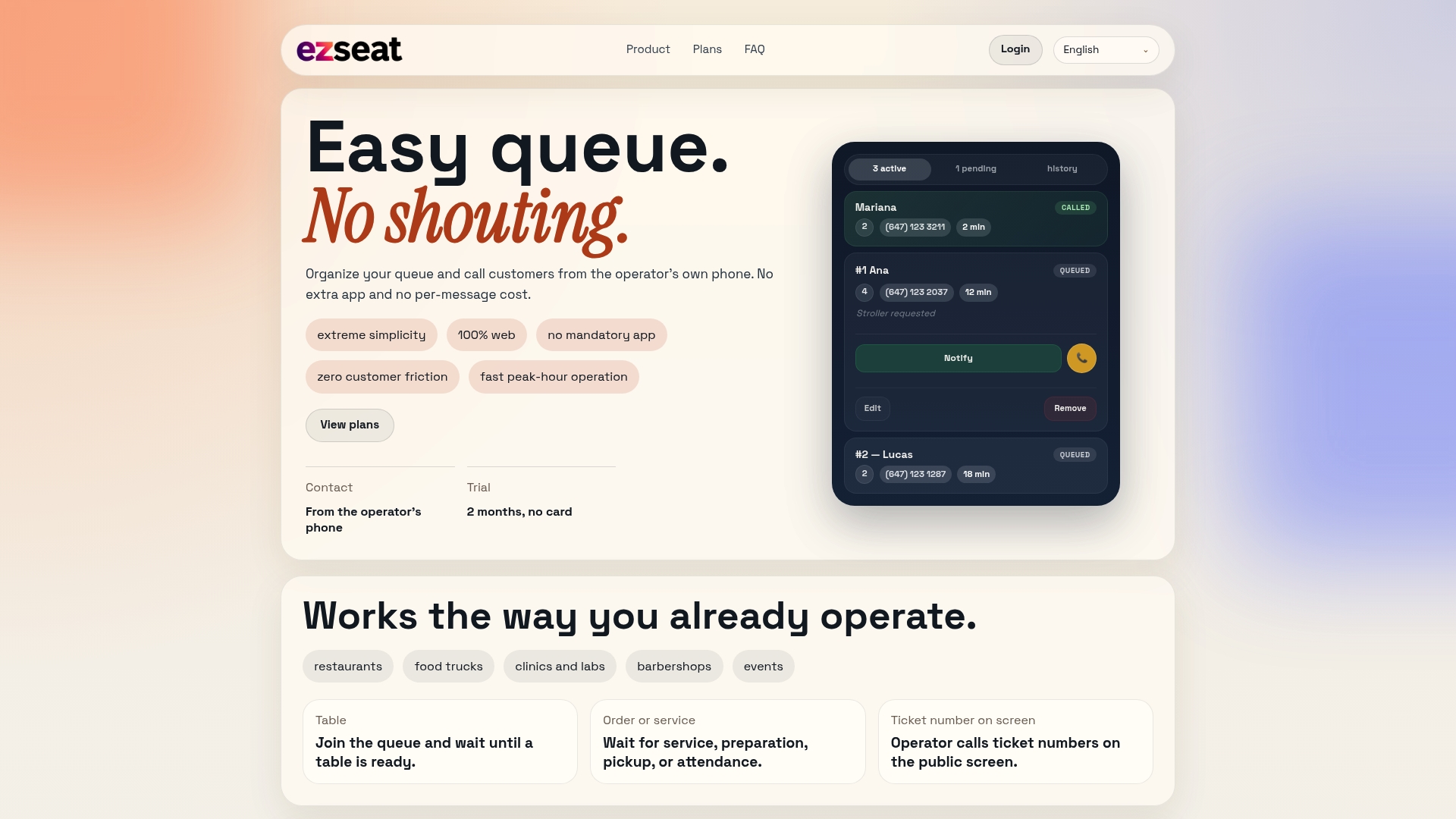
The free two-month trial covers restaurants, clinics, food trucks, barbershops, and event venues. Light and Pro plans scale up as your operation grows, with multi-queue and multi-device support built in. No long onboarding process, no sales call required to see pricing.
Start your free trial at ezseat.app and have your first queue running today.
Useful sources and vendor pages
Use these links to dig into pricing details, free tiers, and demo booking for the tools covered above:
- 10 best queue management software tools compared for 2026 — Guideflow Blog
- Best 20 Free Queue Management Software Picks in 2026
- ezseat.app
- Help Scout