
Most small businesses and startups can run a free waitlist plan safely for a few weeks, but almost none can stay on one past their first real growth moment. The ceiling arrives faster than you'd expect: a signup cap at 50–200 entries, no SMS credits, no API access, and a competitor's logo on your confirmation page. A Johns Hopkins review of waitlist dynamics found that both very small and very large waiting lists reduce referral effectiveness, which means the size of your list matters as much as the software running it. Talk Think Do's practitioner guide adds a harder technical constraint: a waitlist that isn't atomic with your booking capacity will produce race conditions and inconsistent counts the moment demand spikes.
Here's the short version by use case:
- Micro pop-ups and one-day events (under 100 guests): A free tier from a form builder or indie tool is probably fine.
- Single-location coffee shops or food trucks in early testing: Free works until you need SMS notifications or want to remove the provider's branding.
- Pre-launch indie builders collecting emails: Free newsletter or viral-referral tools cover you until you hit a few hundred signups or need referral analytics.
- Restaurants, clinics, barbershops, or any venue running daily queues: Free plans will fail you at the worst moment. Ezseat is built for exactly this scenario, with browser-based queue entry, SMS/call notifications, and multi-device support that don't disappear behind a paywall when you need them most.
Key Takeaways
Free waitlist software limitations hit hardest at the exact moment your business needs the tool most: when demand spikes, SMS notifications matter, and a second staff member needs access.
| Point | Details |
|---|---|
| Free caps arrive fast | Most free tiers cap at a few hundred signups or guests per month, often before a first real launch or busy weekend. |
| SMS is almost never free | Nearly every free plan excludes SMS notifications; adding them typically costs $0.01–$0.10 per message. |
| Atomicity is the key technical test | Ask vendors directly whether simultaneous slot claims are handled atomically, or double-bookings will follow. |
| Long waitlists hurt conversion | Practitioner analysis shows that waitlists without clear timelines erode trust and reduce conversion over time. |
| Ezseat for production use | Ezseat's two-month full-feature trial lets restaurants, clinics, and events validate real-volume performance before paying. |
Table of Contents
- What do free waitlist software limitations actually look like across tools?
- What do free plans actually restrict, by tool archetype?
- What hidden costs and upgrade triggers do businesses miss?
- How do you evaluate whether a free plan will actually work for your business?
- What does the research say about waitlist failure modes?
- When is a free plan okay, and when should you pay?
- Why we favor production-ready queue management over free-tier workarounds
- Ezseat handles what free plans can't
- Sources
What do free waitlist software limitations actually look like across tools?
The table below reflects publicly listed pricing and features as of mid-2026, verified against each tool's own pricing page. Pricing changes frequently; confirm directly with each vendor before committing.
How we checked pricing: Each tool's pricing page was reviewed directly in mid-2026. Free-tier caps and first paid tier prices reflect publicly listed information at that time and may change. SMS policies and API access were cross-referenced with each tool's feature comparison pages.
What do free plans actually restrict, by tool archetype?
Evaluating tools one by one misses the pattern. Most free waitlist tools fall into five archetypes, and each archetype has a predictable set of limitations that will surface at a predictable moment in your growth.
Viral-referral launch tools
Tools like LaunchList, Prefinery, Viral Loops, and KickoffLabs are built for pre-launch hype: they give you a landing page, a referral widget, and a leaderboard. On the free tier, you typically get 200–250 leads before hitting a hard cap, and referral analytics (which is the whole point of these tools) are usually locked behind the first paid tier.
The operational effect is real. If your launch goes better than expected, you'll hit the cap mid-campaign, at exactly the moment you need the data most. There's no SMS, no API, and no white-label option on free plans. Use this archetype for indie product launches where you expect under 200 signups and don't need to export data mid-campaign.
Form builders repurposed as waitlists
Tally is the clearest example: unlimited forms, clean UI, and zero cost until you need custom fields or want to remove the Tally badge. The core limitation isn't a signup cap; it's the absence of any queue logic. There's no position tracking, no SMS notification, no reservation mechanics. You're collecting emails, not managing a waitlist.
Bolt-on waitlists that lack reservation logic create race conditions when you try to promote people from the list to an actual booking. That's fine for a simple email collection. It's a problem the moment you need to tell someone "you're next."
Newsletter platforms repurposed as waitlists
Beehiiv and Mailchimp both offer free tiers with subscriber caps (roughly 2,500 and 500 respectively) and basic email automation. They work well for waitlists where the only action is "send an email when we launch." The moment you need to segment by position, trigger SMS, or integrate with a booking system, you're either upgrading or duct-taping together a Zapier workflow that will break under load.
Mailchimp's free tier also places its own branding on outgoing emails, which is a visible trust signal problem for any business trying to look established.
Indie one-time-purchase tools
A handful of smaller tools offer lifetime deals or minimal free tiers. These tend to have the most unpredictable limitations: some cap by total signups ever (not per month), some restrict export to CSV only, and support is often a community forum or a single founder's inbox. They're fine for a one-time launch with a known, bounded audience. They're not built for ongoing operations.
Enterprise queue and booking systems
Qminder, WaitWhile, Waitlist Me, and NextMe all target service businesses. Their free tiers are either very limited (100 guests/month, single location, no SMS) or are trials with a hard end date. Qminder doesn't offer a true free tier at all; its trial converts to a plan starting around $389/month, which is enterprise pricing.
The practical effect: if you're running a clinic, a barbershop, or a multi-location restaurant, the free tier of any enterprise queue tool will feel adequate for the first two weeks and then stop working for your actual volume. A production-ready system like Ezseat gives you the full feature set during a two-month trial so you can validate scalability before committing, rather than discovering the limits mid-service.
What hidden costs and upgrade triggers do businesses miss?
The sticker price of a free plan is $0. The real cost shows up in five places most founders don't budget for.
SMS and phone credits. Almost no free tier includes SMS. When you add it, costs typically run $0.01–$0.10 per message depending on carrier routing and whether you're using a 10DLC number or a short code. For a restaurant sending 200 "your table is ready" texts per week, that's a real line item. Understanding the difference between short code and 10DLC delivery matters before you commit to any SMS-dependent workflow.

Custom domain and white-label fees. Most free tiers show the provider's branding on your confirmation pages, emails, and public queue screens. Removing it typically requires the first or second paid tier. For a clinic or a restaurant, a confirmation email that says "Powered by [Tool Name]" undermines the professional impression you're trying to create.
Export and API restrictions. Many free plans lock data export behind a paywall or limit it to CSV with no API access. If you need to sync your waitlist with a CRM, a booking system, or a POS, you'll either pay for API access or manually export data, which doesn't scale.
Per-seat and per-admin fees. Single-admin free tiers are common. The moment you add a second staff member to manage the queue, you're on a paid plan. For any business with more than one person at the front desk, this is an immediate upgrade trigger.
Overage charges. Some tools charge per signup or per SMS above the free cap rather than requiring a plan upgrade. These can accumulate invisibly. A launch that drives 400 signups when your cap is 250 might generate an unexpected invoice rather than a plan prompt.
The most common upgrade scenario: a small restaurant runs a free waitlist tool for two weeks, hits the SMS limit, adds a second staff member to manage the queue, and crosses the monthly guest cap in the same week. A plan that cost $0 becomes $19–$79/month overnight, with no warning and no time to evaluate alternatives.
Pro Tip: Before you launch on any free plan, calculate your expected first-month volume: estimated signups × SMS messages per person × number of staff who need access. If any of those numbers pushes you past the free cap, budget for the first paid tier from day one.
Practitioner analysis also points out that long-lived waitlists without clear timelines erode conversion over time. A free plan that keeps people on a list for months without a clear "you're next" trigger isn't just a feature problem; it's a trust problem.
How do you evaluate whether a free plan will actually work for your business?
Run these checks before you commit to any free tier.
Capacity check. Count your expected signups in the first 30 days. Don't assume you'll stay under; assume you'll exceed it.
Reservation atomicity test. Ask the vendor directly: "If two people try to claim the same open slot simultaneously, what happens?" A production system handles this with atomic reservation logic. A bolt-on waitlist will double-book or throw an error. This is the single most important technical question for any business where slots are finite (tables, appointments, event seats).
Promotion model check. Ask: "Can I configure automatic promotion, time-limited offers, and manual promotion per service or per queue?" Per Talk Think Do's waitlist design principles, a sensible waitlist supports all three promotion models and configures queue depth per service, not as a single global unbounded queue. If the answer is "we just move people up the list," that's a red flag.
Export and data portability. Ask: "Can I export my full waitlist, including position history and timestamps, on the free plan?" If the answer is no or "CSV only on paid," you're locked in. Switching tools mid-launch means losing your list.
Anti-bot and fraud protection. Ask: "What prevents someone from flooding my queue with fake entries?" Simple CAPTCHA is not enough. Queue flooding is a documented failure mode for low-cost queue systems, and a flooded queue destroys the experience for legitimate customers.
Support SLA. On a free plan, support is usually email-only with no guaranteed response time. For a restaurant or clinic running a live queue during service hours, that's not a safety net. Know what you're getting before you need it.
Red flags that tell you the free plan won't scale: no export on free, no reservation-and-release mechanics, no per-queue configuration, no fraud protection, and no way to add a second admin without upgrading.
For clinics specifically, the stakes are higher. Healthcare queue management has compliance and volume requirements that most free tools simply aren't designed to meet.
What does the research say about waitlist failure modes?
The academic and practitioner evidence on waitlist failure is more specific than most tool-comparison articles acknowledge.
The Johns Hopkins review of waitlist dynamics found that list size itself is a conversion variable. A very small list signals low demand; a very large one signals congestion. Both reduce the incentive to refer others. The implication for free-plan users is direct: an unbounded queue on a free tier, with no cap and no transparency about position, can actively hurt your conversion rather than help it.
Talk Think Do's technical analysis of booking waitlists identifies a second failure mode: the bolt-on implementation. When a waitlist is stored separately from booking capacity and promoted via a background job rather than an atomic transaction, you get race conditions. Two customers get the same slot. Your reported queue count diverges from actual availability. Staff spend time resolving conflicts that the software should have prevented. This isn't a theoretical risk; it's a routine outcome for any free tool that wasn't built with reservation logic at its core.
Bot attacks compound both problems. Low-cost queue systems that rely on basic CAPTCHA or no duplicate prevention are frequently exploited. A flooded queue inflates your apparent demand, burns through your free-tier cap, and delivers a broken experience to real customers. Ezseat addresses this with atomic queue joins and multi-device support, so the count your staff sees on a public display screen matches the count in the system.

Operational mitigations that work regardless of which tool you use: cap your queue size per service rather than running a global unbounded queue, set a time limit on waitlist offers (a slot that goes unclaimed after 10 minutes should release automatically), require a confirmation step before promoting someone, and keep an audit trail of every status change.
When is a free plan okay, and when should you pay?
The decision rule is simple: if your waitlist is a one-time, bounded event with under 100–150 participants and no SMS requirement, a free plan is fine. If any of the following apply, budget for a paid plan from the start.
- You expect more than 150–200 signups in the first month.
- You need SMS or phone notifications to reach customers.
- You have more than one staff member managing the queue.
- You operate more than one location.
- You need to remove provider branding from customer-facing pages.
- You need API access or integration with a booking, POS, or CRM system.
- You're running a clinic, healthcare practice, or any regulated environment.
- You expect viral or referral growth that could spike signups unpredictably.
For micro pop-ups, single-day events, and pre-launch indie projects with a known, small audience, a free tier from a form builder or viral-referral tool covers the basics. For everyone else, the free plan is a trial, not a long-term solution.
The production-ready choice for restaurants, clinics, food trucks, barbershops, and events is Ezseat. It offers browser-based queue entry (no app download required for customers), public display screens, SMS and call notifications, multi-queue and multi-device support, and kiosk check-in, all accessible during a two-month free trial. That trial period is long enough to validate whether the system handles your actual peak-hour volume before you commit to a paid plan.
Why we favor production-ready queue management over free-tier workarounds
The conventional wisdom in startup circles is to stay free as long as possible and upgrade only when forced. For most SaaS tools, that's reasonable advice. For queue management, it's the wrong frame.
A waitlist or queue is a customer-facing system. When it fails, the failure is visible in real time: a customer who was told "you're next" gets skipped, or two people show up for the same table, or the SMS that was supposed to bring someone back to the counter never arrives. Those failures don't just cost you a transaction; they cost you the customer's trust in your operation.
Free-tier tools are built to demonstrate value, not to handle production load. The missing features (atomic reservation logic, per-queue configuration, audit trails, fraud protection) aren't premium add-ons. They're the features that make a queue system reliable under real conditions. Treating them as optional until you can afford them is the same as treating your POS system as optional until you can afford it.
The short-term savings of a free plan are real. The long-term cost of a broken queue experience, measured in lost customers and staff time spent resolving conflicts, is harder to see on a spreadsheet but consistently larger. Businesses that treat their queue as a first-class operational feature from day one tend to retain customers through their growth phase rather than scrambling to fix the system while also managing growth.
Ezseat handles what free plans can't
Free plans from form builders, viral-referral tools, and entry-level queue apps share a common gap: they're built for demos, not for daily service. Ezseat is the production-ready alternative for restaurants, clinics, food trucks, barbershops, and events that need a queue system that works at 6 PM on a Friday, not just in a sandbox.
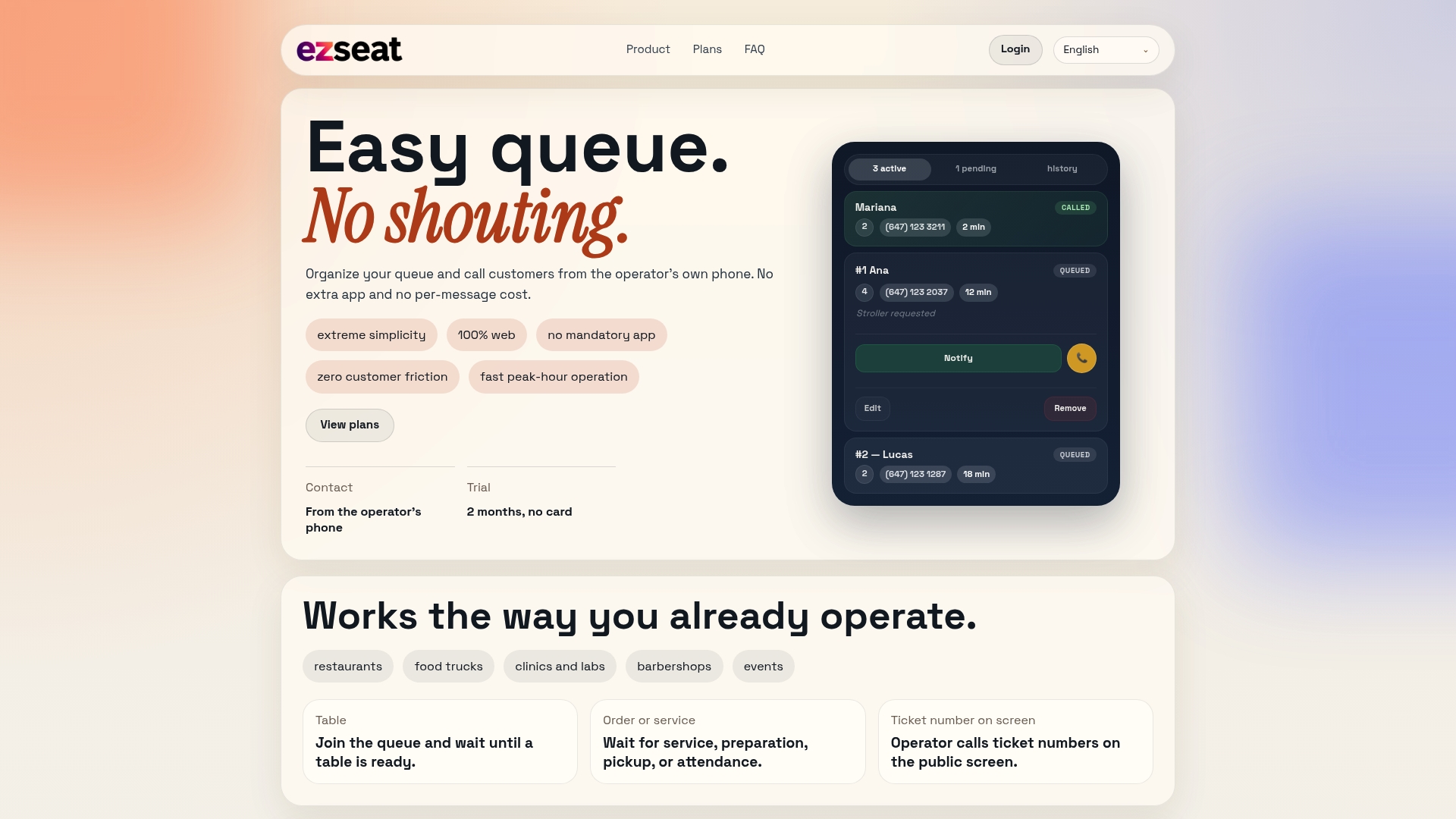
Where free tiers cap out at 100–200 guests, lock SMS behind a paywall, and show a competitor's logo on your confirmation page, Ezseat gives you browser-based queue entry (no app download for customers), SMS and call notifications with transparent pricing, public display screens, multi-queue and multi-device support, kiosk check-in, and custom queue fields. Multi-location and multi-admin support are included, not gated. The two-month free trial covers the full feature set, so you can test real peak-hour volume before committing.
Start your Ezseat and see whether the system holds up under your actual service conditions.
Sources
How we verified pricing: Each tool's pricing page was reviewed directly in mid-2026. Free-tier caps, SMS policies, and first paid tier prices reflect publicly listed information at that time. Confirm current pricing with each vendor before making a decision.
- As VIP online waiting lists gain in popularity, study finds potential pitfalls | Hub
- How Booking Waitlists Should Work | Talk Think Do
- The Waitlist Delusion - by Gaurav Vohra - Growth by Gaurav