
A walk-in waitlist is a digital queue that logs unscheduled arrivals, assigns each visitor a position or token, and sends notifications when it's their turn. No clipboard, no shouting names, no guessing. For U.S. clinics, urgent care centers, and service venues, the recommended starting point is Ezseat: a web-based queue system that supports kiosk, QR/browser, and SMS entry without requiring patients or customers to download anything.
Quick wins operators report within the first week:
- Fewer walk-outs from patients who can't see where they stand
- Cleaner lobby flow with no crowding at the front desk
- Less manual triage time for staff during peak hours
- A timestamped record of every arrival, wait, and service event
Systems like UPMC's patient portal show how health networks already use online waitlists for sooner appointments, letting patients accept earlier slots when cancellations open up. That same logic applies to walk-in management at the clinic level.
Key Takeaways
A web-based walk-in queue system delivers measurable gains in lobby flow, staff efficiency, and patient experience when it routes visitors to the right staff and captures timestamps for scheduling decisions.
| Point | Details |
|---|---|
| Start with QR/browser + SMS | A browser-based pilot requires no hardware and can go live in days, not weeks. |
| Require a BAA for healthcare | No signed Business Associate Agreement means no compliant deployment in a U.S. clinical setting. |
| Track abandonment from day one | A high walk-out rate signals ETA inaccuracy or notification timing problems, not patient resistance. |
| Use timestamps for staffing | Hourly arrival data lets you reshape staff schedules to match actual demand rather than assumed patterns. |
| Ezseat as the pilot-ready option | Ezseat supports kiosk, QR, browser, and SMS entry with a two-month free trial and BAA availability for clinics. |
Table of Contents
- How does a walk-in waitlist system work from arrival to service?
- What operational benefits can clinics and service venues expect?
- What features should you require from a walk-in queue system?
- Which entry method fits your venue: kiosk, QR, or phone?
- HIPAA and patient-privacy checklist for U.S. healthcare providers
- Which metrics should you track, and how do you use queue data?
- What does a walk-in waitlist pilot actually cost, and how long does it take?
- How does acceptance from a waitlist work?
- How do walk-in queue solutions compare?
- Real-world use cases: where walk-in queue systems deliver
- What operators learn after going live with a web-based waitlist
- Ezseat makes it easy to run your first walk-in pilot
- Sources
How does a walk-in waitlist system work from arrival to service?
The workflow has six clear steps, and understanding each one helps you spot where a vendor's system might fall short.
- Arrival and check-in. The patient or customer arrives and joins the queue via a kiosk on-site, a QR code posted at the entrance, a browser link, or an SMS short code. No app required.
- Token and position assignment. The system issues a queue number and displays an estimated wait time. Platforms like MyTime calculate ETAs using staff availability and working-hour algorithms, filtering out stale or abandoned entries so the estimate stays accurate.
- Triage and routing. Configurable rules direct the visitor to the right staff member, room, or service lane. This is where the real value sits: routing is journey orchestration, not just a digital version of a paper sign-in sheet.
- Notification. When the visitor's turn approaches, the system sends an SMS alert or updates an on-screen display. United Health Services, for example, publishes live walk-in wait estimates and a reserve-your-spot flow that patients can use before they leave home.
- Service and check-out. Staff mark the visit complete; the system logs the service duration and closes the queue entry.
- Schedule sync. A well-integrated system creates instant slots in your appointment calendar so walk-ins don't collide with reserved bookings. Silos between the appointment calendar and the walk-in queue are the most common source of double-booking.
Pro Tip: Configure a short priority buffer — typically 5 to 10 minutes — for scheduled appointments so walk-ins don't accidentally displace a reserved slot during a surge.
What operational benefits can clinics and service venues expect?
The clearest gains show up in three areas.
Efficiency. Digital check-in removes the manual sign-in step and reduces front-desk triage time. CERTIFY Health's client documentation describes instant slot creation and real-time schedule updates that reduce walk-out rates in clinical deployments. Less time spent managing the line means more time spent delivering the service.
Patient and customer experience. Transparent ETAs reduce anxiety. When someone can see their position on a screen or get a text update, they're far less likely to leave. CityHealth's guidance on typical urgent-care visit durations gives operators a practical baseline for setting realistic ETA ranges — knowing the typical duration of urgent-care visits helps you calibrate the queue display rather than showing a number that frustrates people.
Operational control. Every arrival gets a timestamp. That data feeds staffing decisions, peak-hour forecasting, and capacity planning in ways a paper sign-in sheet never could. Remote waiting, where patients wait in their car or nearby until notified, also reduces lobby density when distancing matters.
What features should you require from a walk-in queue system?
Use this checklist on every vendor demo call.
Core features to require:
- Kiosk and browser/QR entry (both, not one or the other)
- SMS notifications with opt-in compliance
- Staff dashboard with real-time queue view and manual override
- Multi-queue support for different service types or rooms
- Configurable routing rules (by service type, staff, or urgency)
- EHR/PMS integration or a documented API
- Exportable timestamps and reporting
- Business Associate Agreement (BAA) for any U.S. healthcare setting
Questions to ask in a demo:
- Where does patient data reside, and is it encrypted in transit and at rest?
- Can you provide a signed BAA before go-live?
- How does the queue sync with your appointment calendar in real time?
- Does the system track abandonment (walk-outs) and flag them?
- Is there a geo-fence or distance check to prevent remote joins from far away?
- What does the API cover, and what does it cost?
- What support and training are included during the pilot?
Red flags: No BAA for a healthcare deployment. A system that only digitizes sign-in without routing or alerts. Pricing that isn't transparent about SMS volume costs. No way to export timestamps for your own KPI tracking.
Which entry method fits your venue: kiosk, QR, or phone?
Each method has a distinct trade-off, and most high-volume venues end up using more than one.
- Kiosk. Best for low-tech patient populations and settings where you want maximum control over the check-in experience. Requires hardware, a touchscreen placement plan, and a cleaning protocol. Highest upfront cost but lowest friction for patients who don't own smartphones.
- QR/browser join. Easiest to deploy — print a QR code, post it at the entrance, and you're live. Supports remote waiting. Works well for mobile-savvy patrons and venues with good signage. One caveat: without a distance check, patients can join from home and arrive late, which skews the queue order.
- Phone/SMS join. Accessible for non-smartphone users. Patients text a number to join. The difference between a short code and a 10DLC number matters for deliverability and compliance; see the short code vs. 10DLC breakdown before you commit to an SMS setup.
- Hybrid deployment. The recommended pattern for most clinics: kiosk on-site plus QR/browser for remote joins, with SMS notifications for both. This covers the full range of patient tech comfort levels.
Pro Tip: Start your pilot with QR/browser entry and SMS notifications only. It takes hours to configure, costs nothing in hardware, and gives you real queue data before you invest in kiosks.
HIPAA and patient-privacy checklist for U.S. healthcare providers
Running a walk-in queue in a clinical setting means handling protected health information (PHI), even if you're only collecting a name and phone number. Work through this list before go-live.
- BAA. Get a signed Business Associate Agreement from your vendor before any patient data touches their system. No BAA means no compliant deployment.
- Minimal PHI capture. Collect only what the workflow requires: name, phone number, and reason for visit at most. Avoid collecting date of birth or insurance details in the queue entry unless your intake workflow specifically requires it.
- Encryption. Confirm data is encrypted in transit (TLS 1.2 or higher) and at rest.
- Access controls and audit logs. Staff access should be role-based. Ask to see a demo of the audit log during procurement.
- Retention and deletion policies. Know how long the vendor retains queue records and how you can request deletion.
- EHR matching. Clarify how the system creates or matches patient records in your EHR. A mismatch here creates duplicate records and billing problems.
- Patient notice. Post brief signage at the check-in point explaining that a text notification will be sent and that the data is handled per your privacy policy.
For clinic queue management in healthcare settings, the BAA and audit log are the two items most often skipped during a rushed procurement. Don't skip them.
This is operational guidance, not legal advice. Consult your privacy officer or legal counsel for policies specific to your organization.
Pro Tip: During your demo, ask the vendor to walk you through the audit log interface and provide a sample BAA. If they hesitate on either, treat that as a disqualifying signal.
Which metrics should you track, and how do you use queue data?
Queue data is only useful if you act on it. These are the KPIs that drive real decisions.
| KPI | How to calculate | Operator action |
|---|---|---|
| Average wait time | Total wait minutes / number of visits | Adjust staffing if average exceeds your target range |
| Abandonment rate | Walk-outs / total arrivals | Investigate if above 10%; usually signals ETA inaccuracy or lobby friction |
| Throughput per staff hour | Completed visits / staff hours on duty | Identify under- and over-staffed periods |
| Average service time | Total service minutes / completed visits | Detect bottlenecks in specific service types |
| Peak-hour arrival distribution | Arrivals logged by hour | Reshape staff schedules to match actual demand |
| ETA accuracy | Predicted wait vs. actual wait | Tune routing rules if gap exceeds 15 minutes consistently |
The most useful action is comparing hourly arrival timestamps against your current staff schedule. When the data shows a consistent surge between 11 AM and 1 PM that your schedule treats as a normal period, you have a concrete case for adding a flex shift. One urgent care operator who mapped timestamp data against staffing found that shifting one staff member's start time by 90 minutes cut peak-period wait times without adding headcount.
Pro Tip: Combine queue timestamps with check-out times to calculate actual service duration per visit type. A long average wait with a short service time points to a routing problem; a long service time points to a capacity problem. They need different fixes.
What does a walk-in waitlist pilot actually cost, and how long does it take?
Pricing shapes to expect:
- Monthly subscription tiers (Light and Pro are common structures, with Pro adding multi-queue, advanced routing, and reporting)
- SMS costs billed per message or bundled, with 10DLC registration adding a one-time setup fee
- Optional kiosk hardware (tablet plus stand, typically sourced separately)
- Integration labor if you need EHR/PMS connectivity beyond a standard API
Pilot timeline:
- QR/browser + SMS pilot: 3–14 days from account setup to live queue. No hardware required.
- Kiosk pilot: 2–4 weeks, including hardware sourcing, placement, and staff training.
- Full rollout with EHR integration: 4–8 weeks depending on your EHR vendor's API documentation and your IT team's availability.
Minimal pilot milestones: Configure queue and routing rules (Day 1–2). Train front-desk staff (Day 3). Go live with QR/SMS entry (Day 4). Run for two weeks. Pull abandonment rate, average wait, and throughput data. Review and decide on kiosk or integration investment.
Ezseat offers a two-month free trial, which is enough runway to complete a QR/SMS pilot and a two-week review cycle before any subscription cost applies.
How does acceptance from a waitlist work?
When a cancellation or no-show opens a slot earlier than a patient's current appointment, a well-configured waitlist system can automatically offer that slot to the next eligible patient on the list. UPMC's patient portal, for example, lets patients join a waitlist for sooner appointments and accept or decline the offer through the portal without calling the front desk.
For walk-in queues specifically, acceptance works differently: the system monitors no-shows and abandoned positions in real time, collapses the queue, and recalculates ETAs for everyone still waiting. A patient who was position 8 might jump to position 5 within minutes if two people ahead of them leave. SMS confirmation requests, where the system texts a patient to confirm they're still waiting before calling their number, reduce the dead time between positions and keep throughput high.
The practical rule: configure your system to send a confirmation ping 5–10 minutes before a patient's estimated turn. If they don't respond within 2–3 minutes, the system skips them and moves to the next position. This single setting has a measurable effect on throughput during busy periods.
How do walk-in queue solutions compare?
Rather than a feature-by-feature table, the more useful frame is the three categories operators actually choose between.
Entry-level field apps typically offer basic digital sign-in and SMS alerts. They're inexpensive and fast to set up, but they rarely include routing rules, EHR integration, or BAA support. Fine for a food truck or a small barbershop; not adequate for a clinic.
Enterprise scheduling platforms with waitlist modules offer deep EHR integration and robust reporting, but they come with long implementation timelines, per-seat pricing, and contracts that assume you have an IT department. The online scheduling and customer experience research from ExpressBook illustrates how over-engineered scheduling tools often add friction rather than remove it for smaller venues.
Web-based queue systems sit in the middle: browser entry with no app requirement, kiosk and QR support, SMS notifications, multi-queue setup, and BAA availability for healthcare. Ezseat fits this category. Operators can review user-reported reliability and feature patterns on G2, Capterra, and Trustpilot before committing to any vendor in this space.
The selection question is really: does the vendor's system route visitors to the right staff, or does it only show a token number? Routing is what separates a queue system from a digital clipboard.

Real-world use cases: where walk-in queue systems deliver
Urgent care centers see the clearest ROI. A center running 80–120 walk-ins per day without a queue system typically has front-desk staff managing a paper list, fielding "how much longer?" questions, and manually calling names. A QR/SMS system removes all three tasks. Patients wait in their cars, get a text when they're two positions away, and walk in ready. Lobby density drops, and staff can focus on intake rather than crowd management.
Primary care clinics with mixed schedules benefit from the appointment buffer configuration. When walk-ins and scheduled patients share the same staff, a queue system that syncs with the appointment calendar prevents the scenario where a walk-in surge pushes a 2 PM scheduled patient to 3:30 PM.
Service venues — barbershops, food trucks, event check-ins — use the same browser/QR entry pattern with shorter service times. A barbershop running a QR code waitlist can eliminate the "call ahead to check the wait" phone call entirely. Customers join from the parking lot, watch their position on their phone, and walk in when they're next.
The common thread across all three: the value isn't the token number. It's the timestamp data and the routing logic that make the operation measurably better.
What operators learn after going live with a web-based waitlist
The lobby change is immediate and obvious. Within the first day, front-desk staff stop fielding "how long is the wait?" questions because the answer is visible on the screen or in the patient's text messages. That alone frees up meaningful time during peak hours.
What takes a few days to calibrate:
- Signage matters more than you expect. Patients who don't see the QR code or don't understand they should scan it will still walk up to the desk. Post the code at eye level at the entrance, at the desk, and in the waiting area.
- Staff training on overrides is critical. Every queue system has a manual override for urgent triage. If staff don't know how to use it confidently, they'll default to the paper list during the first busy period.
- Measure abandonment from day one. A high abandonment rate in the first week usually means the ETA display is inaccurate or the notification timing is off, not that patients dislike the system.
- Expect a day or two of adjustment. Some patients will be confused. Brief them at the desk the first time, and the behavior normalizes quickly.
The operators who get the most from a walk-in queue system are the ones who treat the timestamp data as a staffing tool, not just a lobby management tool.
Ezseat makes it easy to run your first walk-in pilot
Clinics and service venues that need a queue system without a six-week implementation or a forced app download have a direct path: Ezseat. Patients and customers join via browser, QR code, or kiosk, get SMS updates when their turn approaches, and never touch an app store. Operators manage the entire queue from a phone or tablet, with multi-queue support, configurable routing, and a staff dashboard that handles overrides in seconds.
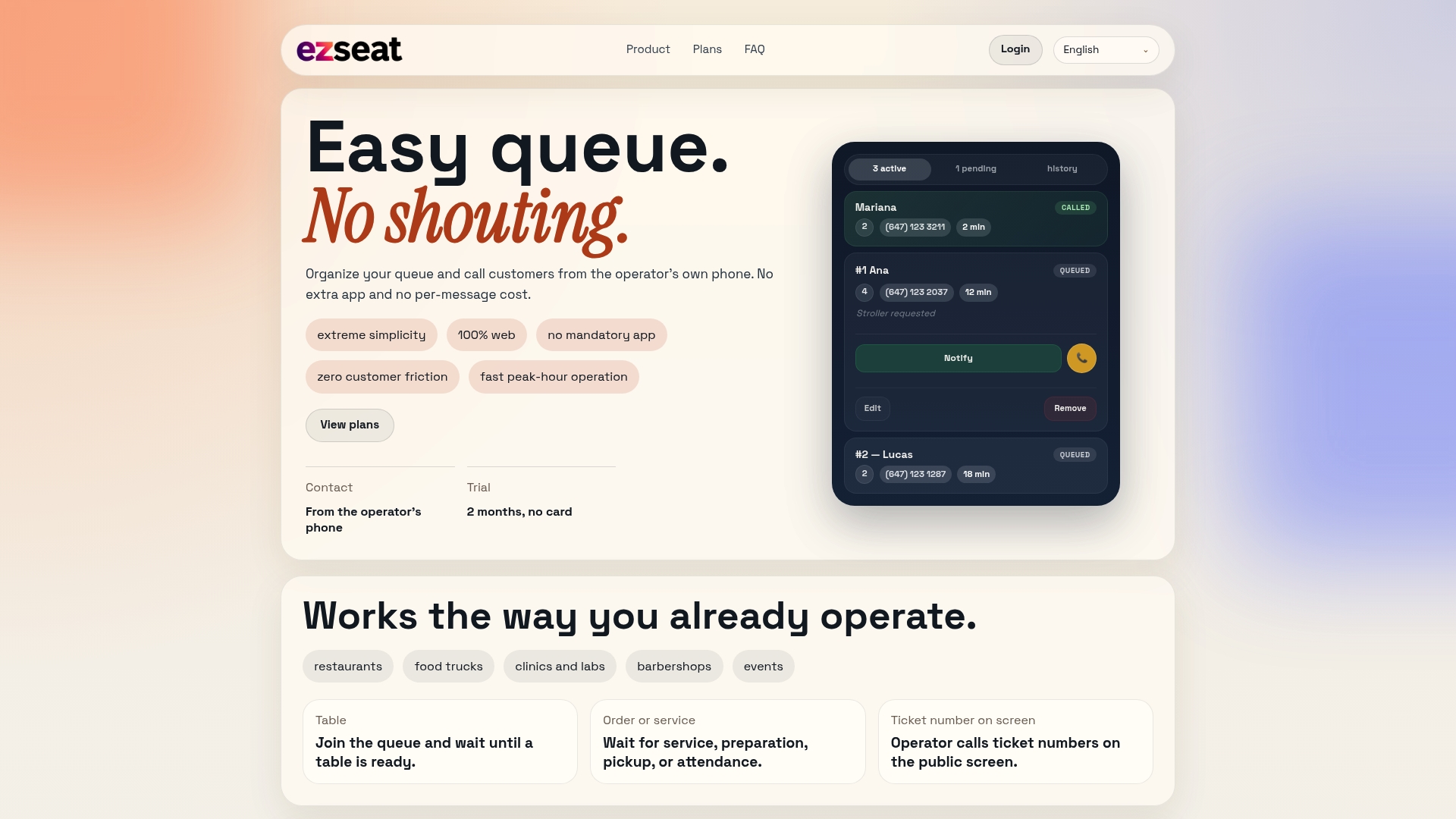
For healthcare operators, Ezseat supports HIPAA-aware workflows and BAA availability, so you're not building a compliance workaround on top of a consumer tool. The two-month free trial gives you enough runway to run a full QR/SMS pilot, pull your first abandonment and wait-time report, and make a data-backed decision before any subscription cost applies. Support and training are included during the pilot period.
Start your free Ezseat pilot and have your first queue live within a day.
Sources
- Waitlist for Sooner Appointments
- Reserve your place in line - online! | United Health Services
- How Long Does Urgent Care Take? CityHealth Wait Times
- Online Walk-in Waitlist : Support Center
- G2
- Capterra
- Trustpilot
This article is general information, not a substitute for advice from a qualified doctor. Consult a qualified healthcare professional about your own circumstances before acting on anything here.