
This page gives you copy-ready queue policy examples for no-shows, time limits, priority lanes, group handling, and virtual queues, built for restaurants, clinics, food trucks, barbershops, and events. Pick the template closest to your venue, plug in your own numbers for average wait and abandonment rate, and adjust from there. A tool like Ezseat can run the notifications and display side once the rules are set.
TL;DR:
- Most queue issues stem from poor communication, with virtual queues and SMS notifications significantly reducing lobby congestion.
- Customizable templates require real service data, ideally collected over two weeks, to set appropriate time limits and grace periods.
- Monitoring abandonment rates and compliance levels provides essential feedback for adjusting policies and ensuring customer adherence.
- Proper staff scripts and gradual implementation improve policy adherence and customer understanding, especially during peak hours.
Table of Contents
- Copy-Ready Queue Policy Templates
- How to Adapt a Template to Your Venue
- Implementation Checklist and Staff Scripts
- Key Metrics to Track and What They Tell You
- Ezseat Perspective: Common Fixes We See in Real Deployments
- Turn These Policies Into a Working Queue Today
- Sources
- FAQ
Copy-Ready Queue Policy Templates
You do not need a lawyer to write a queue policy. You need clear numbers and consistent wording. Below are six templates you can paste into a staff handbook, a customer-facing sign, or an SMS confirmation, then edit the bracketed numbers to match your venue.
No-show / token expiry template: "Your spot is held for [10] minutes after we call your name or number. If you don't check in within that window, your token expires and moves to the back of the active queue. You'll get one reminder notification at [5] minutes remaining."
Time-limit per seat or service slot: "Standard service time is based on your measured averages per table/chair/appointment. A brief grace period applies before a slot is marked complete and reassigned. Staff may extend service for medical, accessibility, or safety reasons without penalty."
Priority / fast-track policy: "Priority access is reserved for pre-booked appointments, VIP members, accessibility needs, or emergency cases. Priority bypasses should be limited to maintain fairness for walk-ins."
Group-handling rule: "Groups of a moderate size or more are counted as a single queue entry and require all members present to check in together. Groups may not split across multiple queue positions to claim faster service."
Cancellation and reschedule policy: "Cancellations made well in advance of your slot carry no fee. Late cancellations or no-shows close to the slot time may incur a fee or forfeit priority booking status for future visits."
Virtual queue / callback template: "Join the queue from your phone at [ezseat.app/yourvenue] with no app download. You'll receive a text when you're [3] spots away, and again when it's your turn. If you don't respond within [10] minutes of the final alert, your spot is released."
These six cover most of what a small or midsize operation needs. Research on delay communication backs the notification approach: studies on service systems find that even simple alerts change how customers judge their wait, often more than the actual time saved does.
How to Adapt a Template to Your Venue
A template is a starting point, not a finished policy. The numbers only work once you know your own service rhythm.
Start by mapping your service categories and timing them for a week or two. A barbershop has one service type; a clinic might have five, each with a different average duration. The Zeour flow-design methodology recommends logging at least 14 days of half-hourly data before touching your rules, since a single busy Saturday will skew your averages badly.

Once you have real numbers, set time limits and grace periods against them, not against a guess. If your average haircut runs 22 minutes, a 15-minute time limit will generate constant friction.
Then decide your intake model:
- Appointments work best when service time is predictable and long (clinics, consultations).
- Virtual queues fit high walk-in volume with some wait tolerance (restaurants, barbershops, food trucks).
- First-come-first-served suits short, simple transactions where a line barely forms.
A food truck at a festival needs a different no-show rule than a dental clinic. The truck can afford a 2-minute hold; the clinic needs 10 to 15 minutes because rescheduling a patient is costlier than losing a taco order. Document your exceptions in writing too. Accessibility needs, medical emergencies, and known VIPs should have a stated process, not staff improvising on the spot.
Pro Tip: Write your exception list before launch, not after the first argument at the counter. Staff who know the rule in advance enforce it more confidently and more kindly.
Implementation Checklist and Staff Scripts
Rolling out a new queue policy works better as a sequence than a single announcement. A step-by-step deployment guide outlines roughly this order, and it holds up across venue types:
- Audit your flow. Time your actual service durations and find where lines form.
- Configure channels. Decide if customers check in via web-based check-in, a kiosk, or a phone call, and write your signage copy to match.
- Train staff with scripts. Role-play the exact language for checking someone in, calling the next customer, and handling a no-show.
- Soft launch on a slow day. Test the policy before your busiest shift, not during it.
- Stress-test peak hours, then review the first 30 days of data before making permanent changes.
A common mistake is launching three new channels at once on a Saturday rush. Start with one channel, train thoroughly, and add complexity later.
Sample scripts help more than most owners expect:
- Greeter: "Welcome. You can join our queue from your phone right here, no app needed. You'll get a text when you're close to the front."
- You're next: "You're next in line. Please head to [counter/station] within the next few minutes."
- No-show: "We tried reaching you twice and your hold time has expired. I can add you back to the queue now if you'd like."
Key Metrics to Track and What They Tell You
Four numbers tell you almost everything about whether your queue policy is working:
- Abandonment rate — the percentage of people who leave the queue before being served.
- Average wait — mean time from check-in to service.
- 90th-percentile wait — what your worst-case customer experiences, often more telling than the average.
- Compliance rate — how often staff and customers actually follow the stated policy.
You can collect these through your queue system's logs, manual sampling with a clipboard and stopwatch, or a people counter at the door. If abandonment climbs, shorten your grace period or add a virtual queue option before you add staff. A literature survey on delay information found that simply announcing wait status, even in broad terms like "short" or "long," measurably lowers how costly customers perceive the wait to be. Track compliance rate too. A rule nobody follows is not a policy, it is a suggestion.
Ezseat Perspective: Common Fixes We See in Real Deployments

Most queue problems we see are not staffing problems. They are communication problems. Operators write a fair policy, then never tell the customer where they stand, and the lobby fills with people asking "how much longer?"
Browser-based check-in and virtual queues fix this by moving people out of the physical line entirely. Customers wait wherever they want and get a text when it's time. That single change, more than any staffing increase, tends to be what actually calms a crowded waiting room. Reported drops in lobby occupancy from virtual queuing back this up.
— Ezseat
Turn These Policies Into a Working Queue Today
Writing the policy is the easy part. Running it consistently, shift after shift, is where most operators fall behind, especially once volume picks up and staff start improvising on the fly. Ezseat is built to enforce exactly the templates above without extra hardware or an app download.
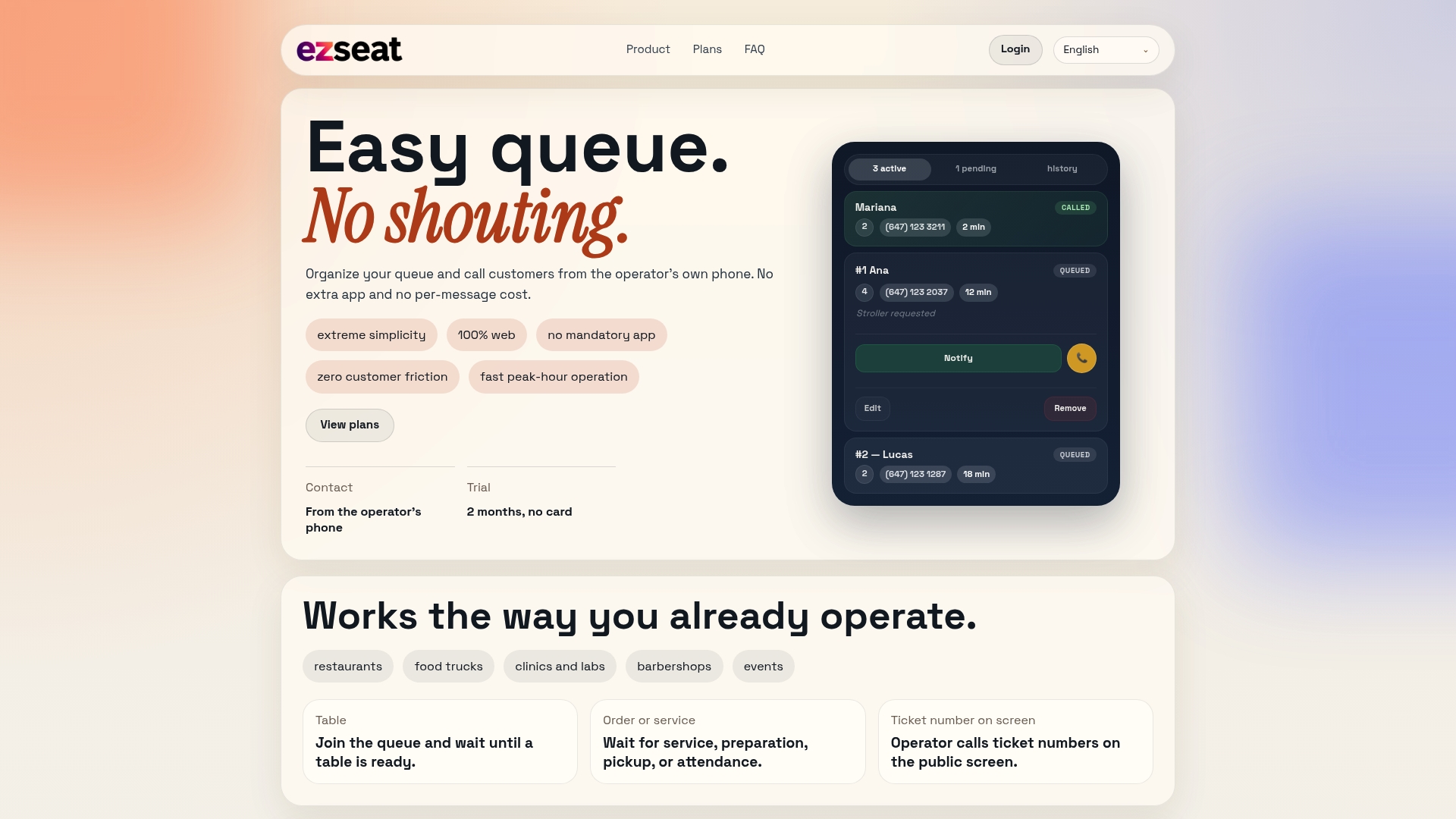
Customers join from a browser using a QR code or link, get SMS or call notifications when they're close to being served, and see live position updates on a queue display screen if you want one on-site. That covers the no-show, time-limit, and virtual queue templates above without a single spreadsheet. For front-line wording, pairing your Ezseat notifications with proven call center script practices keeps staff consistent even during a rush. A free trial is offered by some queue management services, allowing a soft-launch of one channel, testing against a real Saturday, and observing abandonment numbers before committing. Start your trial at Ezseat and set up your first queue policy this week.
Sources
The templates above draw on Microsoft's guidance on queue-position messaging, an academic survey on delay announcements, a step-by-step QMS deployment guide, and practical flow-design and wait-reduction research.
- Sharing delay information in service systems: a literature survey | Queueing Systems
- How to Set Up a Queue Management System | Step-by-Step Guide for First-Time Buyers
- Customer Flow Design: Wait Time Reduction | Zeour Ltd
FAQ
What Should a No-Show Policy Include?
A hold time (commonly 5 to 15 minutes), a reminder notification before expiry, and a clear rule for what happens next, usually moving the customer to the back of the active queue.
How Long Should a Grace Period Be?
Base it on your measured average service time, not a guess. Most venues use 3 to 5 minutes past the stated slot before marking it late.
Can I Have a Priority Lane Without Upsetting Regular Customers?
Yes, if you cap how often priority entries bypass the regular line, commonly around one in five slots per hour, and state the eligibility rule publicly.
What Metric Should I Watch First After Launching a New Policy?
Abandonment rate. A rising abandonment rate signals your time limits, grace periods, or notification cadence need adjustment before you touch staffing.
Do Virtual Queues Actually Reduce Crowding?
Yes. Browser-based check-in and remote waiting can meaningfully cut physical lobby occupancy, since customers wait off-site until notified.