
A staff notifications queue is the automated workflow that delivers and tracks staff alerts about assigned queue items. When alerts start getting missed, the fix isn't guesswork: check which channels are active, then pull the recent delivery logs. Do that first, and most teams see fewer missed items and faster response within days.
TL;DR:
- Using SMS for urgent alerts and email for routine updates ensures staff receive time-sensitive information despite potential channel limitations.
- Regularly scheduled batch processes should handle recurring notifications, with immediate sends reserved for critical, deadline-driven items.
- Recipient list accuracy relies on current assignment data and schedule-aware routing, preventing misdirected or missed notifications.
- Multi-channel redundancy, including fallback options like in-app alerts, is essential for maintaining notification reliability during outages or network issues.
- Monitoring delivery logs, verifying scheduler runs, and rechecking recipient queries are key steps to troubleshoot missed or delayed staff alerts effectively.
Table of Contents
- What Is a Staff Notifications Queue and How Does It Work?
- What Notification Channels Should You Use for Staff Alerts?
- How Do You Schedule and Batch Recurring Notifications?
- How Should You Build Recipient Lists and Routing Logic?
- What Makes a Notification Template Actually Actionable?
- How Do You Keep Notifications Reliable During Outages?
- How Do You Troubleshoot Missed or Delayed Notifications?
- How Do You Train Staff and Measure Notification Effectiveness?
- What Ezseat Has Learned From Real Deployments
- See How Ezseat Handles Staff Alerts in Practice
- Sources
What Is a Staff Notifications Queue and How Does It Work?
A staff notifications queue is the pipeline that decides who gets told what, through which channel, and when. It sits between the event that triggers an alert (a customer joins a line, a ticket gets assigned, a shift needs coverage) and the human who has to act on it. Under the hood, there are usually three moving parts: a trigger, a recipient-resolution query, and a delivery mechanism with a status record attached.

Ops teams often call this "employee notification management" or a "staff alert system," and IT documentation sometimes uses "team message queue." They're all describing the same mechanism. What separates a well-run queue from a chaotic one isn't the tool. It's whether someone configured the scheduling, the routing logic, and the failure handling on purpose, instead of leaving the defaults in place and hoping.
What Notification Channels Should You Use for Staff Alerts?
Not every alert deserves the same channel. Push notifications and in-app or pane alerts are cheap and fast, but they die quietly if a browser permission gets revoked or a device goes to sleep. SMS cuts through almost anything, which is why it's the go-to for time-sensitive queue alerts, but it costs more per message and can't carry rich formatting. Email is durable and audit-friendly, but staff routinely ignore it during a rush. Voice calls escalate urgency but interrupt whatever the person is doing. Slack and Microsoft Teams integrations work well for teams already living in those tools.
Match the channel to the stakes:
- Urgent, time-sensitive items (a customer waiting, an overdue task): SMS or push, with voice as backup.
- Routine or informational updates (shift summaries, low-priority assignments): email or an in-app pane.
- Team-wide coordination: Slack or Teams channels, since they're already part of daily workflow.
- Permission-fallback cases: if browser push gets denied, route to the in-app webpage view instead of losing the alert entirely, a pattern documented in queue settings and staff assignment notification behavior.
How Do You Schedule and Batch Recurring Notifications?
Real-time delivery for every single event sounds appealing until your staff starts muting notifications out of fatigue. The better pattern separates two jobs: a scheduled process that catches recurring and pending items, and a near-real-time path reserved for anything genuinely urgent.
- Run a scheduled job (an application engine or equivalent scheduler) regularly, such as daily or at whatever cadence your volume demands, to process pending and recurring notifications and resolve the current recipient list before anything sends, following the pattern enterprise notification engines use for run controls.
- Decide per-notification-type whether staff need a summary or a per-item alert. A queue with 40 pending tickets doesn't need 40 separate texts.
- Deduplicate by building the recipient list as a query with subquery filters that count assigned items per user, then send one consolidated message. This is exactly how Deliver-based workflows avoid flooding one person with a dozen emails a day.
- Reserve immediate, unbatched sends for anything with a hard deadline or safety implication.
Pro Tip: Set your scheduled job to run regularly during business hours and overnight for summaries. If a run fails, log the failure loudly. A silent scheduler failure is worse than no scheduler at all, because nobody notices until a customer complains.
How Should You Build Recipient Lists and Routing Logic?
Routing breaks down most often not because the channel failed, but because the recipient list was wrong. Someone got reassigned, a shift ended, or a group membership changed, and the notification either went nowhere or went to someone who'd already left for the day.
- Build recipient queries with configurable joins or subqueries that reflect current assignment state, not a cached snapshot from setup day.
- Handle one-to-many relationships explicitly: one queue item can belong to a shift group, and one staff member can belong to multiple groups.
- Generate per-user summary counts instead of one notification per assigned record, mirroring the recipient list query pattern used in workflow-based queue tools.
- Make routing schedule-aware so alerts follow the person on shift, not a name that happens to sit in a static field.
- Define coverage groups for gaps: if the primary assignee doesn't acknowledge within a set window, the queue needs a fallback recipient, not silence.
Getting this right matters more during multi-queue setups, where a single staff member might be covering several queues at once.
What Makes a Notification Template Actually Actionable?
A notification that just says "you have a new item" forces the reader to stop, open a system, and figure out what to do. That's dead time you don't need to spend.
Effective templates lock down the parts prone to error and leave room for context where it matters:
- Locked templates for standardized, high-frequency alerts, so nobody can accidentally send a broken message.
- Semi-automatic templates that pre-fill content but require a quick approval step, balancing speed with oversight.
- Task-flagged notifications that surface in a dedicated task pane instead of a general inbox, which several notification platforms use specifically to boost visibility on items that need action.
- Deep links and action buttons that take staff straight to the relevant record instead of a generic app screen.
Pro Tip: Write the title so the required action and deadline are both visible without opening the message. "Table 12 waiting 8 min, tap to seat" beats "New queue update" every time.
How Do You Keep Notifications Reliable During Outages?
A notification system that only works when the network is perfect isn't a notification system, it's a liability waiting for a bad Tuesday. Critical alerts need a survivability plan, not just a delivery plan.
- Use hybrid architectures where a local device or appliance can fail over to cellular when the primary network drops, a pattern common in situational-awareness alert systems built for premises-dependent setups.
- Queue undelivered messages instead of dropping them, and apply a retry policy with clear limits, not infinite silent retries.
- Surface failed deliveries somewhere a human will actually see them, not buried three menus deep.
- Add a second channel for anything genuinely critical. Multichannel redundancy with two-way acknowledgment is standard practice for emergency-grade alerts, and the same logic scales down to a busy restaurant floor.
Redundancy costs a little more per message. Losing a customer during a Friday rush costs more than that.
How Do You Troubleshoot Missed or Delayed Notifications?
When alerts stop arriving, work the problem in order instead of guessing at the fix.
- Check delivery status fields. Most notification records track push_status, pane_status, and email_status alongside timestamps, which is exactly what the StaffNotification object exposes for auditing.
- Confirm the scheduled job actually ran. A silent scheduler failure looks identical to "nobody got notified" from the outside.
- Re-check recipient-resolution queries. Staff reassignments and shift changes break routing logic more often than the delivery channel itself does.
- Verify permissions, tokens, and network connectivity, especially for browser push and any third-party integration credentials that expire on a schedule.
| Symptom | Likely cause | First fix |
|---|---|---|
| No alert sent at all | Scheduled job didn't run | Check run control, re-trigger manually |
| Alert sent to wrong person | Stale recipient query | Refresh recipient-resolution logic |
| Push notification silent | Permission revoked | Fall back to in-app pane delivery |
| Duplicate alerts | Missing dedup filter | Add subquery filter on assigned count |
| Delayed by hours | Retry backlog | Re-run the failed batch manually |
How Do You Train Staff and Measure Notification Effectiveness?
Technology solves half the problem. The other half is behavior, and that means clear rules about what a notification means and what happens if nobody acts on it.
- Train staff to treat anything marked as a Task as higher priority than a general inbox message, and check the Tasks panel first during a shift.
- Set an automated escalation window so an unacknowledged alert routes to a backup person after a defined delay instead of sitting there indefinitely.
- Track delivery rate, acknowledgment rate, time-to-claim, and walkaway reduction as your core KPIs, since those four numbers tell you whether the system is actually working.
Pro Tip: If time-to-claim creeps up during peak hours specifically, that's a staffing or escalation-window problem, not a technology problem. Don't add more channels when the real fix is a shorter escalation timer.
What Ezseat Has Learned From Real Deployments
Across busy walk-in businesses, combining SMS with task-style flagging can help reduce walkaways during peak hours compared to using push notifications alone. Low-volume hours work fine with batched summaries; once the rush hits, switching to per-item alerts keeps staff from missing time-sensitive queue items. Structured staff training on how to read and act on these alerts matters as much as the technology itself.
— Ezseat
See How Ezseat Handles Staff Alerts in Practice
Some queue management systems are built around the problem this article covers: getting the right alert to the right staff member without adding another app to manage. These systems can run entirely in the browser, allowing customers to join a queue and staff to get notified without requiring installations.
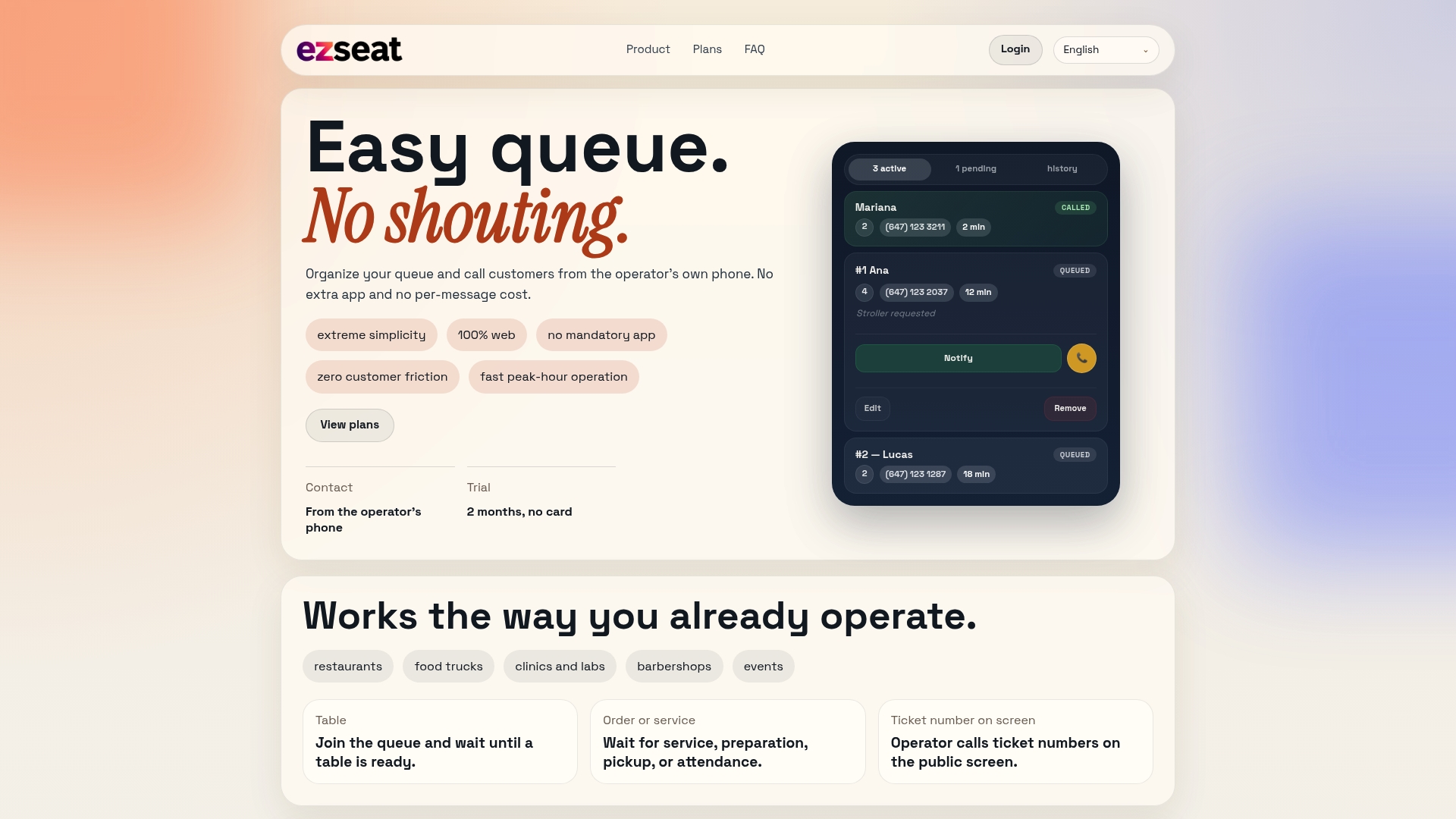
Operators use SMS notifications and task-style alerts to flag waiting customers before they walk away, the same pattern that's cut walkaways for walk-in businesses relying on text alerts instead of shouted names. Restaurants, clinics, food trucks, and event venues use it the same way: assign, notify, track. If your current setup is missing delivery logs, retry handling, or an effective way to route alerts by shift, consider exploring specialized queue management systems designed to address these needs. Visit the Ezseat landing page to start a trial and see the notification flow on your own devices.
Sources
- Understanding Notification Publisher
- Workflow Queue Internal Notification with Deliver
- The StaffNotification object