
Queue systems are secure when you apply zero-trust API protections, strict access controls, payload-level safeguards, and runtime monitoring together. The immediate priorities are to enforce authenticated access on every queue API, strip or encrypt sensitive personal data in message bodies, and turn on telemetry that flags poison-queue growth and abnormal dequeue patterns before they become incidents.
TL;DR:
- Use queue level IAM policies and separate producer and consumer identities; shared credentials obscure which service caused an anomaly and widen unauthorized access.
- Keep secrets and full personal details out of message bodies; send reference identifiers, or use application layer encryption with regularly rotated keys.
- Set time to live values to operational needs, route repeated failures to poison queues, and investigate sudden growth as a possible attack or logic flaw.
- Apply adaptive rate limits by caller behavior, then alert on unusual dequeue to delete ratios and correlate caller, method, and message metadata in logs.
- For health or citizen data, document flows in a privacy impact assessment, restrict access by stated purpose, and match retention to legal requirements.
Table of Contents
- Common threats and attacker techniques that target queue systems
- Architectural controls: zero trust, gateways, and private endpoints
- Application-level protections for message handling and encryption
- Runtime protections: rate limiting, telemetry, and anomaly detection
- Sector and compliance considerations for sensitive queue data
- An operator's checklist for secure queue operations
- An architect's take on prioritizing queue security work
- How Ezseat supports privacy-first, browser-first queue management
- FAQ
- Sources
Common threats and attacker techniques that target queue systems
Most queue breaches do not start with a sophisticated exploit. They start with a mis-scoped access policy that lets a service account read or write messages it was never meant to touch. Once that door is open, attackers and careless integrations both find the same shortcuts.
The realistic threat list for any queue deployment includes:
- Unauthorized reads or writes caused by overly broad IAM policies or shared credentials across services.
- Message poisoning, where malformed or malicious payloads repeatedly fail processing and clog the pipeline.
- Replay attacks that resubmit captured messages to trigger duplicate actions.
- Queue draining, where an attacker quietly deletes messages to disrupt operations without obvious errors.
- Resource exhaustion, where a flood of requests or oversized payloads causes denial of service.
Long time-to-live settings compound these risks because stale messages sit exposed longer than operationally necessary. Embedding secrets, such as API keys or session tokens, directly in message bodies gives any principal with read access to that queue a free credential. Improper separation between producer and consumer identities is another recurring issue: when every service shares one identity, you lose the ability to tell which component actually caused an anomaly.
Architectural controls: zero trust, gateways, and private endpoints
The architecture question is where to enforce policy, not whether to enforce it. NIST's API protection guidance treats every API call, including internal queue operations, under a zero-trust model: authenticate the caller, authorize the specific action, then validate the payload. That sequence matters because validating before authorization can leak information to an unauthenticated caller through error messages alone.
An API gateway sitting in front of queue operations gives you one place to apply that sequence consistently. For queues that should never be internet-reachable, Amazon SQS security best practices recommend VPC endpoints over public queue policies, and Oracle's queue security guidance similarly favors private subnets with IAM-scoped access over open network paths.
Centralized gateway enforcement and per-service enforcement each have a cost:
- A centralized gateway gives you one policy surface to audit and update, but a misconfiguration there affects every queue behind it.
- Per-service enforcement limits the blast radius of a single mistake but multiplies the number of places you need to review for drift.
Most teams land on a hybrid: gateway-level authentication and coarse authorization, with fine-grained, queue-specific rules enforced closer to the service that owns the data.
Pro Tip: Treat queue endpoints exactly like public-facing APIs, even when they sit inside a private network; internal network location is not an authorization decision.
Application-level protections for message handling and encryption
Once traffic reaches a queue, the application layer decides whether a breach stays contained or spreads. The core discipline is simple to state and easy to get wrong in practice.
- Authenticate and authorize the caller before any payload validation runs, so an unauthenticated request never gets far enough to learn why it failed.
- Keep secrets and full personal data out of message bodies; send a reference identifier instead and have the consuming service pull the sensitive detail from a vault using its own credentials at processing time.
- Encrypt sensitive payloads at the application layer when a reference pattern is not practical, and rotate the encryption keys on a regular schedule.
- Set time-to-live values that match operational need rather than defaulting to the platform maximum, and route repeatedly failing messages to a poison queue instead of letting them retry indefinitely.
Azure's queue storage security documentation is explicit that any principal with read or process permission on a queue can see the full message body, which is why Microsoft recommends managed identities scoped to the queue level rather than shared account keys, along with client-side encryption for anything genuinely sensitive. The same document flags poison queues as both an operational safety net and a security signal: a sudden spike in poisoned messages often points to a logic flaw or an active attack, not just bad data.
Runtime protections: rate limiting, telemetry, and anomaly detection
Access control and encryption stop most intrusions before they start. Rate limiting and observability catch what gets through anyway, and they are where most queue security programs fall short in practice.
- Apply rate limits per user, per service, and per IP address, and pair them with concurrent-request caps and circuit breakers so one misbehaving client cannot starve everyone else.
- Use token-bucket or leaky-bucket algorithms for smoother enforcement than a hard request ceiling, with limits that adapt to observed behavior rather than a single static number.
- Log caller identity, the API method invoked, and message metadata, then correlate those logs with distributed traces to spot drains, spikes, or unusual delete patterns.
- Set alerts specifically for poison-queue growth and for dequeue-to-delete ratios that drift from baseline, and route both into your SIEM alongside a documented runbook.
NIST's updated API protection guidelines call for adaptive rate limiting based on observed caller behavior rather than fixed thresholds alone, which catches slow, low-volume abuse that a simple cap would miss.
Teams integrating chatbot front ends that enqueue support tickets or booking events face the same exposure at the entry point; a chatbot security checklist covering authentication and input handling at that layer closes a gap that queue-side controls alone cannot.

Sector and compliance considerations for sensitive queue data
Healthcare, public-sector, and retail deployments each add requirements on top of the baseline controls. When messages carry health information or other sensitive personal data, a documented privacy impact assessment and purpose-based access control are not optional extras.
- Run a data protection impact assessment before health or citizen data touches a queue, and restrict access by documented purpose rather than by broad role alone.
- Tune time-to-live and retention settings to the legal retention period that applies, and log every cross-border data access for audit.
- Expect public-sector systems to require multi-factor authentication, role-based access control, and periodic penetration testing with a written security policy on file.
The NHS England federated data platform DPIA illustrates this well: it documents data flows end to end and ties access to specific purposes rather than to generic system roles, a pattern worth borrowing even outside healthcare.
An operator's checklist for secure queue operations
A short, repeatable checklist catches more real-world mistakes than a long policy document nobody rereads. Run through this at setup and again at every major release:
- Set queue-level IAM policies instead of account-wide credentials.
- Store and rotate encryption keys in a dedicated vault, never in application code.
- Scope SAS tokens or equivalent access tokens to the narrowest permission and shortest lifetime the task allows.
- Set deliberate TTLs and configure poison queues for every production queue.
- Enable diagnostic logging and alerting from day one, not after the first incident.
Our 30/90 Day Audit Checklist for customer queue privacy walks through this same sequence with operator-facing detail for restaurants, clinics, and events running browser-first queues.
An architect's take on prioritizing queue security work
Identity and least privilege come first; validation and telemetry layer on top once access itself is locked down. Platform defaults usually beat custom logic, so automate policy enforcement instead of reviewing it by hand. Keep sensitive data out of messages entirely, and design every consumer to fail toward a safe, visible default rather than a silent one.
— Ezseat
How Ezseat supports privacy-first, browser-first queue management
Running a queue system securely does not require customers to install anything or operators to manage extra hardware. Our platform lets guests join a queue from a web browser, which keeps the technical footprint small and reduces the surfaces you need to secure in the first place.
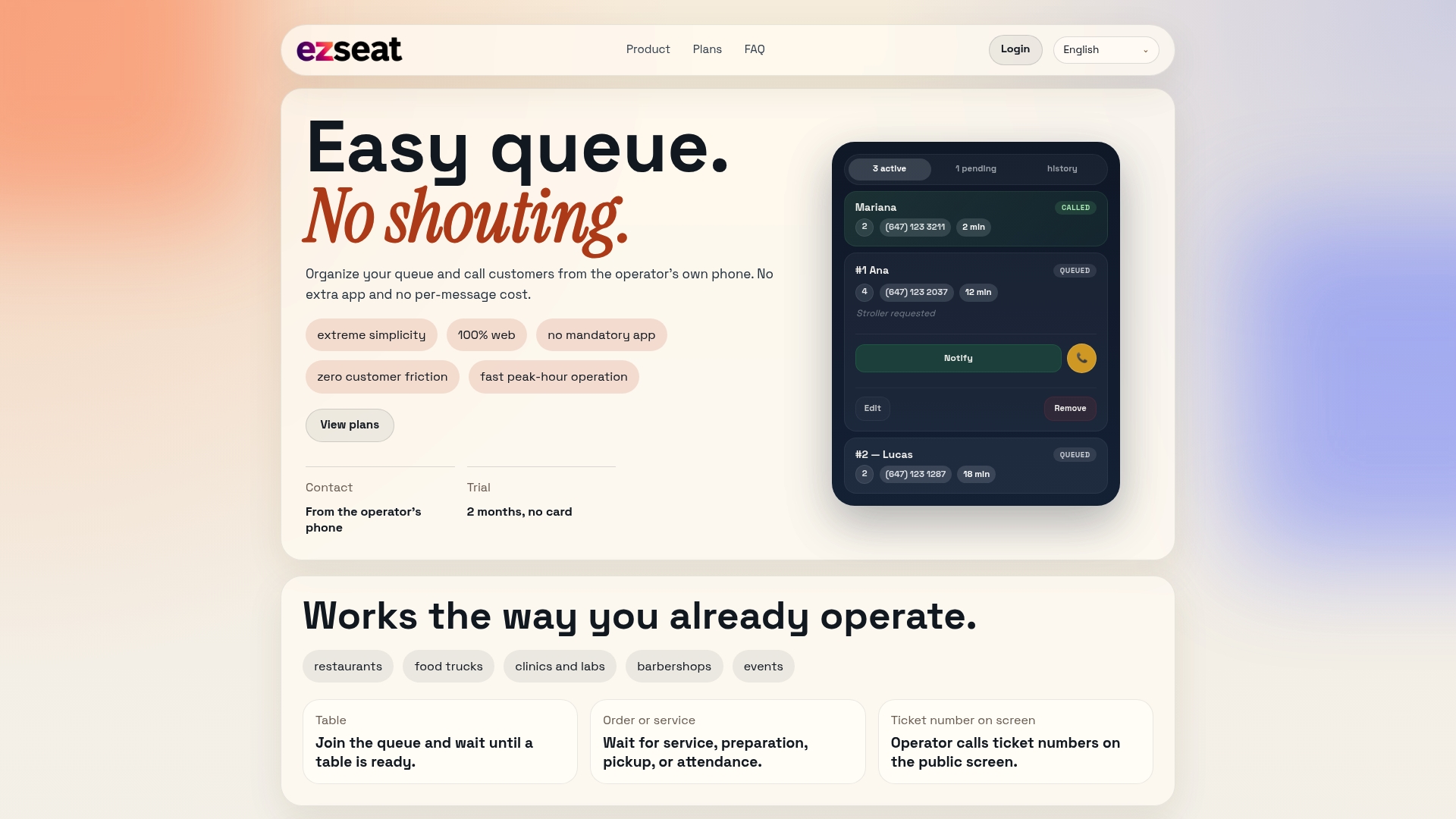
- Browser-first entry means no app, no device management, and fewer endpoints to lock down.
- Configurable notifications and multi-queue support let you segment access by location or service without sharing one broad policy across everything.
- Flexible Light and Pro plans scale with your operation, with a free two-month trial before any charge applies.
If you are reviewing your own queue privacy posture, our 30/90 Day Audit Checklist for customer queue privacy is a practical place to start, and you can see current plan details directly on Ezseat.
FAQ
What are the most important controls for queue system security?
Authenticate and authorize every call before validating it, encrypt sensitive payloads, and apply least-privilege access scoped to each queue. Add rate limiting and logging so anomalous activity, like poison-queue growth, gets flagged before it becomes an incident, following the sequence NIST recommends for cloud-native APIs.
What are the four types of queues?
Definitions vary by context, but in queuing theory the common categories are single-server queues, multi-server queues, queues with finite capacity, and priority queues that serve certain messages or customers ahead of others. In software architecture, the equivalent distinctions are usually drawn by delivery guarantee, such as standard, first-in-first-out, and dead-letter or poison queues.
Can you give an example of a queue system?
A restaurant using a browser-based waitlist, where guests join from their phones and staff manage flow from a tablet without shouting names, is a practical example of a queue system in everyday use. On the infrastructure side, services like Amazon SQS, Azure Queue Storage, and Oracle Queue serve the same function for passing messages between software components.
How do I keep sensitive data safe inside queue messages?
Avoid putting secrets or full personal data in the message body at all; send a reference and have the processing service retrieve the sensitive detail from a vault under its own credentials. When that pattern is not practical, Azure's queue security guidance recommends encrypting the payload at the application layer and rotating the keys regularly.
Sources
For hands-on implementation, start with the platform vendor's own security documentation alongside the current API protection standard. The NIST API protection guidelines set the zero-trust baseline, while Azure Queue Storage, Amazon SQS, and Oracle Queue documentation cover platform-specific identity, encryption, and network controls. For sensitive or public-sector data, the NHS England DPIA framework is a useful model for documenting data flows and access purpose.
- Guidelines for API Protection for Cloud-Native Systems (NIST, March 2026 update)
- Secure your Azure Queue Storage | Microsoft Learn
- Amazon SQS security best practices
- Securing Queue (Oracle Cloud Infrastructure)
- Overarching DPIA for the Federated Data Platform (NHS England)