
For most small to mid-size businesses, Ezseat is the strongest Skiplino alternative — browser-first, no app install required, and live in hours rather than weeks. Beyond Ezseat, the shortlist worth evaluating is:
- Waitwhile — best for businesses that need rich notification workflows and calendar integrations
- Qminder — best for organizations that want staff performance analytics alongside queue data
- Engageware — best for enterprises needing contact-center and omnichannel integration
- WaitQ — best for SMBs that want a simple, flat-rate check-in tool
- Skiplino — the baseline most buyers are already familiar with; useful as a benchmark
All five offer a free trial or demo. Ezseat's free trial runs two months before any charge, giving you enough runway to test it through a real busy period before committing.
Table of Contents
- How do these Skiplino alternatives compare at a glance?
- Short profiles: Ezseat and the other top alternatives
- How to choose the right alternative for your business
- What to expect on pricing, trials, and setup timelines
- How we selected and compared these alternatives
- Key takeaways
- Why Ezseat fits most SMBs better than enterprise-first alternatives
- Ezseat's free trial: what you get and how to start
- Useful sources and vendor pages
How do these Skiplino alternatives compare at a glance?
| Product | Best for | Pricing shape / free trial | Key features | Setup time | Integrations & API | Scalability | Support & onboarding |
|---|---|---|---|---|---|---|---|
| Ezseat | SMB restaurants, clinics, food trucks, events | Monthly / annual; two-month free trial | Browser join (no app), kiosk, SMS/call notifications, public screens, multi-queue | Hours to 1 day | API; multi-device | Multi-location, multi-queue | Self-serve + docs |
| Waitwhile | Notification-heavy workflows, scheduling integrations | Tiered monthly; free trial available | App + web, SMS/email notifications, scheduling, integrations | 1–3 days | Strong API, CRM connectors | Multi-location | Chat + email support |
| Qminder | Analytics-driven queue workflows, staff performance | Per-location monthly; demo available | iPad-based check-in, analytics dashboard, staff metrics | 1–3 days | API; limited third-party | Multi-location | Onboarding + email |
| Engageware | Enterprise omnichannel, contact-center integration | Enterprise quote; demo required | Full omnichannel, contact-center integration, appointment + queue | Weeks to months | Deep API, CRM/ERP | Large-scale multi-region | Dedicated CSM |
| WaitQ | SMBs wanting simple flat-rate check-in | Flat monthly; trial available | Web check-in, real-time queue control, basic notifications | Hours to 1 day | Basic API | Single to a few locations | Self-serve |
| Skiplino | Businesses benchmarking against the original | Tiered; free plan available | App-based queue, kiosk, SMS notifications, analytics | 1–3 days | API available | Multi-branch | Email + chat |

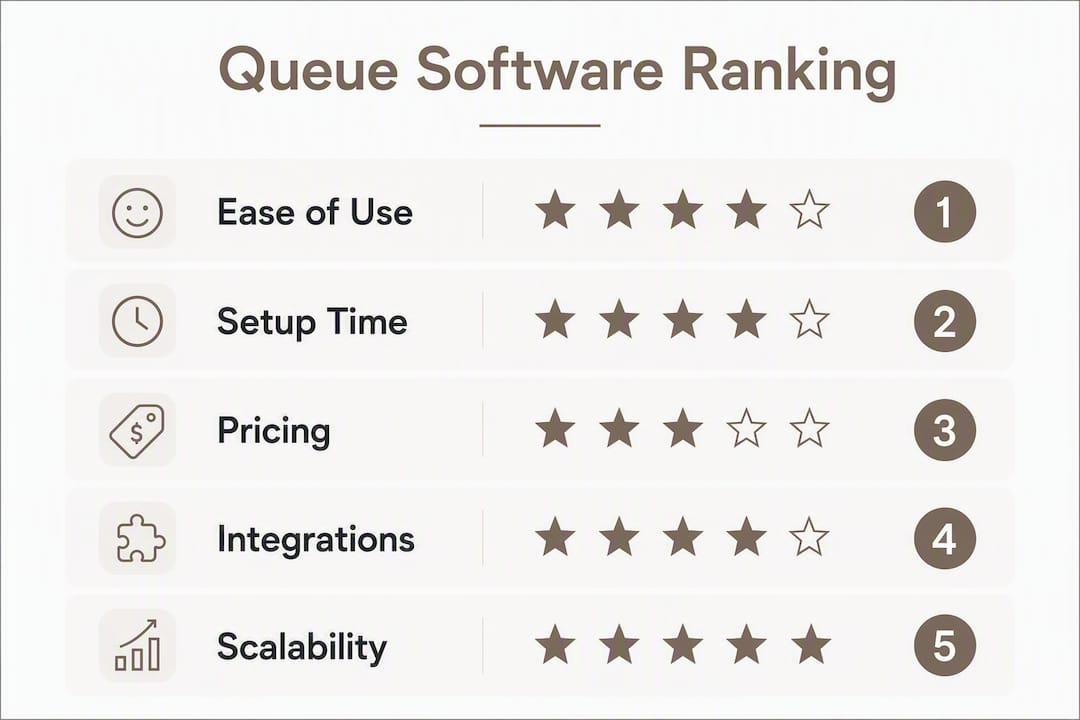
A few things worth flagging: Engageware's pricing is not published and requires a sales conversation, so budget extra procurement time. Published pricing and a clear trial policy are strong trust signals; when a vendor hides pricing behind "contact sales," expect negotiation and a longer buying cycle. Qminder's analytics are genuinely strong, but its iPad-first design means you are buying into Apple hardware if you want the full kiosk experience.
Short profiles: Ezseat and the other top alternatives

Ezseat (recommended for most SMBs)
Ezseat is built around one core idea: customers join the queue from any phone browser, no app download needed. That single design choice removes the biggest friction point in most queue deployments. Operators manage everything from their own phone or tablet, and multi-device, multi-queue setups let smaller teams run the floor without dedicated hardware.
Strengths:
- Two-month free trial before any charge
- Browser-based join flow works on any smartphone
- Public screens, reception kiosk, SMS/call notifications included
- Multi-queue and multi-device support without hardware lock-in
- Designed for restaurants, clinics, food trucks, and event operators
Limitations:
- Lighter on enterprise integrations than Engageware or Waitwhile
- Best suited for single to mid-size multi-location operators, not large-scale enterprise rollouts
Pricing follows a Light/Pro tier structure on monthly or annual billing. No credit card required to start the trial.
Waitwhile
Waitwhile is the go-to when notification logic is your priority. Its scheduling and messaging capabilities go well beyond basic SMS: you can build conditional notification flows, sync with calendar systems, and connect to CRMs through a documented API. Setup typically takes one to three days for a standard deployment.
Strengths:
- Flexible SMS, email, and push notification workflows
- Strong third-party integrations and API documentation
- Scheduling and virtual queue in one platform
Limitations:
- Pricing tiers can climb quickly as locations or users scale
- More configuration overhead than a simple SMB needs
Qminder
Qminder's differentiator is its analytics layer. Beyond moving customers through a queue, it tracks how long each service interaction takes, flags bottlenecks by staff member, and surfaces that data in a real-time dashboard. If you manage a clinic or a bank branch where staff performance data matters, that visibility is genuinely useful.
Strengths:
- In-branch analytics and staff performance tracking
- Clean, iPad-native check-in experience
- Per-location pricing is predictable for multi-branch planning
Limitations:
- iPad-first design creates hardware dependency
- API integrations are more limited than enterprise-tier competitors
Engageware
Engageware operates at a different scale entirely. It is built for organizations that need queue management woven into a broader contact-center stack, with omnichannel routing, CRM/ERP connectors, and appointment scheduling all in one platform. Some platforms support both cloud and on-premises modes and provide APIs for payments and scheduling, and Engageware sits firmly in that category.
Strengths:
- Deep contact-center and omnichannel integration
- Enterprise-grade scalability across large, multi-region deployments
- Appointment + queue management in a unified platform
Limitations:
- No published pricing; requires a sales conversation
- Implementation measured in weeks to months, not days
- Overkill for single-location or small multi-location operators
WaitQ
WaitQ keeps things simple: web check-in, real-time queue visibility, and flat-rate pricing. For an SMB that does not need analytics dashboards or deep integrations, that simplicity is a feature, not a gap. Setup is measured in hours.
Strengths:
- Flat-rate pricing is easy to budget
- Fast to deploy, minimal configuration
- Real-time queue control without complexity
Limitations:
- Limited scalability beyond a handful of locations
- Basic API; not suited for businesses with integration requirements
Skiplino
Skiplino is the baseline most buyers are already comparing against. It covers the core feature set: app-based queue entry, kiosk support, SMS notifications, and a multi-branch dashboard. Its free plan makes it accessible for very small operations, but the app-install requirement for customers adds friction that browser-first alternatives avoid.
Strengths:
- Established feature set with a free entry tier
- Multi-branch support and analytics included
- Familiar to teams already using it
Limitations:
- Customers must download an app to join the queue
- App dependency can reduce adoption, especially at pop-up or event settings
Pro Tip: Before committing to any platform, run a one-week pilot during your busiest period. Queue adoption rates during peak hours tell you far more than a polished demo ever will.
How to choose the right alternative for your business
The three criteria that matter most: how easily customers can join the queue, whether the system works when your internet hiccups, and how well it connects to the tools you already use.
Customer entry friction is where most deployments succeed or fail. Digital queue management reduces walkouts and creates calmer waiting experiences by giving customers real-time updates on wait time and position. A system that requires an app download loses a meaningful share of customers before they ever join. Browser-based entry, like Ezseat's, removes that barrier entirely.
Hardware compatibility is the hidden cost most buyers discover too late. Prioritize platforms that support standard tablets and phones to avoid recurring hidden costs from proprietary kiosk hardware. Ask vendors directly: does your kiosk mode run on any browser-equipped tablet, or do I need to buy your hardware? If the answer is the latter, factor that into the total cost of ownership.
Integration depth separates tools that fit into your workflow from tools that create parallel work. Platforms that document APIs and provide connectors reduce long-term integration costs. During any demo, ask for the API documentation link, not a feature list.
Questions to ask every vendor during a demo:
- What happens to the queue if the internet goes down?
- Can I export all customer and queue data at any time, in what format?
- Does kiosk mode require your hardware, or will a standard tablet work?
- What is your SLA for downtime, and how is it enforced?
- Which CRM, POS, or calendar systems do you have native connectors for?
Red flags to watch for: no offline mode at all, proprietary kiosk hardware required, no publicly accessible API documentation, and pricing that only appears after a sales call.
Pro Tip: Migrate in stages. Run the new system alongside your existing process for one week before cutting over fully. It surfaces integration gaps before they become customer-facing problems.
What to expect on pricing, trials, and setup timelines
Queue management software pricing generally falls into three shapes: flat monthly (common for SMBs), per-location or per-counter billing (common for mid-market), and enterprise quotes (for large-scale deployments).
- Flat monthly / self-serve SMB plans — Ezseat and WaitQ both use this model. Pricing is published, trials are self-serve, and you can be live the same day you sign up. Ezseat's free trial is among the longest available in this category.
- Per-location billing — Qminder and Waitwhile use variants of this model. Costs scale predictably with your footprint, but review the per-location rate carefully before expanding to a third or fourth site.
- Enterprise quotes — Engageware requires a sales conversation. Budget two to four weeks for procurement, and expect a pilot program rather than a self-serve trial.
SMB-oriented vendors often provide self-serve trials; enterprise vendors commonly require custom quotes. That gap in buying experience is itself a signal about which vendors are built for your scale.
Typical setup timelines:
- Browser-first, self-serve launch (Ezseat, WaitQ): hours to one day
- Cloud platform with notification configuration (Waitwhile, Qminder): one to three days
- Full enterprise rollout with CRM/contact-center integration (Engageware): weeks to months
Onboarding surprises usually come from integrations, not the queue software itself. If you are connecting to a POS or CRM, add a week to your timeline and test the data flow before going live.
How we selected and compared these alternatives
The shortlist was built using four filters: feature parity with Skiplino (virtual queues, kiosk support, real-time notifications), published pricing or a self-serve trial, documented integration capability, and availability in the United States market. Vendor documentation, platform directories including G2 and Capterra, and independent vendor pages informed the feature and pricing assessments.
Conflict-of-interest disclosure: Ezseat is the publisher of this article. Ezseat is included in the comparison and recommended for SMBs based on its browser-first design and trial terms. Every other vendor's features and limitations are stated as factually as the available documentation allows.
Key takeaways
For most SMBs evaluating queue management software, the decision comes down to one question: how much friction does your chosen system add for customers trying to join the queue?
| Point | Details |
|---|---|
| Browser-first beats app-first | Systems requiring an app download lose customers before they join; browser-based entry removes that barrier. |
| Hardware costs hide in kiosk requirements | Ask every vendor whether kiosk mode runs on a standard tablet; proprietary hardware adds recurring cost. |
| Trial length signals vendor confidence | Ezseat offers a two-month free trial before any charge applies, which is longer than typical for SMB providers. |
| Setup time varies widely by tier | Self-serve SMB tools go live in hours; enterprise platforms with integrations take weeks to months. |
| Integration depth is a long-term cost | Documented APIs and native connectors reduce the ongoing cost of connecting queue data to your existing tools. |
Why Ezseat fits most SMBs better than enterprise-first alternatives
The honest case for Ezseat is not that it beats every competitor on every feature. It does not. Engageware has deeper contact-center integration. Qminder has richer staff analytics. Waitwhile has more notification flexibility.
What Ezseat does better than all of them for a restaurant, clinic, food truck, or pop-up event is get out of the way. Customers open a browser link, join the queue, and wait wherever they want. Operators manage the flow from their own phone. There is no hardware to buy, no app to push customers toward, and no IT project to kick off. The two-month free trial means you can test it through a real busy season before spending anything.
Where Ezseat is not the right call: if you are running a multi-region enterprise deployment that needs to connect queue data to a contact-center platform or a large CRM, Engageware or Waitwhile will serve you better. The complexity those platforms carry is justified at that scale.
Ezseat's free trial: what you get and how to start
Ezseat's two-month free trial includes the full feature set: browser-based queue entry, public screens, reception kiosk mode, SMS and call notifications, custom queue fields, and multi-device operator support. No credit card required to start.
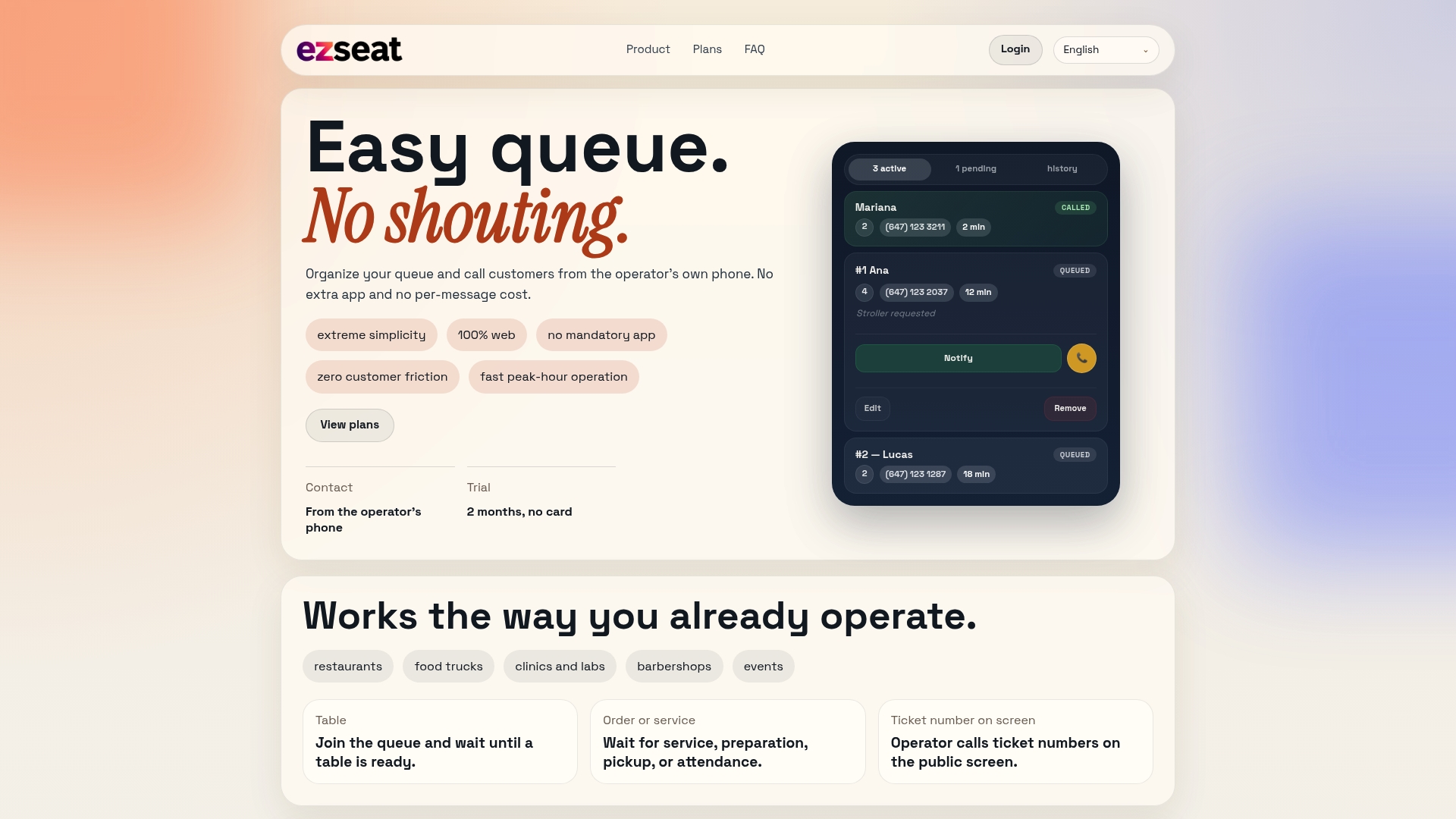
Getting live takes four steps: sign up at ezseat.app, configure your queues (name them, set custom fields if needed), test the browser join flow and kiosk screen on your own device, then open the doors. Most operators complete that sequence in under a day.
During the trial, run it against the checklist from the "how to choose" section above. Check how the queue behaves during a busy period, confirm the notification flow works on your customers' phones, and verify that any integrations you need are in place before the trial ends.
Useful sources and vendor pages
- G2: Top Skiplino Alternatives & Competitors in 2026 — user reviews and feature comparisons across queue management platforms
- Capterra: Skiplino Alternatives — verified user reviews and side-by-side feature ratings
- Slashdot: Top Skiplino Alternatives in 2026 — community-sourced alternative listings
- WaitQ: Best Skiplino Alternative — WaitQ's own positioning page for direct feature comparison
- GetApp: Skiplino 2026 Pricing, Features, Reviews & Alternatives — pricing context and user-sourced alternative recommendations